
A GLOBAL artificial intelligence summit begins in New Delhi on Monday as concerns grow over the risks posed by AI, including misinformation, job disruption and child safety.
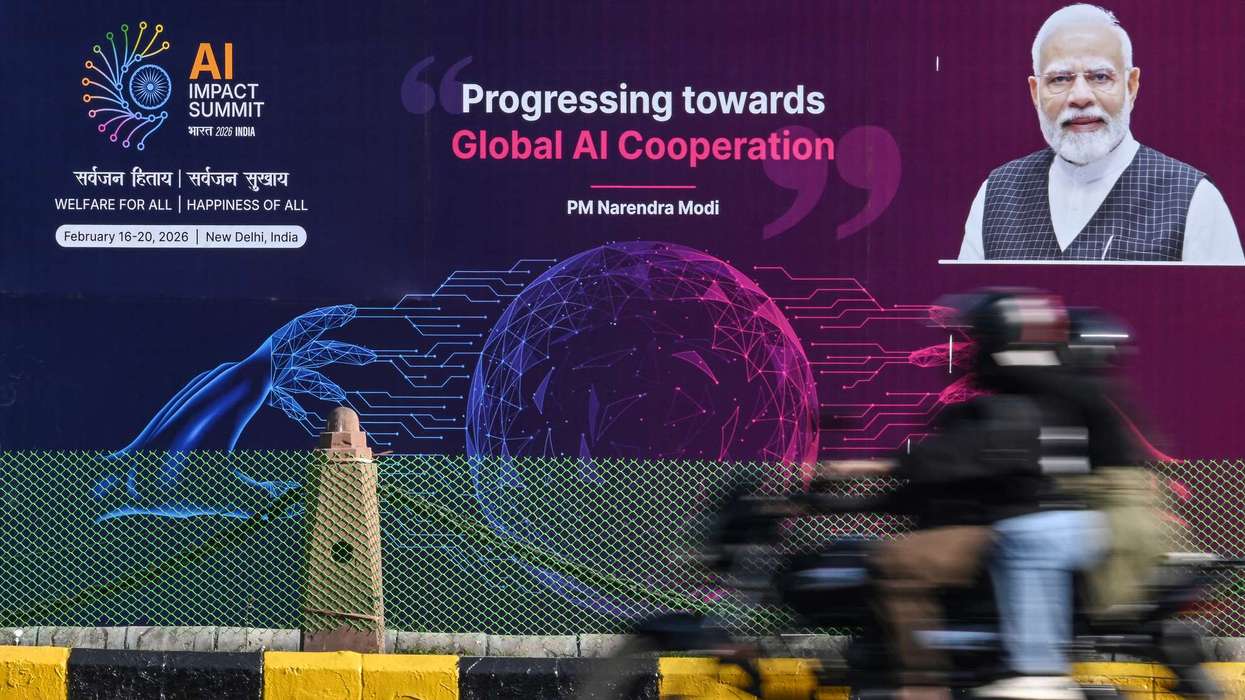
Indian prime minister Narendra Modi will on Monday afternoon inaugurate the five-day AI Impact Summit, which aims to declare a “shared roadmap for global AI governance and collaboration”.
“This occasion is further proof that our country is progressing rapidly in the field of science and technology,” and it “shows the capability of our country's youth”, he said in an X post on Monday.
The summit is the fourth annual gathering addressing the problems and opportunities posed by AI, after previous international meetings in Paris, Seoul and Britain’s wartime code-breaking hub, Bletchley.
Touted as the biggest edition yet, the Indian government is expecting 250,000 visitors from across the sector, including 20 national leaders and 45 ministerial-level delegations.
Also in attendance will be tech CEOs including Sam Altman of OpenAI and Google’s Sundar Pichai, although unforeseen circumstances have reportedly led Jensen Huang, head of US chip titan Nvidia, to cancel his planned appearance.
Modi will seek to “strengthen global partnerships and define India’s leadership in the AI decade ahead” in talks with the likes of France’s Emmanuel Macron and Brazil’s Luiz Inacio Lula da Silva, organisers say.
The Global AI Impact Summit, from February 16 to 20, will see a host of heads of state and government, including Macron and Lula, along with representatives from more than 60 other countries, convene in New Delhi.
The UK delegation will be led by deputy prime minister David Lammy and AI minister Kanishka Narayan. The British government said the UK’s focus during the summit will be on championing how AI can supercharge growth, unlock new jobs, improve public services and deliver benefits for people across the globe.
“This summit is an important moment in determining how we can work together with our international partners to unlock the full benefits and potential of AI, while baking in robust and fair safety standards that protect us all," said Lammy, in a pre-summit statement.
The Department for Science, Innovation and Technology (DSIT) said India and Britain were “natural tech partners”, with software giants like Infosys, Tata Consultancy Services (TCS) and Wipro expanding their operations across the UK.
“AI is the defining technology of our generation and we’re determined to make sure it delivers for everyone," said Narayan, the first Indian-origin MP from Wales.
“It can cut waiting times, transform public services, create new jobs and give hard working communities a fresh start – and that’s exactly the message we're taking to the summit. It is central to our plans for delivering national renewal but its benefits can’t and shouldn’t be reserved by the few," he said.
The AI minister said the UK is “leading from the front, pushing a global vision for AI that helps people everywhere to learn more, earn more, and shape the future on their terms”.
“We are totally aligned in making sure that the people of Britain and the people of India get to not just look at AI being built by others but build AI and benefit from AI directly," he said.
Besides Delhi, Narayan will also travel to Bengaluru to explore how India and the UK are working together to reap the benefits of breakthrough tech.
Both countries are investing tens of millions in cutting-edge research – from better batteries and next generation telecoms for rural communities, to genomic medicine that could tackle rare diseases, DSIT said.
India is also a vitally important market for British businesses generally, with UK firms generating more than 47.5 billion pounds in revenue from their business in India, the department stated.
During the AI Impact Summit this week, the UK is expected to announce new support for an African Language Hub, enabling AI to work in 40 African languages with the aim of making the technology more inclusive and accessible for millions.
This will be one of three new initiatives being announced as part of the more than 100 million pounds AI for Development (AI4D) programme, created to ensure that developing countries benefit fully from the AI revolution.
The Asian AI4D Observatory will be geared towards supporting responsible AI innovation and governance across South and Southeast Asia, and the AI4D Compute Hub at the University of Cape Town will give African innovators the compute power they need to turn ideas into impact.
The Delhi summit has the loose themes of “people, progress, planet” — dubbed three “sutras” — and organisers have highlighted it as the first such summit to be hosted by a developing country.
“The summit will shape a shared vision for AI that truly serves the many, not just the few,” India’s IT ministry has said.
AI safety remains a priority, including the dangers of misinformation such as deepfakes.
The Bletchley gathering, held in 2023 — a year after ChatGPT stunned the world — was called the AI Safety Summit.
The meetings’ names have changed as they have grown in size and scope, and at last year’s AI Action Summit in Paris, dozens of nations signed a statement calling for efforts to flank AI tech with regulation to make it “open” and “ethical”.
But the United States did not sign, with Vice President JD Vance warning that “excessive regulation... could kill a transformative sector just as it's taking off”.
Last month saw a global backlash over Elon Musk’s Grok AI tool because it allowed users to produce sexualised pictures of real people, including children, using simple text prompts.
“Child safety and digital harms are also moving up the agenda, particularly as generative AI lowers the barrier to harmful content,” AI Asia Pacific Institute director Kelly Forbes told AFP.
“There is real scope for change,” although it might not happen fast enough, said Forbes, whose organisation is researching how Australia and other countries are requiring platforms to confront the issue.
While demand for generative AI has boosted profits for many tech companies, some attendees have warned that the broad focus of the Delhi summit could reduce the chances of concrete commitments from world leaders.
But whether leaders will take meaningful steps to hold AI giants accountable is in doubt, Amba Kak, co-executive director of the AI Now Institute, told AFP.
Industry commitments made at previous events “have largely been narrow 'self regulatory' frameworks that position AI companies to continue to grade their own homework”, said Kak, a former AI advisor to the US Federal Trade Commission who is taking part in the summit.
Last year India leapt to third place — overtaking South Korea and Japan — in an annual global ranking of AI competitiveness calculated by Stanford University researchers.
But experts say the country still has a long way to go before it can rival the United States and China.
Seth Hays, author of the Asia AI Policy Monitor newsletter, said talk at the summit would likely centre around “ensuring that governments put up some guardrails, but don't throttle AI development”.
“There may be some announcements for more state investment in AI, but it may not move the needle much — as India needs partnerships to integrate on the international scene for AI,” Hays told AFP.
(With inputs from agencies)