
INDIA and the UK should strengthen collaboration in the creative industries, the high commissioner to the UK has said.
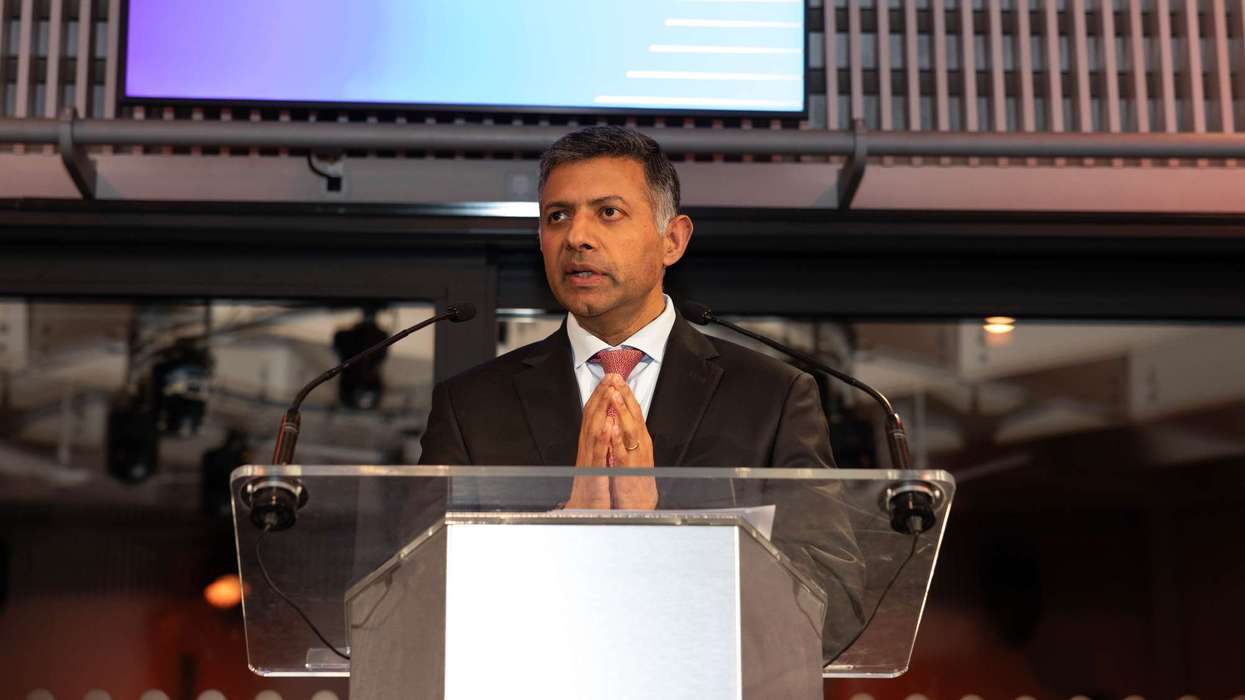
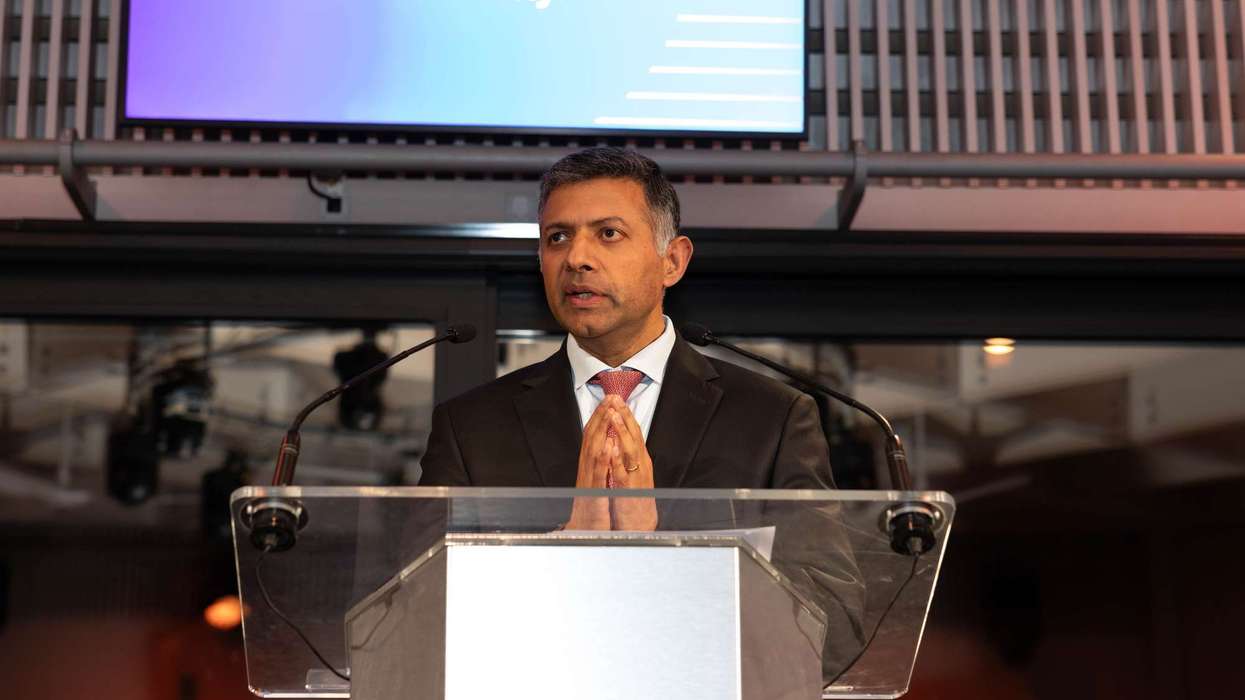
Vikram Doraiswami said the sector represented an underexplored frontier in the bilateral relationship, as he addressed guests at a special gathering in south London last week.
The event at the National Theatre brought together prominent figures from the arts, entertainment, business and policy to explore the growing potential of cultural ties between the two nations.
“The next great opportunity for the India-UK relationship is not just in Scotch whisky, much as we enjoy it, nor only in technology, much as we are good at it. It is also in the creative industries,” Doraiswami said last Wednesday (11).
Among those in the audience were National Theatre director Indhu Rubasingham, former prime minister Rishi Sunak and his wife Akshata Murty.
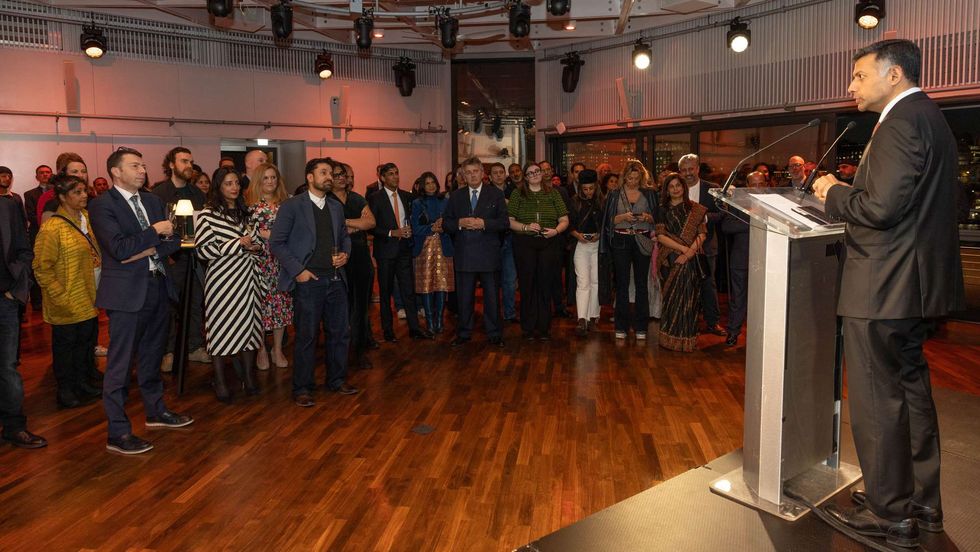 Attendees including artist Chila Burman, Rishi Sunak and Akshata Murty.
Doraiswami noted Britain’s unparalleled expertise in turning culture into a world class product, and said, “There is a real opportunity for us to take to India not just content, though that is very welcome, but also the incredible expertise the UK has in making museums, art, sport, theatre and music into a first-rate product.”
He added, “There is a reason why so many Indians come here, and come here to enjoy what the UK has to offer. Imagine if you could do this in India too, and how much bigger that opportunity would be.”
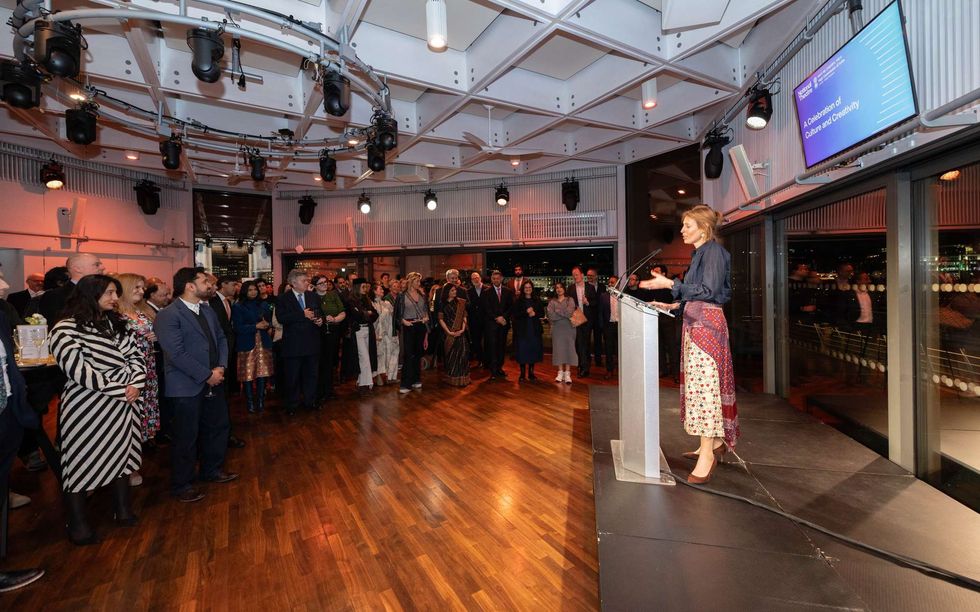 Kate Varah.
According to the Indian diplomat, theatre, as an art form, was particularly well suited to building bridges between peoples.
“What is told here is something that cannot be captured, cannot be owned, cannot become a commodity. It can only be shared,” he said. “The theatre is different. It is shared because it is a story, and you cannot enjoy a story unless you share it.”
The high commissioner described storytelling as central to the work of diplomacy itself.
“The work of governance and diplomacy these days is as much theatrical as anything else,” he said, drawing laughter from the audience.
“What is exciting is the opportunity that theatre presents for all the work we do in diplomacy, which is, at its heart, about storytelling.”
Rubasingham noted it was the first time the High Commission of India had partnered with a UK national arts institution for such an event.
The National Theatre director and co-chief executive said the theatre shared the UK government’s ambition to deepen ties with India.
“The UK and India are creative powerhouses, and tonight is a moment to celebrate that,” she said.
Rubasingham, whose ethnicity is Sri Lankan, spoke of a visit to Mumbai last October, when she joined prime minister Sir Keir Starmer’s trade delegation to India.
“I witnessed international diplomacy at the highest level: the leaders of one of the world’s oldest democracies and the world’s largest democracy, sitting together as peers. Given the long and deeply entangled history between our two countries, that was genuinely moving,” she said.
Rubasingham set out her vision for the National Theatre’s relationship with India and its diaspora, saying the institution had a long history of telling Indian stories.
She recalled directing The Waiting Room by Tanika Gupta at the National more than two decades ago, with veteran Indian actress Shabana Azmi in the lead role. “What struck us all was the sight of queues around the block: Asian audiences desperate to see her live on stage,” she said.
She also pointed to some key productions with Indian connections, including the Ramayana on the Olivier stage and Anupama Chandrasekhar’s The Father and the Assassin in 2022, which made Chandrasekhar the first female Indian playwright to have a new play on the Olivier stage. “Our message to Indian creatives, businesses and audiences is this: the National Theatre is a place for you,” Rubasingham said.
Guests at the event were treated to an exclusive preview of a new stage adaptation of The Jungle Book, which Rubasingham revealed would open at the National Theatre later this winter.
Rudyard Kipling’s classic has been adapted by Chennai-based Chandrasekhar and directed by Rubasingham.
The adaptation will be set in the Sundarbans, the vast mangrove forest spanning India and Bangladesh, rather than the more familiar jungle setting of earlier versions of the story. Rubasingham said it would feature puppetry and said rehearsals were due to begin in September.
In a moment of theatre, a prototype puppet, Moti the vulture, was brought out before guests for a rare preview.
Rubasingham also confirmed, to evident delight in the room, that Olivier Award-winning actor Hiran Abeysekera, among guests at the event, would appear in the production.
Abeysekera is known to theatre audiences for his acclaimed turn in Life of Pi at the National Theatre, a role which won him the Olivier Award for best actor in 2022. Further casting and booking details are expected to be announced in due course.
National Theatre executive director and co-chief executive Kate Varah used her address to outline how the institution was already reaching Indian audiences through its digital platforms.
She said the National’s two streaming services, NT Live, which screens productions in cinemas, and NT at Home, which offers access online, were the primary means by which the theatre now reached audiences in India and in 184 countries around the world.
“These unique digital platforms truly democratise access to the productions made here, and ensure that every show has a global life beyond its stage run,” she said.
Varah also announced that the National Theatre had begun in-person schools work in India, partnering with the National Centre for Performing Arts in Mumbai to run Connections, its 30-year-old youth theatre festival.
Sixteen schools, colleges and NGOs have already taken part, performing plays commissioned specially for the festival from Indian playwrights.
Varah pointed to the digital programme’s reach in UK and US schools as a model for what could be achieved in India.
The National’s digital work is currently available in 90 per cent of state secondary schools in the UK; last year the same programme was launched in 5,000 public schools across all 50 US states.
“Imagine what we could achieve, what the impact could be, in six years, or in sixty years, if a similar initiative could be created for schools and educational settings in India,” she said.
Varah also acknowledged two guests who she said were already helping the National Theatre advance its India ambitions: Murty and Jonathan Badyal, a partner at Trafalgar Strategy and former Universal Music UK director of communications.
Culture secretary Lisa Nandy, the first Cabinet minister of Indian heritage in the UK, also encouraged the National to deepen ties with India, Varah added.