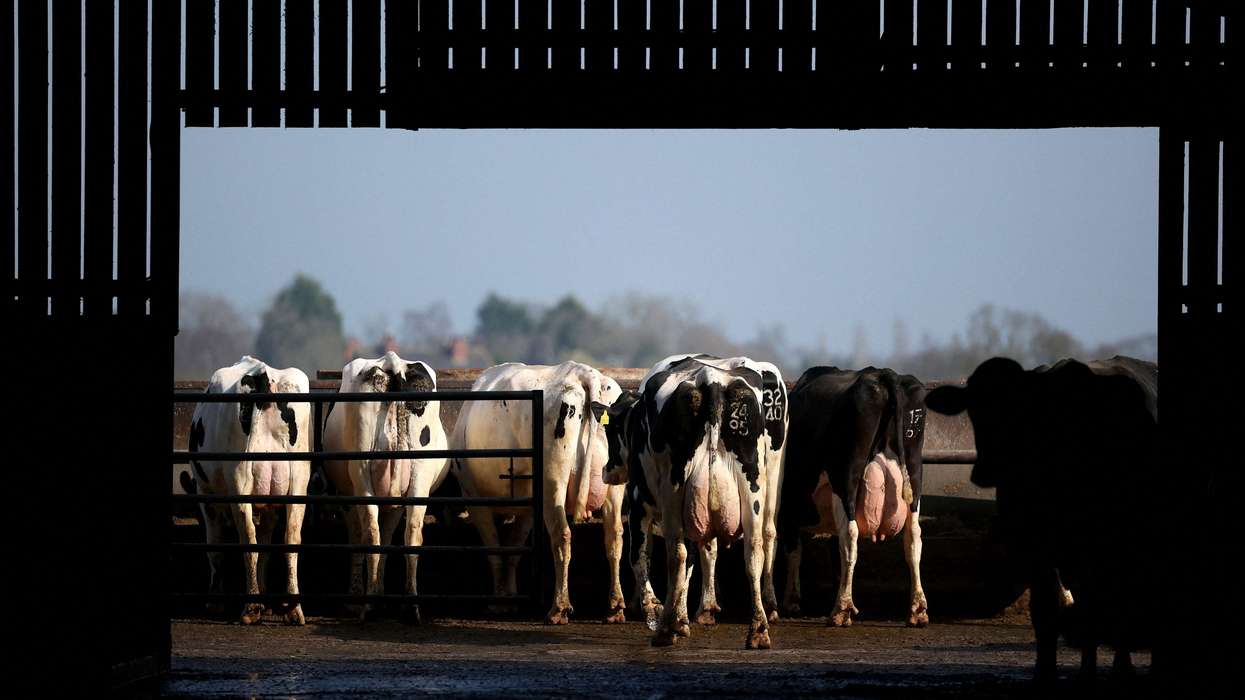

MILK prices have dropped sharply due to excess supply, leaving dairy farmers Kelly and Ed Seaton expecting losses this year from their 200 Holstein cows in north-west England.
Across Britain, farmers say milk production is no longer profitable, raising concerns about closures and adding to a decline in dairy producers. The number has fallen by 20 per cent since 2019 to about 7,000, according to the Agriculture and Horticulture Development Board.
Prices paid to many UK dairy farmers have fallen by up to 15 pence per litre, or about 40 per cent, since October 2025, as milk production rises in the UK and globally.
UK supply is exceeding processing capacity and outpacing demand.
"It's simply a matter of too much milk in the market," said Kelly Seaton, whose farm spans 175 acres on the Shropshire–Cheshire border. Her husband’s family has been in dairy farming for more than a century.
NUMBER OF DAIRY COWS IN UK AT DECADE LOW
Milk production in the U.S. and Europe has recovered this year after a weaker 2025. In Britain, the milking herd stood at 1.6 million cows in January, the lowest in a decade, but output per animal has increased. Dry weather last year led farmers to use more concentrated feed instead of grazing, raising yields.
Britain is just under 90 per cent self-sufficient in dairy, but prices are affected by global markets and remain volatile. The downturn has been faster than expected, leaving farmers with limited time to respond.
Across Europe, falling prices have led to calls for support. Italy in January asked the European Commission to pay farmers to cut production and subsidise storage, a request that has not been accepted.
"For the past few months, we've truly seen a tsunami of milk supply worldwide," Francois-Xavier Huard, CEO of French dairy association FNIL, said last month.
SELLING AT LESS THAN COST PRICE
Seaton said it costs about 40 pence to produce a litre of milk, but she is paid 30.5 pence by a local processor that makes a Red Leicester-style cheese.
Her revenue this month will be about £20,000 lower than in September.
"We'll definitely make a loss this year," she said, adding she doesn't blame her processor.
Their pricing follows that of German-owned Muller, along with Denmark-based Arla and First Milk, which dominate the UK market.
Arla, which produces Lurpak butter and Castello cheese, said last month it expects the global surplus to continue to push prices down.
"We are price takers, rather than price makers - you haven't got a choice," Seaton said.
Gwyndaf Thomas, who keeps 300 Friesian cows in Carmarthenshire, Wales, and supplies milk for mozzarella, said he has seen similar changes.
"We've never seen price cuts on this scale - they're savage cuts in such a short period," he said.
Paul Tompkins, who runs a farm in the Vale of York with 500 Holstein cows, said he expects to lose about £600,000 this year after making a profit in the previous two years.
He said farmers without contracts linked to production costs with major supermarkets were likely losing money.
"The question for us as an industry is how do you manage increasing price volatility going forward," he said.
FURTHER PRICE FALLS TO COME?
Milk production in the UK usually rises in spring as more cows calve, increasing the risk of further surplus and lower prices.
The UK dairy sector is worth more than £6 billion a year and accounts for 20 per cent of agricultural output, according to the agriculture ministry.
Tompkins, who is also deputy president of the National Farmers’ Union, said the government could have done more to support the sector, which is also facing higher labour costs, inheritance tax changes, and increases in fuel, energy and fertiliser prices linked to the Iran war.
CONSUMERS WANT MORE DAIRY FOODS LONG-TERM
The price fall comes as demand for dairy is expected to increase. A growing global population with higher incomes is consuming more dairy, while countries such as China are adopting diets that include more dairy products.
Global per-capita demand for fresh dairy products is forecast to rise by 11 per cent by 2033, according to OECD/FAO projections.
The NFU said that without a stable and profitable sector, UK food security could be affected.
"Ultimately you become, as an industry, more susceptible to large corporations getting larger, fewer farmers, fewer processors and people looking elsewhere to get product in," said independent farm consultant Paddy Snodgrass.
Seaton said: "We do just have to accept that we are going to have bad times and hope that the good times counter the bad."
(With inputs from Reuters)