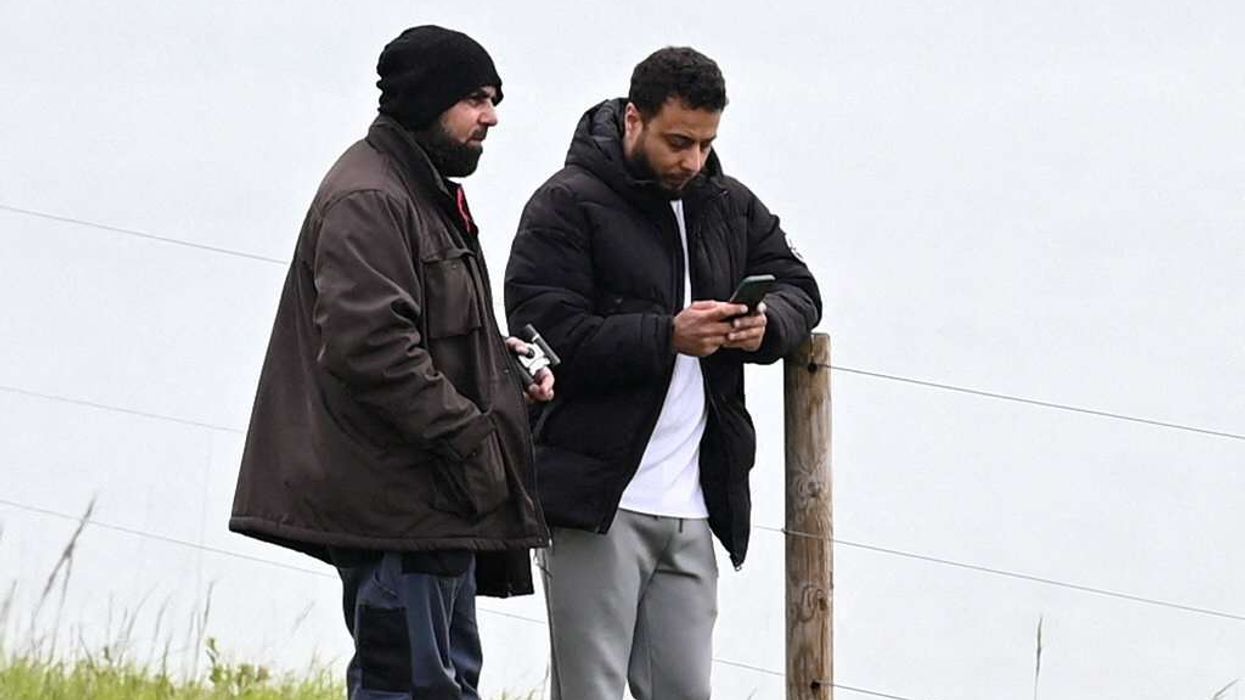

TWO men were found guilty on Tuesday of plotting to kill hundreds of people in an Islamic State-inspired gun attack targeting the Jewish community in England, a case investigators said highlights renewed concerns about the militant group.
Police and prosecutors said Walid Saadaoui, 38, and Amar Hussein, 52, were Islamic extremists who planned to use automatic firearms to kill as many Jews as possible. Their trial began a week after an unrelated fatal attack on a synagogue in the northwest city of Manchester in October.
Had the plan been carried out, it would have been “one of, if not the, deadliest terrorist attacks in UK history”, said Assistant Chief Constable Robert Potts, who leads Counter-Terrorism Policing in northwest England.
The convictions come little more than a week after a mass shooting at a Jewish Hanukkah celebration on Sydney’s Bondi Beach that killed 15 people. Islamic State said the Australian attacks were a “source of pride”. While the group did not claim responsibility, its reaction has raised concerns about a rise in violent Islamist extremism.
European security officials say Islamic State does not pose the same threat as it did a decade ago, when it controlled large areas of Iraq and Syria, but warn that it and affiliated al Qaeda groups are again seeking to inspire attacks abroad through online radicalisation.
“You can see signs of some of those terrorism threats starting to grow again and starting to escalate,” British Foreign Secretary Yvette Cooper said last week.
Two men prepared to become martyrs
Prosecutors told jurors that Saadaoui and Hussein had “embraced the views” of Islamic State and were prepared to risk their own lives to become “martyrs”.
Prosecutor Harpreet Sandhu said Saadaoui had arranged for two assault rifles, an automatic pistol and almost 200 rounds of ammunition to be smuggled into Britain through the port of Dover when he was arrested in May 2024. Sandhu said Saadaoui also planned to obtain two more rifles, another pistol and at least 900 rounds of ammunition.
Police said the plan never came close to being carried out because the man Saadaoui was trying to source the weapons from, known as “Farouk”, was an undercover operative.
Sandhu said the assault rifles Saadaoui sought were similar to those used in the 2015 attack on the Bataclan concert hall in Paris that killed 130 people. He said Saadaoui “hero-worshipped” Abdelhamid Abaaoud, who coordinated that attack.
Saadaoui said in a message to “Farouk” that the Paris attack was “the biggest operation after that of Osama (bin Laden)”, an apparent reference to the September 11, 2001 attacks in the United States.
“Based on Walid’s communications and interactions with the undercover operative, and some of the things he said, that made it very clear that he regarded a less sophisticated attack with less lethal weaponry as not being good enough,” Potts said.
“Because, in effect, it was his role and his duty to kill as many Jewish people as he could, and that wasn’t going to be achieved via the use of a knife or, for example, potentially a vehicle as a weapon.”
Both Saadaoui and Hussein pleaded not guilty. Saadaoui said he had played along with the plot out of fear for his life. Hussein did not give evidence and was largely absent from the trial after shouting from the dock on the first day, “how many babies?”, an apparent reference to Israel’s war in Gaza.
They were convicted at Preston Crown Court on a single charge of preparing terrorist acts.
Walid Saadaoui’s brother, Bilel Saadaoui, 36, was found guilty of failing to disclose information about acts of terrorism, although prosecutors said he had been reluctant to join the plot.
Islamic State threat growing
The case is the latest in Britain and elsewhere to be inspired by Islamic State, which emerged in Iraq and Syria a decade ago and declared a “caliphate”, largely displacing al Qaeda.
At its height from 2014 to 2017, the group controlled large areas of both countries, ruled over millions of people and imposed a strict interpretation of Islamic sharia law. Its fighters also carried out or inspired attacks in dozens of cities worldwide, often claiming responsibility even when there was no direct link.
The SITE Intelligence Group said after the Bondi Beach attack in Australia that Islamic State had encouraged Muslims to take action elsewhere, particularly highlighting Belgium.
A European intelligence official, speaking on condition of anonymity, said Islamic State was flooding social media with propaganda. While this influenced only a small number of people, it had led to more terrorism investigations than last year.
Ken McCallum, head of Britain’s domestic intelligence agency MI5, said in October that the security services had stopped 19 late-stage attack plots since the start of 2020 and disrupted hundreds of other terrorism threats.
“Terrorism breeds in squalid corners of the internet where poisonous ideologies, of whatever sort, meet volatile, often chaotic individual lives,” McCallum said.