
THE author of a prize-winning business book on artificial intelligence has stated: “I think robots are coming.”
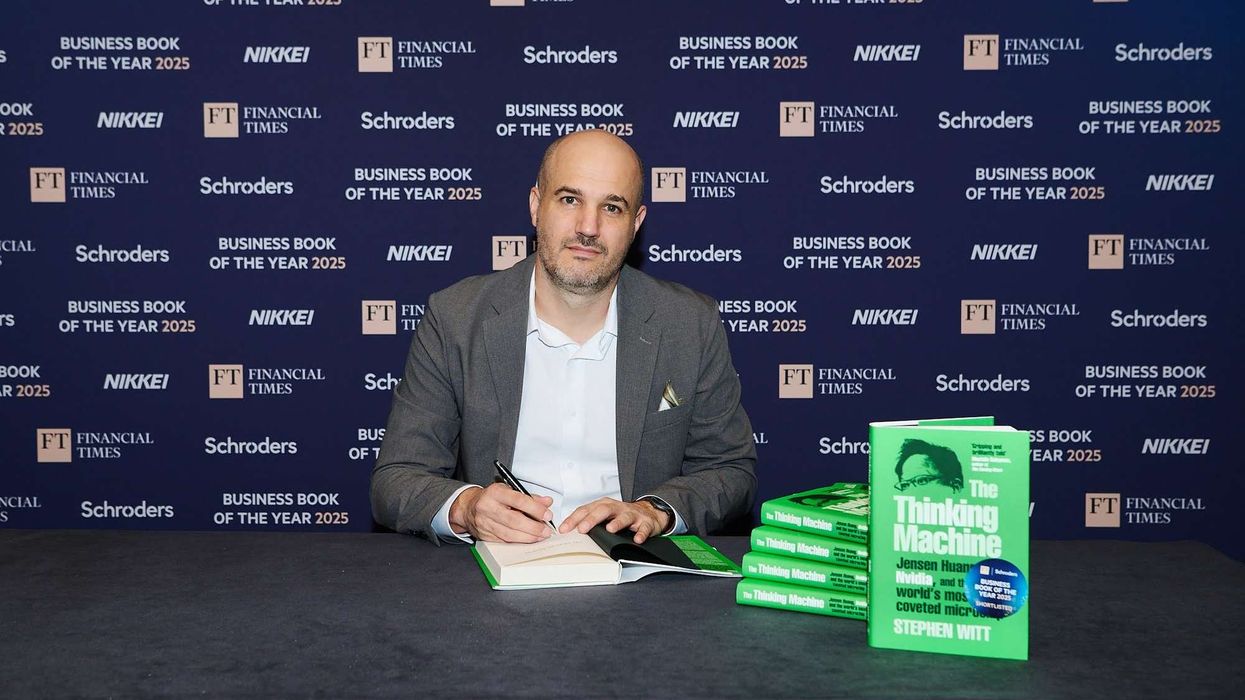
The remark, which sounded almost like a warning, was made last week by Stephen Witt, when he was named the winner of the prestigious FT Business Book of the Year 2025 for The Thinking Machine: Jensen Huang, Nvidia, and the World’s Most Coveted Microchip.
Speaking at a dinner at the InterContinental Hotel in London, co-sponsored by the Financial Times and Schroders, Witt set out the story of Huang, who was born in Taiwan, faced racism after he emigrated to the US at the age of 10 and now heads the most valuable company in the world with a market capitalisation of “$4- 5 trillion” (£3-3.7tr).
“You’re always an immigrant,” Huang says in the book. “I’m always Chinese.”
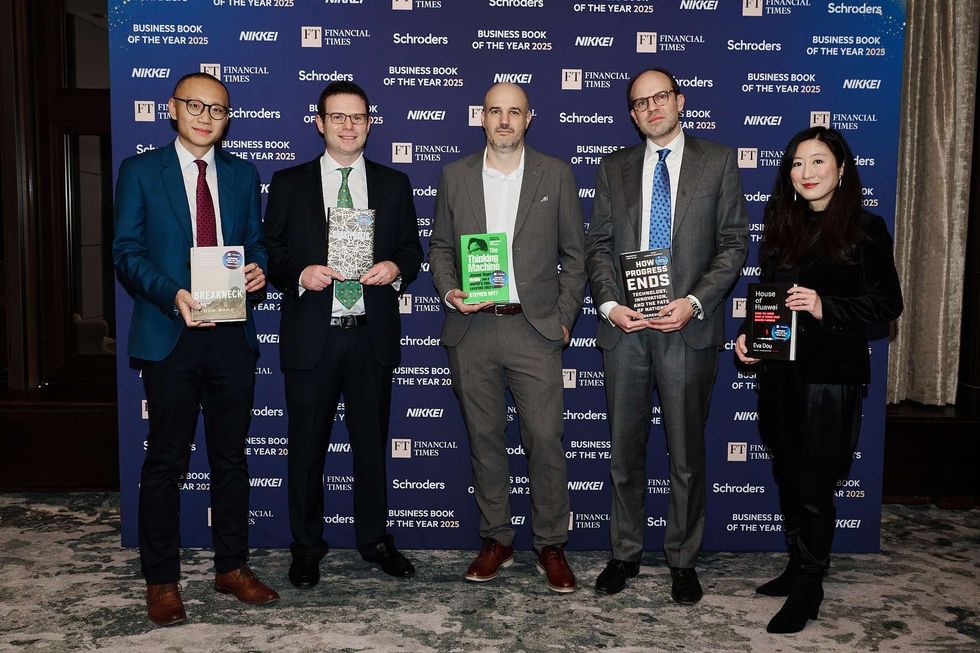 Shortlisted authors Dan Wang, Edward Fishman, Stephen Witt, Carl Benedikt Frey and Eva Dou
But his tale also illustrates how America has been enriched by immigrants, probably more so than any other country in the world.
After being named winner of the £30,000 prize, Witt, a TV producer and journalist, explained how he thinks AI will transform the world.
“Jensen Huang is just the most unusual person I’ve ever met,” said Witt. “He’s the most capable individual I’ve ever met. But it comes from a place of deep, almost like self-loathing, neurotic, he’s completely driven. I mean this not in a clinical sense, but he’s completely driven by negative emotions.
“In the time that I was writing this book, Nvidia went from being the seventh most valued company in the world to the most valuable. So what’s happening?
“Well, they’re building the hardware that powers the AI revolution, and all of us are on the precipice of just unprecedented technological, economic and social change, and this company made it happen. I was talking to Bill Dally, the chief scientist at Nvidia, but previously the head of Stanford University’s computer science department. He said, ‘We built the software tools that powered AI in the 1980s, and then we got the data we needed in the 2000s, but nobody was building the microchips we needed. In fact, it was unprofitable to do so for 10 years. Jensen loved building this stuff, and it was not clear that he would ever have any kind of customer at all.’
“I don’t know if you guys are familiar with the (1989) movie, Field of Dreams. He (the farmer played by Kevin Costner) built a baseball in a cornfield and then waits for the players to arrive. That’s what Jensen really did. It’s a very counter-intuitive business strategy. His customers didn’t like it, his investors didn’t like it, and Nvidia stock price was stagnant for 14 years, while he built the capacity for these systems. He didn’t even know AI was coming.”
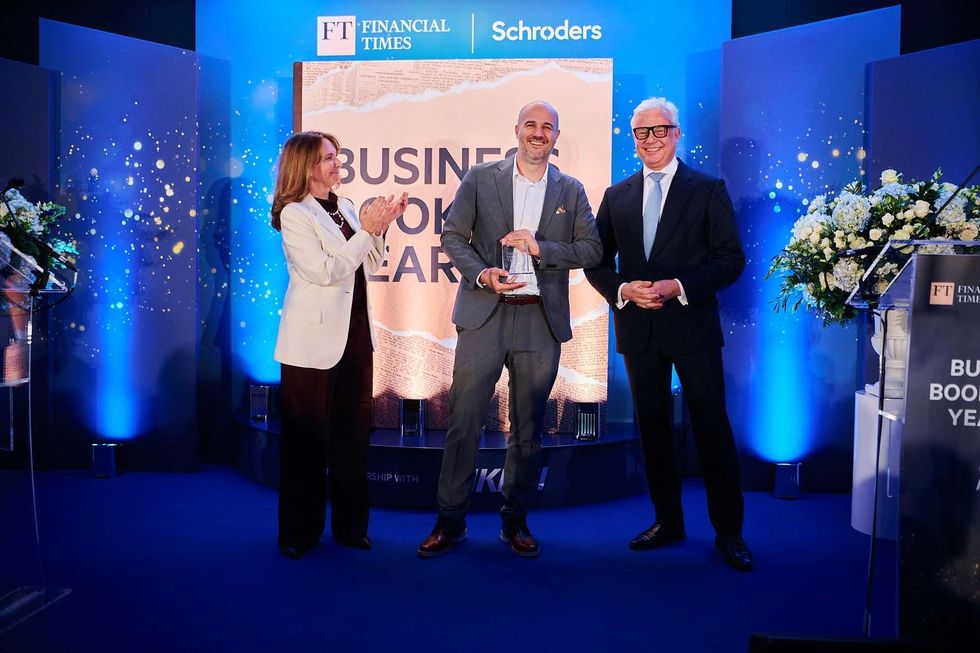 Roula Khalaf, Stephen Witt and Richard Oldfield at the awards ceremony in London
Witt said when Jensen spotted the potential of AI, “he shifted his whole company in one memo overnight in 2014 – he wrote an email saying, ‘We’re no longer a graphics card company. We’re now an AI company.’ He doesn’t like it when I say ‘monopoly’, but he proceeded to accumulate a 90 per cent market share building the training AI chips. What does the future hold for Nvidia? I think robots are coming.”
“This is the thing Jensen talks about all the time,” continued Witt. “I’m writing about it now, as a follow up. Jensen’s going to train the brains of these robots. He’s going to train them in a digital gymnasium that he has built inside Nvidia’s cloud structure.
“They’re going to learn to wash dishes and drive cars and clean the floor, but instead of breaking dishes at the sink, they’re going to do it virtually. Once the brain is sufficiently sophisticated, it will be downloaded into a microchip and updated through the cloud. So your robot you buy at home will be a little wonky at first, and then it’ll start to get better and smarter and smarter and smarter until you reach a point where it seems indispensable.”
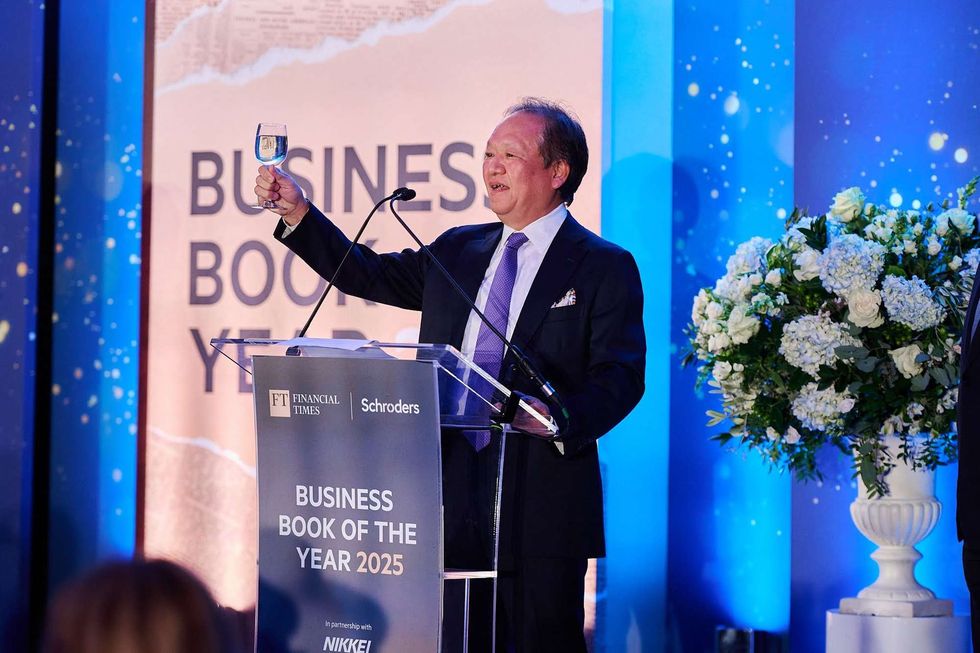 Daisuke Arakawa
Witt emphasised: “I think we’re just in the first stage. It’s a radical concept, but I think we are entering an era where everything that we take for granted will change. I think the whole world is going to be transformed.”
The other 2025 finalists, who each received a cheque for £10,000, were: House of Huawei by Eva Dou, which investigates the rise of the Chinese technology company and its founder; Chokepoints by Edward Fishman, about the use of economic sanctions (this has a great deal on India’s purchase of Iranian and Russian oil); How Progress Ends by Carl Benedikt Frey, on what decides the destiny of civilisations; Abundance by Ezra Klein and Derek Thompson, about the growth dilemma facing the US; and Breakneck by Dan Wang, contrasting the US and its arch rival, China.
The award is in its 21st year. It is the second year in succession that the £30,000 award has gone to a book about the rapid spread of generative artificial intelligence. Last year’s winner, Supremacy by Parmy Olson, examined the rivalry between OpenAI and DeepMind.
Roula Khalaf, editor of the FT and chair of the judging panel (which includes Baroness Shriti Vadera, chair of the Prudential and of the Royal Shakespeare Company), said the shortlisted books “help us understand the forces that are shaping our world”.
She added: “Stephen Witt has written a fascinating account of the making of one of the most consequential companies of our times.”
Richard Oldfield, chief executive of the Schroders group, revealed: “The judging panel had a really difficult job coming from an astonishing 530 entries down to a short list of six candidates. Each book offers unique insights into the ways countries, businesses, and technology are shaping our future. Collectively, they help us navigate an era defined by rapid change and increasing complexity.”
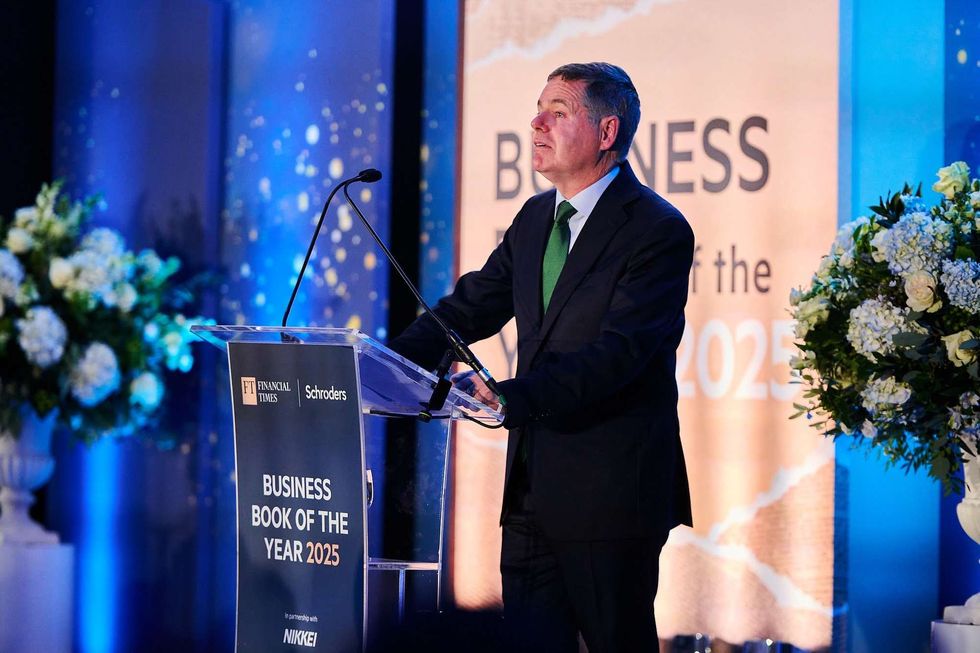 Paschal Donohue
Daisuke Arakawa, senior managing director for global business of Nikkei Inc, owners of the FT, said: “AI is transforming society at an alarming rate, and they say it is only a matter of time before we see the emergence of artificial super intelligence that surpasses the human mind. The rise of artificial intelligence leads us to ask about the nature of human intelligence, another big topic, and yet I believe in human potential. And that is precisely why I will do my best to ensure this award continues to shape history. So here is to your health and success and to human intelligence.”
The keynote address was delivered by Paschal Donohoe, who recently left his job as Ireland’s finance minister to take up a post as managing director and chief knowledge officer at the World Bank.
He stressed that attaining public consent for the practice of sensible economic policy “matters to the 831 million people in our world who continue to live in extreme poverty”.
He pointed out: “In an age of declining attention spans, there’s no point having answers to the big questions if they are buried in thickets of inaccessible jargon. These books are shining examples of how to be relevant but to do so with style, elegance and lucidity.