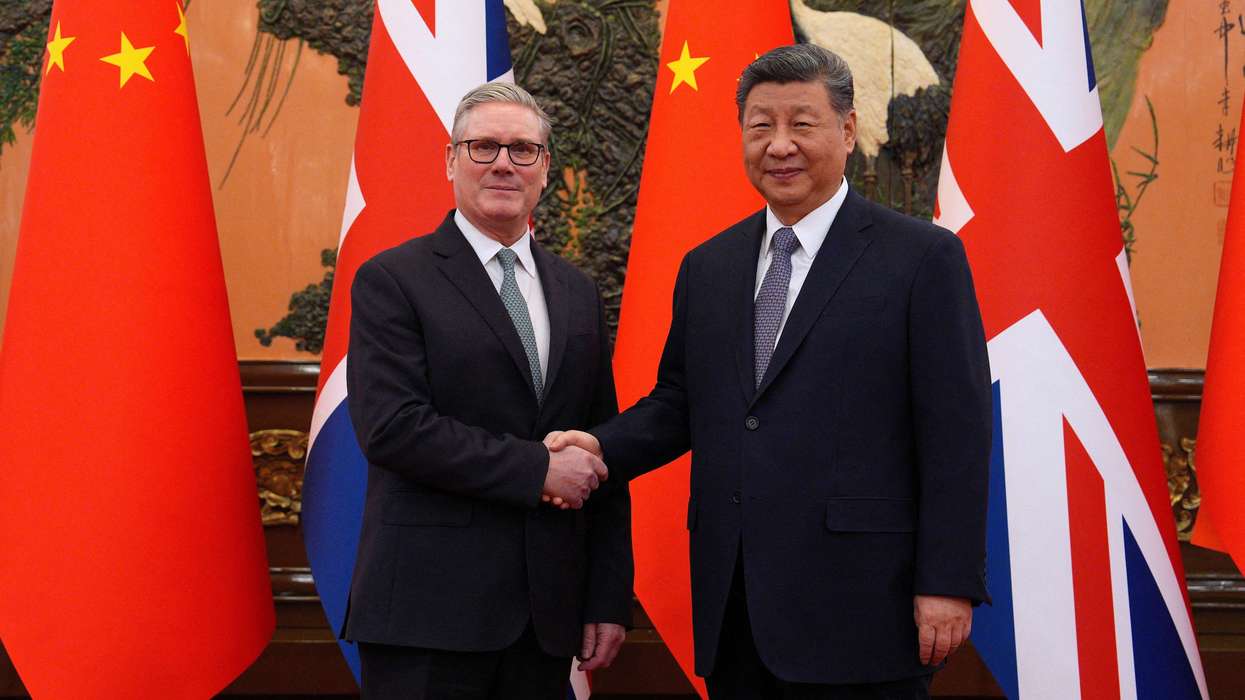

PRIME MINISTER Keir Starmer told Chinese president Xi Jinping on Thursday that he wanted to build a “sophisticated relationship” with Beijing to support security and the economy, signalling a shift after years of strained ties.
Starmer is on a four-day visit to China, the first by a British prime minister since 2018. On Thursday, he spent around three hours with Xi during a formal summit and a lunch in Beijing. The two leaders also spoke about football and Shakespeare.
“China is a vital player on the global stage, and it's vital that we build a more sophisticated relationship where we can identify opportunities to collaborate, but of course also allow a meaningful dialogue on areas where we disagree,” Starmer told Xi at the start of their meeting.
Xi said relations between Britain and China had gone through “twists and turns” that had not served either country, and said China was ready to develop a long-term partnership.
“We can deliver a result that can withstand the test of history,” Xi told Starmer at the Great Hall of the People, where he was joined by senior Chinese ministers.
Starmer has made improving ties with China a priority as his Labour government seeks economic growth, despite concerns in Britain over espionage and human rights. He is the latest Western leader to engage with Beijing as countries adjust to uncertainty in relations with the United States under president Donald Trump.
Trump’s threats of trade tariffs and comments about taking control of Greenland have caused tensions with long-standing allies, including Britain. Starmer’s visit followed a trip by Canadian Prime Minister Mark Carney, who signed an economic deal with China that drew criticism from Trump.
Starmer told reporters that discussions had made progress on reducing tariffs on whisky, while Xi said China would consider waiving visas for British nationals.
“The relationship is in a good place, a strong place,” Starmer said. Asked if Xi was someone he could do business with, he replied “yes”.
Starmer said the talks were warm and constructive, and said the two discussed English Premier League clubs during the lunch. He presented Xi with a football from a recent match between Manchester United and Arsenal.
Britain and China also agreed to step up cooperation against migrant smuggling networks. Downing Street said the two countries would sign an agreement targeting supply chains used by people smugglers.
“More than half of small boat engines used by people smugglers crossing the English Channel are manufactured in China,” Downing Street said.
The agreement includes intelligence sharing and direct engagement with Chinese manufacturers to ensure legitimate businesses are not exploited by organised crime. British and Chinese officials will also work to reduce the use of Chinese-made engines in small boats used to transport migrants across the Channel.
The deal also seeks to improve cooperation against trafficking of synthetic opioids such as nitazenes, which Downing Street said are produced in China and exported to the UK.
Starmer said he had adopted a policy of engagement with China after relations worsened under previous Conservative governments, which limited Chinese investment and raised concerns over Hong Kong.
“I made the promise 18 months ago, when we were elected into government, that I would make Britain face outwards again,” Starmer told Xi.
“Because, as we all know, events abroad affect everything that happens back in our home countries, from prices on the supermarket shelves to how secure we feel.”
Opposition Conservative Party leader Kemi Badenoch said she would not have gone to China due to security risks. British security services have said China routinely spies on the UK government, an allegation China denies.
Starmer said he also raised the case of Jimmy Lai, the former Hong Kong media tycoon and British citizen convicted in December on national security charges. He described the discussion as “respectful”.
On Wednesday, Starmer arrived in Beijing and met a group of business leaders and cultural figures travelling with him. He told them that “it is in our national interest to engage with China”.
“You're part of the change that we're bringing about,” he said.
Later, Starmer dined at a Beijing restaurant known for mushroom dishes and practised saying “xie xie” while posing for photographs, according to a video posted on Weibo.