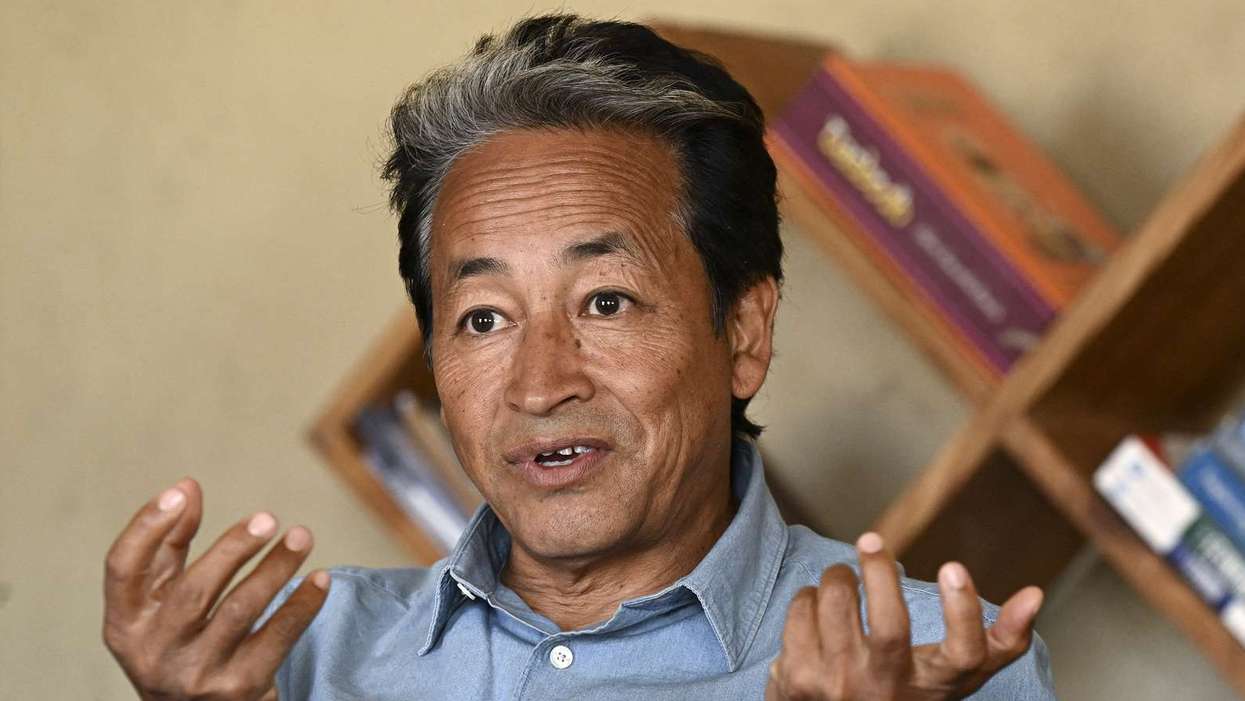

INDIA on Saturday ended the preventive detention of Ladakh activist Sonam Wangchuk, releasing him six months after he was held following protests in the Himalayan region.
Wangchuk, 59, an environmental advocate linked to Ladakh's movement for greater autonomy, was detained in September and later charged under India's National Security Act after protests in the region left four people dead and dozens injured.
New Delhi had blamed the violence on "provocative speeches" by Wangchuk, who had been on a hunger strike demanding either full federal statehood for Ladakh or constitutional protections for its tribal communities, land and environment.
Authorities in the sparsely populated, high-altitude region bordering China and Pakistan had said at the time that the order, issued by the district magistrate of Leh, was required to "maintain public order".
Under the National Security Act, a suspect can be detained for up to 12 months without being formally charged.
The home ministry said in a statement on Saturday that it had decided to end Wangchuk's detention "with immediate effect" after "due consideration".
It was not clear if the charges against Wangchuk had been dropped.
Mustafa Haji, a lawyer for the Leh Apex Body — which led last year's protests — said Wangchuk was released from jail in the western city of Jodhpur soon after.
The home ministry said it remained "committed to fostering an environment of peace, stability, and mutual trust in" Ladakh and would have "meaningful dialogue with all stakeholders".
The decision also comes as the Supreme Court continues to hear a petition filed by Wangchuk's wife Gitanjali Angmo challenging the legality of his detention.
The fate of that case remains unclear now that Wangchuk has been released.
An engineer by training, Wangchuk is known for water conservation projects in the Himalayas.
He received the Ramon Magsaysay Award in 2018 for his environmental work and contributions to reforming local schooling in Ladakh.
His life and work are said to have inspired a character played by Bollywood actor Aamir Khan in the film "Three Idiots".
Prime minister Narendra Modi's government separated Ladakh from Indian-administered Kashmir in 2019 and placed both under direct rule.
Ladakh has since asked New Delhi to include it in the "Sixth Schedule" of India's constitution and to have its own local legislature to make laws and policies.
India's army maintains a large presence in Ladakh, which includes disputed border areas with China.
Troops from the two countries clashed there in 2020, killing at least 20 Indian and four Chinese soldiers.
(With inputs from agencies)