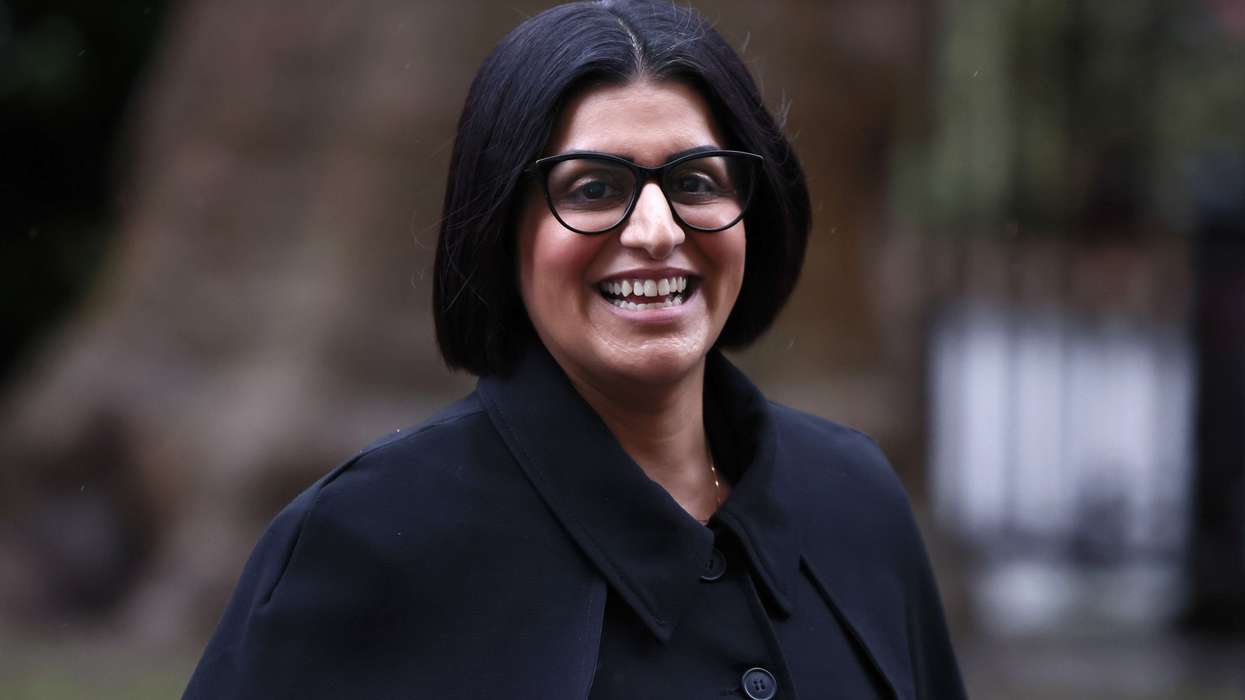

Shabana Mahmood tops this year’s Power List because as home secretary, she occupies one of the great offices of state.
That she was given this job is a testament to her organisational skills and standing in the Labour party but it is possibly the toughest in government, long designated “the graveyard for political careers”.
Mahmood is now responsible for everything from immigration – a poisoned chalice if ever there was one – to law and order, policing, national security, and terrorism.
She appears to have defined herself not as a home secretary who happens to be Muslim but almost as a Muslim home secretary.
When Labour won the general election in July 2024, Sir Keir Starmer made her justice secretary and Lord Chancellor. She was second on the Power List behind the mayor of London, Sir Sadiq Khan. In his cabinet reshuffle on 5 September 2025, the prime minister promoted her to home secretary.
Those who have sought to profile the home secretary have focused on the measures she has announced to curb immigration. But in the current climate when the debate is being shaped by the Reform party leader Nigel Farage, no home secretary can be “liberal”.
“On my second day as home secretary, over 1,000 people arrived by small boat,” she pointed out, adding, “Last year alone, £4 billion was spent on asylum accommodation.”
She intends making settlement harder. It will take longer than five years. “Some will be able to earn an earlier settlement than 10 years, based on their contribution, while others will be forced to wait longer if they are not contributing enough. In some cases, they will be barred from indefinite leave to remain entirely.”
A family of four will be offered up to a maximum of £40,000 – that is, £10,000 per person – to leave the UK. This compares with the cost of £158,000 to pay for hotel accommodation for three people for a year, she reasoned.
And study visas are being curbed, especially for Afghanistan, Cameroon, Myanmar and Sudan.
Sunder Katwala, director of British Future, has analysed Mahmood’s measures in Eastern Eye: “Labour has made protection temporary for all refugees. (Priti) Patel suggested five years for permanent status for legal routes, and 10 for boat arrivals, but Labour proposes to hike that to 20 years, reviewing claims every 30 months. Such extraordinary timelines are unprecedented anywhere.
“Mahmood warns that Labour can achieve nothing else in government if it cannot control dinghies in the Channel, since it needs people to believe in the state. But will her reforms work?
“Few realise net migration is on track to fall to zero during 2026 with net emigration likely in 2027. There would be real costs to accidentally eliminating net migration, entirely.
“The future of the politics depends on what happens after May’s elections. Should they trigger a Labour leadership contest, Mahmood would have to decide whether to pitch this Labour values case as a candidate herself – or try to persuade others that she has got the policy and politics right instead.”
“How to balance control with contribution and compassion, and push back against the politics of remigration and racism, will remain a key exam question in Labour politics,” observed Katwala.
To get an insight into who Shabana Mahmood really is, it is perhaps worthwhile taking a look at her background and the arc of her career.
Her parents came to Britain from Pakistan’s Mirpuri community in Kashmir, by far the most socially conservative section of Britain’s immigrant population. Over the last 50 years, Mirpuris – in sharp contrast to the Gujarati Hindu refugees who came from Uganda in 1972, for example – have integrated least into the British way of life. Life in cities where they have settled, such as Bradford, Birmingham and Manchester, has not been very different from that in Pakistan. In many families, daughters have been discouraged from going to university. Culture has evolved with every passing generation but what allowed Mahmood to escape her background is that she went to Oxford.
She allowed herself a little joke when announcing that newcomers would be expected to speak English as a foreign language to A-level standard.
“A working knowledge of Shakespeare and Chaucer is very welcome, but will not be a condition of settling in this country,” she quipped.
Given that the Reform leader Nigel Farage is setting the pace on immigration control, making deportation criteria even retrospective, any home secretary would have been forced to adopt measures similar to Mahmood’s. She has to appeal simultaneously to the wider electorate, while not giving offence to Muslim voters plus the Labour left.
In an interview with Lord (Michael) Gove, editor of The Spectator, she spoke about her faith: “It’s the absolute core of my life. If you look around my office, you’ll see quite a lot of references to my faith. It grounds me in my life, and it’s where I draw my sense of duty and public service from.”
Gove, who has himself served as justice secretary and Lord Chancellor when the Tories were in power, might have thought that comment was meant for Spectator readers but it was really aimed at the wider Muslim community. The reality is that for politicians like Mahmood, Muslim support is very much a doubled edged weapon. Her first priority will be to ensure her Birmingham Ladywood seat, where the large number of Muslim voters is both an advantage and a disadvantage, is safe. The 2024 election provided a warning that Labour politicians, who offend Muslim voters on such issues as Gaza, can be ousted.
Something strange is happening in British politics when the Daily Telegraph can express strong support for Mahmood.
Its leading article said that “Shabana Mahmood, the Home Secretary, is absolutely right to ban a planned al Quds march in London”.
Even more intriguing was the endorsement from Gove, who called Mahmood the “most impressive government figure” and predicted “Shabana Mahmood will lead Labour….but not yet”.
She was born on 17 September 1980 in Birmingham, the daughter of Zubaida and Mahmood Ahmed, who came to Britain from Mirpur, where the construction of the Mangla Dam displaced over 100,000 people. As Commonwealth citizens, they were eligible to fill labour shortages in Britain. The early arrivals sponsored relatives to join them. The men went back to get married and bring over their wives who spoke no English, thereby preserving the culture of Mirpur. This troubled area in what is called “Azad Kashmir” in Pakistan has been the source of cross-border terrorism into India for decades. The Mirpuris brought not only their culture but also the politics of Pakistan into constituencies, such as Ladywood in Birmingham, where Mahmood was first elected an MP in 2010.
Mahmood’s father arrived in the early 1970s, followed nearly 10 years later by her mother. From 1981 to 1986, Mahmood lived in Taif in Saudi Arabia, where her father worked as a civil engineer. On the family’s return to the UK, Mahmood, her twin brother, and a young sister and brother, grew up in Birmingham. Mahmood attended Small Heath School before moving on to King Edward VI Camp Hill School for Girls, a “top performing selective grammar school”.
This was crucial in getting a place to read law at Lincoln College, Oxford. She graduated with a 2:1. Mahmood was ambitious enough to stand for the post of president of the Junior Common Room. There was an Indian in the year above her who was reading PPE and got a First. Mahmood received his promise he would support her. Rishi Sunak, who had been a head boy at Winchester, went on to become prime minister.
Those were the years Indian and Pakistani immigrant families blindly supported Labour. In Mahmood’s case, her father was involved in Labour party politics in Birmingham. When Clare Short stood down in Birmingham Ladywood, Mahmood’s selection as the Labour candidate from an all women shortlist at the age of 27 was not without controversy. A rival alleged her selection had been fixed.
“I put my career as a barrister on hold when I was selected as candidate,” said Mahmood.
In her maiden speech in the Commons on 8 June 2010, she emphasised that the first Asian women in parliament from Labour – Priti Patel came in for the Tories – were Muslim: “I am delighted to follow the maiden speech made by my hon. Friend the Member for Bethnal Green and Bow (Rushanara Ali) who, like me, is one of the first Muslim women to be elected to this House. As we are joined in that achievement by my hon. Friend the Member for Bolton South East (Yasmin Qureshi), I can only remark that Muslim women in the Commons are rather like buses: there are none for ages and then three come along at once.
Birmingham, Ladywood, is one of the most multicultural areas in the country. More than 50 per cent of our population is non-white and we have a proud multicultural tradition.
“My grandfather came to this country from Pakistan in the 1960s. He died when I was six years old ….He could not have known that his decisions and his hard work would one day lead to his granddaughter being elected to this House.”
Unlike Starmer, she refused to serve under Jeremy Corbyn but other than that she did a number of jobs in opposition – home affairs; business, innovation and skills; treasury; and chief secretary to the treasury.
As is a passionate supporter of Palestinian rights, she took part in a demonstration outside a branch of Sainsbury’s in Birmingham city centre in 2014. She received a ticking off from Ed Miliband, then the Labour leader. She said: “We lay down in the street and we lay down inside Sainsbury’s to say we object to them stocking goods from illegal settlements – and that they must stop. We managed to close down that store at peak time on a Saturday. This is how we can make a difference.”
Starmer appointed her national campaign co-ordinator followed by shadow justice secretary – and then justice secretary and Lord Chancellor in July 2024.
She joked that at 5ft 1in, she was one of the tiniest Lord Chancellors in history. The heavy gown had to be pinned up so that she could walk without toppling over. The traditional wig was also an issue. “In addition to being short, it turns out I also have a small head. In (the robe-maker) Ede & Ravenscroft, where we went for my fitting, every wig I tried on slipped off. Then the final one was brought out, which apparently is some sort of antique number, and we put it on and it fitted. I thought, ‘Thank goodness for that.’ It was a cross between Mr Ollivander in the Harry Potter wand shop and Cinderella.”
When she was sworn in as Lord Chancellor – she was the first in 1,400 years to take her oath of office on the Quran – she described her amazement that the “little girl from Small Heath, one of the poorest areas in Birmingham, who worked behind the till in her parents’ corner shop”, had risen to hold one of the grandest and most ancient roles in government. Although she had been inspired to become a lawyer by watching Kavanagh QC, the television drama about a brilliant barrister ‘with working-class roots’, she never dreamt that she would one day be justice secretary.”
When she made her speech, she could hear her parents quietly sobbing away. “I couldn’t look at them because I was trying not to get choked up myself,” she admitted.
Theresa May was home secretary for six years from 2010 to 2016. She was followed by Amber Rudd, Sajid Javid, Priti Patel, Suella Braverman, Grant Shapps, Braverman again, James Cleverley, and Yvette Cooper. John Reid, who did the job under Tony Blair from 2006-7 condemned the home office as “not fit for purpose”. Incidentally, it’s a job that had once been done by Winston Churchill from February 1910 to October 1911.
When Mahmood addressed the Labour party conference last year, she began by saying: “It is an honour to address you for the first time as a Labour home secretary. If I am honest, it is an honour I never expected. And it is one that would have been unthinkable to my parents when they first arrived here in the 1970s. But if this is a story of progress, it is a contested one.”
The Muslim voice has become increasingly influential in British politics. According to the 2021 Census, the Muslim population in England and Wales was approximately 3.9 million, with Pakistanis making up 1.6 million. The proportion of non-white people in Mahmood’s constituency has risen to 70 per cent.
Mahmood’s own heroes are Benazir Bhutto and Margaret Thatcher “not for the substance of their politics, but for what they represented for women and the ability to make a contribution”.
Perhaps for now, it would be wiser not to judge her on the substance of her immigration control measures but more on what Shabana Mahmood represents as a British Asian woman.