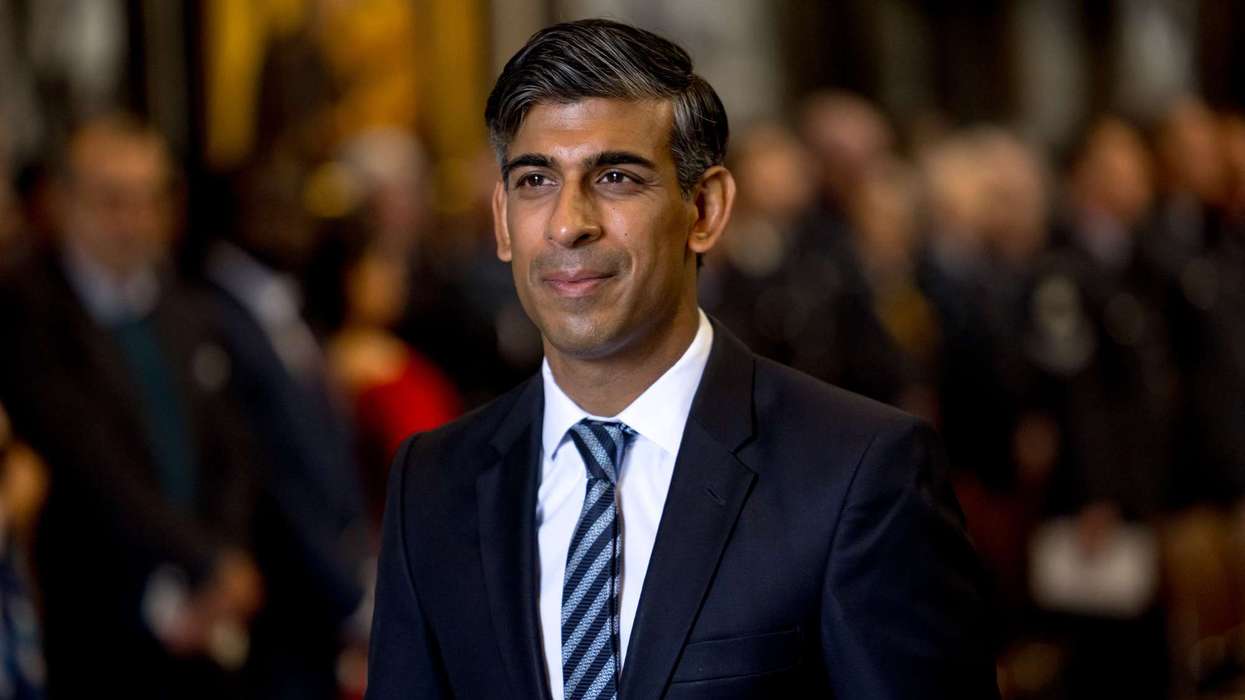

Rishi Sunak appears to be successfully making the transition from “former British prime minister” to international statesman. But his priority remains his constituency, Richmond and Northallerton, where he was first elected a Tory MP in 2015. This is evocative Wuthering Heights country. In fact, the new film adaptation of Emily Brontë’s novel was shot in and around his constituency. Most weeks “Rishi” – this is becoming something of a brand name – will make the three-hour journey to rural Yorkshire.
The charity that Rishi and his wife, Akshata Murty, have set up is called the Richmond Project after his constituency. It is “dedicated to breaking down barriers and building confidence in numbers across all ages”.
The couple (who met when they were students at Stanford) said: “We believe that by building number confidence in everyday life – from play to professions, from shopping to mortgages – everyone can lead more fulfilling lives, regardless of how old you are, where you live, and what you do.”
They will turn 46 this year – Rishi on 25 May, Akshata (who is the daughter of the Infosys founder N R Narayana Murthy) on 25 April.
Rishi has urged people to get early checks for prostate cancer. His diary is “crazy”. He has joined the Blavatnik School of Government at Oxford as a member of the World Leaders Circle and a distinguished fellow. He is the William C. Edwards distinguished visiting fellow at the Hoover Institution, which is an unpaid role allowing him work on “trans-Atlantic relations, economic policy, technology and global security challenges”.
Rishi is a part-time adviser to three companies – Goldman Sachs, Microsoft and Anthropic. He has also been recruited by The Sunday Times as a business columnist (where many readers urged him to come back as prime minister). All the money Rishi earns from his various jobs goes to his charity.
This year he attended the World Economic Forum in Davos in January, where his advice was sought on everything from how to deal with a mercurial US president Donald Trump to the war in Ukraine. But it is India, the fifth largest economy in the world, that is easing his passage from former prime to international statesman. Rishi, who advanced negotiations for the bilateral Free Trade Agreement, is trying to do his bit to strengthen UK-India relations. And in India he is treated as something of a global star.
One of Rishi’s passions is AI. As prime minister, he convened the first international AI summit in Bletchley Park in 2023. He attended the fourth summit, held in New Delhi in February, where he impressed everyone with his keynote address. He did a “fireside chat” with David Lammy, Britain’s deputy prime minister, who was deputising for the British prime minister, Sir Keir Starmer.
It is worth noting that Rishi has been able to maintain harmonious relations with a number of Labour politicians, including Lammy, who said: “I know that former prime minister Rishi Sunak is not just a great son of the United Kingdom, he is also a great son of India.”
Rishi promptly interjected, saying, “son-in-law”, drawing laughter from the audience. These little jokes matter in India. The capital’s long-suffering residents were also entertained when he apologised for being slightly late: “AI can do many things, but can’t yet fix Delhi’s traffic.”
What also goes down particularly well is his ability to explain complicated issues simply and eloquently. He is probably one of the best speakers on the international circuit. Britain has several other former prime ministers – Sir John Major, Sir Tony Blair, Gordon Brown, Lord (David) Cameron, Baroness (Theresa) May, Boris Johnson and the notorious Liz Truss – but Rishi may yet get another big job. As someone who is wealthy in his own right, he does not need anyone else to pay for his curtains or his clothes.
He has decided that it is AI that is going to make a difference to world economies. He has also decided that he is going to devote quite a bit of his time and effort on India.
The India AI Impact Summit, the first global AI summit to be hosted in the global south, reflected the transformative potential of AI, aligning with the Indian vision of Sarvajana Hitaya, Sarvajana Sukhaya (welfare for all, happiness for all). The summit saw participation by more than 110 countries, 30 international organisations, including 20 at heads of state or government level, and 45 ministers. It was attended by 250,000 people.
In his key note address, Rishi said India was uniquely positioned to drive the next phase of AI’s global journey, not just for developed nations, but for the developing world as well.
“There is no better place to discuss this AI transformation than India,” Rishi said, adding that the summit would show how AI can improve health and education “in every corner of the globe” and enhance human dignity.
Recalling that he launched the first AI Leaders’ Summit in 2023 at Bletchley Park, Rishi said the idea was to create a global forum bringing together presidents, prime ministers, CEOs, CTOs and developers to ensure that artificial intelligence evolved in favour of humanity.
“We committed ourselves to an AI future that worked for humanity,” he said, noting that safety was placed at the forefront from the beginning. He noted that frontier labs were now working with the UK’s AI Security Institute to test models before deployment to ensure safety standards.
According to Rishi, public trust will ultimately determine AI’s success, particularly in the public sector, where citizens can directly experience faster services, better healthcare and simpler government interactions.
“Across the world, we’re seeing these different attitudes towards AI. In countries like India, there’s enormous optimism and trust, and in western countries, we’re seeing that anxiety is still the dominant feeling towards AI,” he remarked.
“From the invention of the telephone, it took around 75 years to get to 100 million users; it took the PC 15 years, the internet 7 years. So how long did it take ChatGPT? Two months.”
Placing India at the centre of the global AI narrative, Sunak praised the country’s digital public infrastructure, including Aadhaar, UPI and Ayushman Bharat Health Accounts, as foundational systems capable of delivering AI-powered services to 1.4 billion people.
“The India Stack has shown people how technology can benefit them in their everyday lives,” he said, adding that Indians were among the world’s most prolific users of mobile data and AI tools and the second-largest contributors to AI projects globally.
He also lauded India’s vibrant startup ecosystem, pointing out that the country had produced over 125 unicorns, with companies such as Sarvam AI emerging as leaders in the space.
Referring to India’s culture of frugal innovation, Sunak said it enabled ambitious achievements at lower costs, citing the country’s space missions as an example.
“All of this is why, in the latest Stanford University ranking of global AI powers, India has overtaken the UK,” Rishi said.
"Some jobs will be lost,” he acknowledged. “I think many more will be redesigned. I think history shows us that societies flourish when we manage that transition well. The role of the government isn’t to stop innovation. It’s to make sure that people can take on these new tasks and new roles with confidence and security.
“Now I care about this – while, of course, there’s going to be change, that doesn’t mean that the role for humans is disappearing. It’s just going to change. Every job that all of us do, I think can be broken down into lots of different tasks.”
The scale of AI’s runaway growth is such that companies are investing 20 times more than the entire Manhattan (atomic bomb) Project, which cost approximately $2.2bn in 1945, equivalent to over $30bn today.
“Informed by my time at Stanford, I was of the belief that this is going to be the most transformational thing that happens in our lifetimes, and we’re lucky to live at a time that a general purpose technology comes along, because that’s what AI is, and general purpose technologies have the ability to reshape our entire country, economies, societies, with huge policy implications.”
At the World Economic Forum, where he was interviewed on Davos Daily Show by the Financial Times journalist Andrew Hill, Rishi spoke of the new world order ushered in by Trump: “It’s less rules based, it’s more power oriented. Pax Americana is gone. The US role in the world is changing. You’ve got the rise of multi polarity states like India and the Gulf, with their own views. Hybrid activity in Europe was up four times last year. (There is) Sabotage activity from Russia. You’ve got more state-based conflict than I think at any point since World War Two. So this is the new geopolitical environment. It’s very dangerous.
“It’s obviously incredibly unsettling. And I say that as someone who’s a staunch Atlanticist, and is someone who has always believed in the good that America can do around the world. And so particularly for us Brits, it’s a hard thing when one of your closest friends and allies is doing something that you profoundly disagree with.
“That old world order that we operated under is gone. Yes, this is the new world order, and the quicker we adjust to it, the better.”
On the domestic scene in Britain, Rishi has made an effective intervention after far right extremists claimed only white people could be considered truly British.
Rishi declared: ‘I’m British, English and British Asian.”
Meanwhile, Akshata, who is carving out her own role, has become a trustee at the V&A. She and Rishi also attended the high profile Pink Ball last year at the British Museum. The event, a match for the Metropolitan Museum of Art’s gala in New York, raised £2.5m, which will go partly towards greater UK-India cultural exchanges.
Akshata was guest of honour at the Bharatiya Vidya Bhavan UK’s annual Diwali dinner, where she said: “I think the real test of one’s confidence is whether we can express ourselves fully and comfortably in front of others; can we be proud of our culture, can we own it, can we showcase it without fear or judgment?
“We were privileged to experience that test as residents of 10, Downing Street, one of the world’s most visible stages, when we lived there when my husband was prime minister. There, we had the opportunity to celebrate our traditions and values openly by staying true to who we are and to our culture.
“Whether it was lighting diyas at the front door for the very first time, creating rangoli patterns outside No 11 (the chancellor’s official home, when Rishi held that post), or even making rasam upstairs in the No 10 flat, we never shied away from our heritage, we never shied away from who we are.”
ENDS