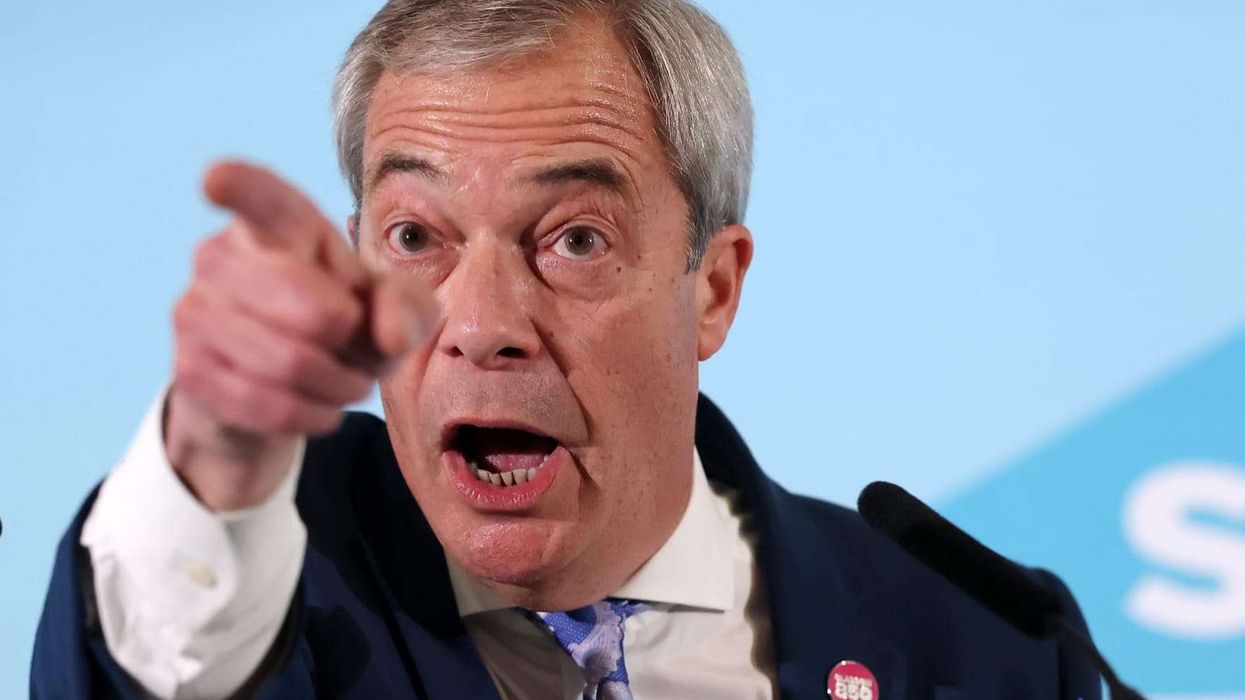

“Look. The most common name in this school has always been Smith. And now it's Patel”, a young Nigel Farage allegedly told his classmates. So, he made a show of burning the Dulwich College school roll booklet to protest, his fellow pupil Andrew Field, now an NHS doctor, recalls.
How far should teenage Farage’s behaviour influence public views of his credentials today as a political leader? That can be the subject of reasonable debate. What is no longer in serious doubt is the credibility of the allegations. More than 28 pupils have come forward. To answer Farage’s question - whether anybody can really remember what happened four decades ago - those on the receiving end, such as Peter Ettegudi, who faced antisemitic abuse, have shown much dignity in recounting why such formative experiences do not fade. Yinka Bankole was only nine or 10 when he claims he was told to go back to Africa when Farage was a 17-year-old sixth former who towered over him. The Guardian verified there were indeed 13 Patels and 12 Smiths in the Dulwich College yearbook of 1980.
When these stories first emerged more than a decade ago, Farage tacitly acknowledged their veracity. “I did say things that would offend deeply … terms of abuse thrown around between fifteen-year-old boys were limitless; there were no boundaries,” Farage wrote to biographer Michael Crick in 2021. What he could recall was that “red-haired boys fared especially badly” - a transparent code to present any racism faced by Jewish, Asian and black students as just one more variant of what everybody else faced, too.
Farage and Reform have tried almost every tactic beyond acknowledging the increasingly obvious truth. “It's not fair” is the gist of Farage’s 2025 defence. Wasn’t everybody doing it? The party leader shouted “Bernard Manning” at BBC and ITV journalists, suggesting they should apologise for “practically everything they broadcast in the 1970s and 1980s” if they expected him to reciprocate. Yet, the BBC website is full of agonised reappraisals of All Garnett and the Black and White Minstrel Show. Dulwich pupils and staff do acknowledge that the 1970s culture was different - yet recall that Farage’s conduct stood out by the standards of a 1980s public school.
The 61-year-old political leader obviously cannot change how his 16-year-old self behaved - even if he may regret his conduct then, or at least the controversy over it today. What Farage can control in 2025 is what he does or does not want to say to those directly involved, or the broader public. Angry denunciations by the party leader and his supporters have only encouraged ever more witnesses to come forward.
How far has Farage changed? He could say that at least one of his friends is a Patel these days, since Tory frontbencher Priti Patel attended his 60th birthday bash. For more than a decade, Farage has emphasised his willingness to select black and Asian candidates who share his Eurosceptic politics as a reputational shield against charges of racism. But those charges have not gone away - not least because Reform still selects too many candidates revealed to be openly racist, too. It threw out Ian Collins, the leader of Staffordshire Council last week, after Hope Not Hate revealed his overt racism on social media. Reform will expel those who express the most indefensibly racist views - when others expose them - but face reputational damage from having to do so quite so often.
Only a third of the British public, overall, are confident that Reform is not racist. That casts doubt on the prediction of Conservative peer Daniel Hannan that scrutiny of his schooldays will boost Farage’s popularity by coming over as an establishment plot. I recall how focused Hannan was - a decade ago - on trying to limit Farage’s profile in the EU referendum. He was a prime mover in Vote Leave’s fear that Farage would cost as many votes as he gained due to his polarising reputation on race, and therefore Hannan advocated ensuring the campaign sought ethnic minority votes, too. Reform does not need 50 per cent of the vote - but it does face a parallel challenge. British Asians are only half as likely as the white British to seriously consider voting Reform. Seven out of ten British Asians do regard Reform as racist, according to YouGov polling this autumn. One in six actively think the party passes that foundational test.
Farage will need to decide if it is now in his interests to acknowledge how his school conduct felt to others. The substantive question should then become less about whether Farage took part in racial bullying in his schooldays - and how far he and Reform can meet the contemporary challenge of whether they can be trusted as fit to govern the Britain that we have become.

The author is the director of thinktank British Future and the author of the book How to Be a Patriot: The must-read book on British national identity and immigration.