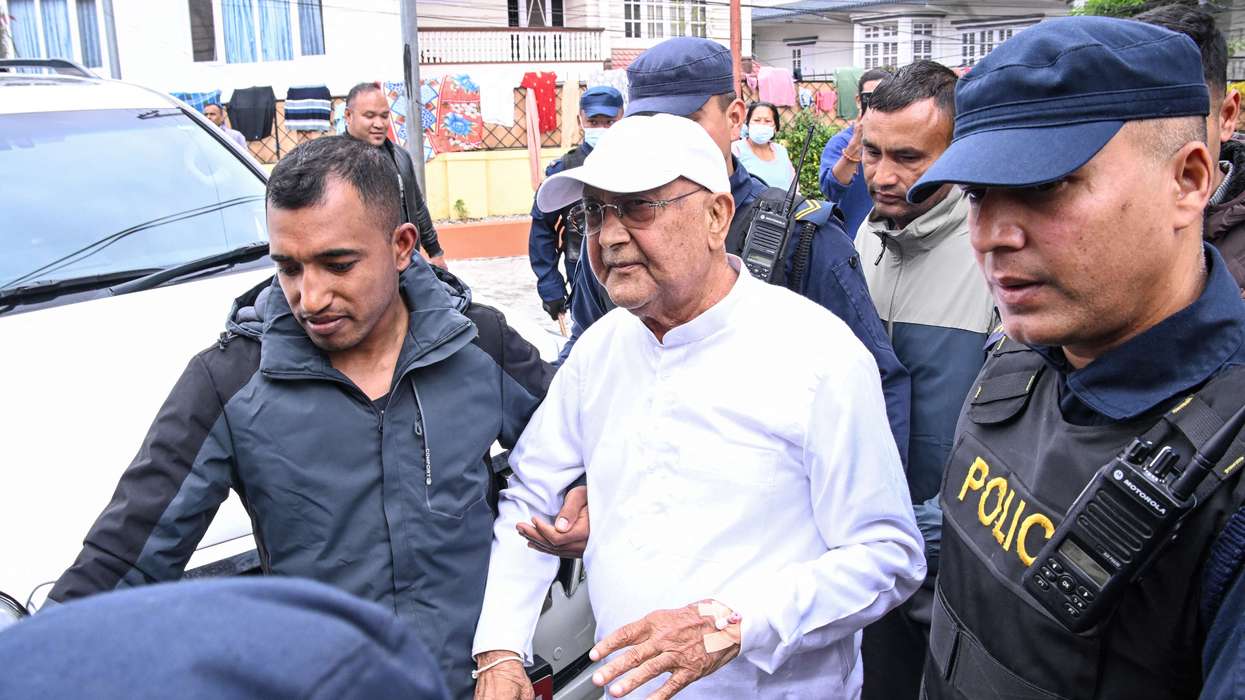

A NEPAL court on Sunday extended by five days the detention of former prime minister KP Sharma Oli and his home minister after their arrest over alleged involvement in a crackdown on the 2025 protests that ousted him.
Oli, 74, and former home minister Ramesh Lekhak were arrested in pre-dawn raids on Saturday, a day after prime minister Balendra Shah was sworn in following the first elections since the September uprising.
They were arrested over their alleged role in the protest crackdown that killed at least 76 people. Neither has been charged, and both deny responsibility for the violence.
"The court has decided to permit a five-day extension," Kathmandu District Court information officer Deepak Kumar Shrestha told AFP.
Shrestha said the court has also directed that the former prime minister receive the medical care he requires.
Oli appeared in court via video link from a hospital on Sunday, where he was admitted on Saturday following a procedural check-up.
Police said Oli has heart and kidney issues. AFP reporters saw him being taken to a hospital on Saturday after his arrest, surrounded by a heavy police guard.
The Supreme Court is due on Monday to consider a petition seeking the release of Oli and Lekhak, court spokesman Arjun Prasad Koirala said.
The arrests followed a recommendation by an inquiry commission that the four-time former prime minister and other officials be prosecuted for failing to stop security forces from firing on demonstrators.
The report said statements given to the commission by Oli and Lekhak, suggesting they did not know about the violence, were an attempt to shift responsibility and amounted to "criminal negligence".
It recommended that they be investigated under a law dealing with death caused by recklessness.
Former energy minister Deepak Khadka was also detained on Sunday "in a case relating to money laundering", Central Investigation Bureau spokesman Shiva Kumar Shrestha said.
'Beginning of justice'
The unrest in early September began over a brief social media ban and widened due to anger over economic hardship.
It spread nationwide the following day as parliament and government offices were set ablaze, leading to the collapse of Oli's government.
Oli's CPN-UML Marxist party called the arrests "a revengeful act" and called for protests.
Police barricaded roads on Sunday and used batons to push back more than 100 of Oli's supporters near the court in Kathmandu, an AFP photographer said.
Supporters said they had submitted a letter demanding his release.
"The prime minister has made a hasty decision that could push the country towards confrontation," said Tejila Thapa, 44, a supporter of Oli.
"This is a wrong decision, and it must be corrected."
Home minister Sudan Gurung said the arrests of Oli and Lekhak were "not revenge against anyone, just the beginning of justice".
Shah, a 35-year-old rapper-turned-politician, and his Rastriya Swatantra Party came to power on a platform of youth-driven political change.
He defeated Oli in his constituency.
Shah's government has announced a 100-point reform agenda, including investigations into the assets of politicians and senior officials.
Before the uprising, Nepal ranked 107th out of 180 countries on Transparency International's Corruption Perceptions Index.
The World Bank said 82 per cent of Nepal's workforce is in informal employment, with GDP per capita at $1,447 in 2024.
(With inputs from agencies)