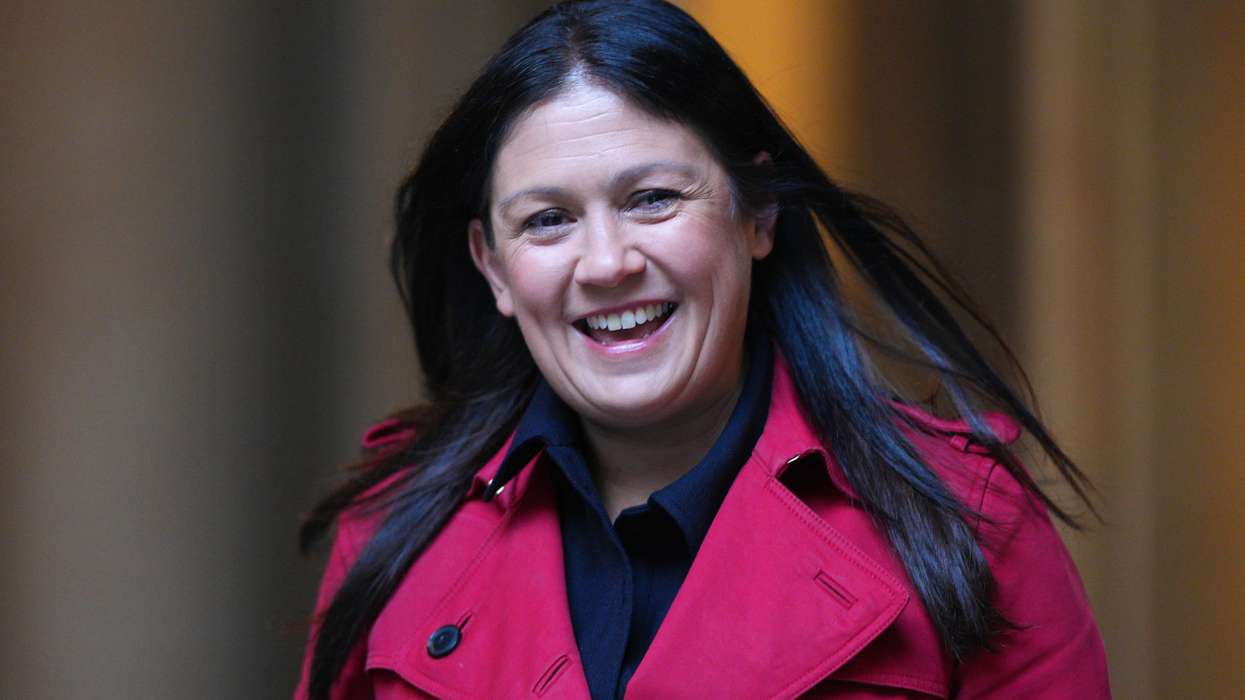

Lisa Nandy, who has inherited the best of two cultures from an Indian father and an English mother, has become one of the key members of Sir Keir Starmer’s cabinet, so far as the British Asian community is concerned.
As secretary of state for culture, media and sport, the 46-year-old Labour MP for Wigan in Greater Manchester took an impressive arts delegation to India in May last year and signed a new “Cultural Cooperation Agreement” with her opposite number, Gajendra Singh Shekhawat.
Nandy has the gift of being able to speak eloquently without notes. She also appears to speak from the heart – and with passion.
In an interview in her parliamentary office in Whitehall, she spoke about the influence of her parents, her pride in her Indian heritage, and her determination to use culture to strengthen relations between the UK and India.
The Labour party has benefited from the fact that India gained its freedom in 1947 after Clement Attlee replaced Winston Churchill as prime minister after the 1945 general election. The first generation of Indian immigrants almost automatically voted Labour out of a sense of gratitude but that relationship fell away when the Conservative party adopted more progressive policies under Edward Heath (he admitted Ugandan Asian refugees in 1972), David Cameron (he wanted a “special relationship” with India), and Boris Johnson (he had Indian relatives though his former wife Marina Wheeler). The Tories appealed to the aspirational instincts of increasingly affluent and well-educated British Indians, with the whole process culminating with Rishi Sunak becoming the country’s first Indian origin prime minister. But the Tory links with British Indians are now being tested as the party moves to the right under pressure from Nigel Farage’s Reform party.
As Labour seeks to rebuild its relationship with British Indians, Nandy has a crucial role to play. This may be hard to believe but in the 81 years since Attlee became prime minister, Nandy is the first Labour cabinet minister of Indian origin.
“There have been cabinet ministers of Asian origin and Indian origin – especially prime minister Rishi Sunak – but on the Labour side, I am the first and the only one so far,” she confirmed.
She wanted to reassure the British Indian community they had a good friend in her. Starmer would be wise to recognise Nandy’s standing and growing influence.
Lisa Eva Nandy was born in Manchester on 9 August 1979 to Dipak Nandy, a “Marxist intellectual” who arrived from Calcutta in 1956 at the age of 20, and (Ann) Luise Byers, a daughter of Lord Byers, leader of the Liberals in the House of Lords for 19 years. Dipak, who became a prominent campaigner in the struggle for equality, became the founder director of the Runnymede Trust.
His daughter said her father became an adviser to the home secretary Roy Jenkins and helped with the drafting of the second Race Relations Act.
“And then my dad moved to Manchester with my mum to set up the Equal Opportunities Commission,” she said.
In May Dipak will turn 90. “Obviously, that takes its toll physically, but mentally, he’s still sharp as a tack. He lives not too far from me in the Northwest now. He follows my progress with interest.”
Her father discussed meeting Martin Luther King Jr and the 1976 Race Relations Act when he appeared on Radio 4’s The Reunion in 2007.
“Yes, he knew Martin Luther King, learning some of the techniques from the civil rights movement in the United States,” said Nandy.
She herself experienced racial tensions in Manchester: “When we were younger, there were a lot of really difficult battles. It had a huge impact on us as kids because we were watching all of this playing out in real time in Manchester in the 1980s. You had groups like Combat 18 (a neo-Nazi terrorist organisation) patrolling the streets. You had politicians, particularly in the Conservative government, fanning the flames of division. Families like ours were being scapegoated. Even in the school playground, you would feel a lot of that. It’s impossible not to become political growing up in that sort of environment.
“My father was away from home a lot but we knew what he was doing. One of the reasons that I am still very connected to my Indian roots is my mum. My mum felt that it was a real gift to us to grow up with Indian heritage and be able to see to see things differently. She worked particularly hard to make sure that we were in touch with our Indian roots and knew our Indian family. Although my dad very much supported that, it was very much my mum, who was English – born and brought up in Surrey – and my uncle Prabir, who made sure we knew our Indian family. We visited India, and they came to stay when they came over here.
“The first time I went to India was as a teenager. It was after I had done my ‘A’ levels. I spent six months there on my gap year. I went to stay with family in Calcutta (Kolkata), travelled up to Darjeeling to see where my dad went to school, and then over to Delhi. I went back with my dad a few years later.”
She has discussed generational changes in philosophy with her father: “His generation does feel quite pessimistic. My generation grew up with a sense that the arc of history always bends towards progress. What we found in recent years is that is absolutely not the case. All of that progress can be unravelled and undone. I’ve discussed that with my dad a number of times. One of the things he said to me was that in the end, every generation has to fight these battles anew, and the battle for progress is never won. You have to pick up the baton. You have to fight those battles afresh. I really have taken that to heart. One of the great gifts that they gave to us was that as a mixed-race kid growing up in Manchester, I didn’t have to be defined by my heritage or my background or the colour of my skin. I don’t think you can say that now for children growing up today, and I’m really determined that we’re going to change that.
“I talked at one reception about when Bend It Like Beckham came out, and seeing a young girl of Indian heritage depicted on screen. It felt it was the first time I’d seen somebody who looked like me and my friends, who was being depicted not for being Indian, but for being a brilliant footballer. It felt like something had shifted. These role models matter. Most of all what matters is that you use that as a catalyst to open the door for people who come after you.”
She moves on to being in the cabinet.
“One of the things that we all feel very acutely sitting around that cabinet table is that a number of us are the first. It’s our job to make sure that we’re not the last. I’m keen to encourage young people growing up in this country, particularly those of Indian or mixed heritage, where they might have looked at the people sitting around that cabinet table and thought, ‘That’s not for me.’ I’m keen to show that it is for them. I remember some of the role models that we had when I was growing up. The women who were pioneers, who had made it into the cabinet and smashing glass ceilings, made a real impact.”
This is Nandy’s personal background against which to analyse the UK-India “Cultural Cooperation Agreement”, which was a precursor to the Free Trade Agreement signed in July last year when Starmer and the Indian prime minister Narendra Modi met at Chequers.
“One of the things that we wanted to do was to make sure that the Indian government understood how central we see our relationship on culture, and how much we want to deepen our cooperation and our friendship,” the culture secretary reasoned. “The cooperation agreement we signed was an act of friendship.”
“We’ve already done quite a bit of work around touring museum exhibitions and collections together. Our science museums are working together. In a world that feels increasingly fractured, helping people to understand one another is really important, but culture is such a positive way to do that.”
She revealed she had chatted about UK-India relations with Sunak: “He and I have discussed this a number of times. He’s been very helpful to us as a government in terms of strengthening and deepening those connections. It’s something our government is determined to do. There is a cross-party grouping of people who see our connection to India and the Indian community here in the UK as a great strength and asset for us.”
During her visit to India last year, Nandy delivered a keynote speech at the World Audio Visual and Entertainment Summit (WAVES) in Mumbai, which was also attended by the Indian prime minister.
“It was fascinating to me to get a feel for Mumbai for the first time,” said Nandy, who wore British Indian designer outfits.
She referenced several British Indian personalities of note, among them Sophia Duleep Singh, Sunak, Charli XCX, Nikita Chauhan, Baroness Shriti Vadera, Chila Burman and Gurinder Chadha.
“My ambition is for our cooperation to lead a cinematic revolution that has impacts far beyond the screen. Already we’re seeing success. British crews working on Indian sets, Indian directors bringing their vision to British audiences and streaming services that offer a bridge between our two cultures. Given the size of our markets and the scale and quality of our TV and film sectors, I know we can be more ambitious.”
She called the agreement a treaty: “What breathes life into this treaty is the passion and the human connections across our thriving creative industries. In this new era where at times, it feels we’ve lost the ability to understand one another across the world, let us use our strengths as the greatest storytellers in the world to bring nations together. Let’s empower the next generation of storytellers from Mumbai to Manchester, Kolkata to Cardiff, Bangalore to Belfast, Lucknow to Leicester and Delhi to Dundee. In film, fashion, music and arts, Britain and India lead the world.”
She visited Yash Raj Films Studios, where many Bollywood blockbusters have been shot. She met female cricketers at the Sharad Pawar Sports Club, and was also introduced to football coaches involved in the Premier League Primary Stars programme in India, a partnership between the Premier League and the British Council to improve physical and sports education in primary schools.
She pledged: “Together, we will light up the world.”
ends