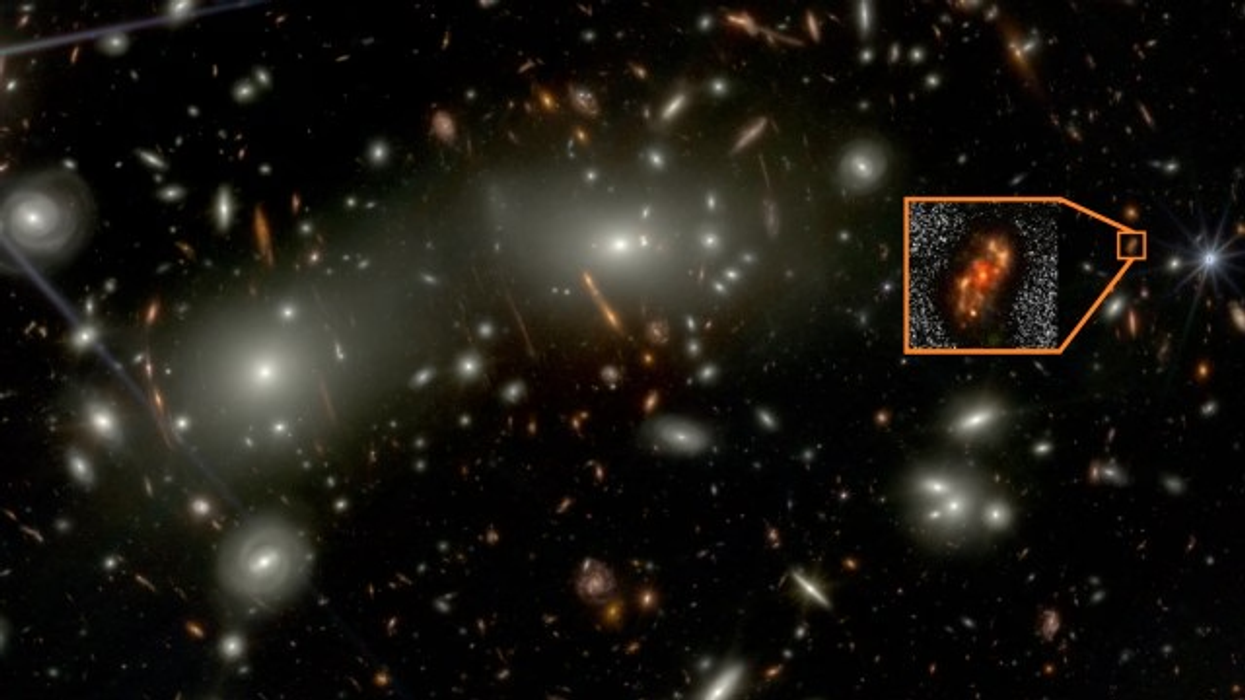

TWO researchers from an astrophysics institute in India's Pune have identified one of the most distant spiral galaxies observed so far, a large system that existed when the universe was about 1.5 billion years old. They said the discovery supports growing evidence that the early universe was more evolved than earlier believed.
The galaxy, named Alaknanda after a Himalayan river, is described as a grand-design spiral that challenges current ideas on how early complex galactic structures formed. One of the researchers said, "Finding such a well-formed spiral galaxy at this early epoch is quite unexpected. It shows that sophisticated structures were being built much earlier than we thought possible."
Alaknanda existed when the universe was only 10 per cent of its present age and appears similar to the Milky Way. The findings have been published in the European journal Astronomy & Astrophysics.
Researchers Rashi Jain and Yogesh Wadadekar from the Pune-based National Centre for Radio Astrophysics (NCRA-TIFR) spotted the galaxy using NASA's James Webb Space Telescope (JWST). Jain said, "Alaknanda lies at a redshift of about 4, meaning its light has travelled more than 12 billion years to reach Earth." She added, "We are seeing this galaxy as it appeared just 1.5 billion years after the Big Bang. Finding such a well-formed spiral galaxy at this early epoch is quite unexpected. It shows that sophisticated structures were being built much earlier than we thought possible."
With JWST's infrared capability, the researchers found that Alaknanda has about "10 billion times the mass of the sun in stars" and is forming new stars at around 63 solar masses per year, which is nearly 20 to 30 times the Milky Way's current rate, according to a release.
Before JWST, astronomers had assumed early galaxies were chaotic and clumpy, and that stable spiral structures appeared only after several billion years. Models suggested early galaxies were too "hot" and turbulent to form ordered disks with spiral arms, the release said.
Wadadekar said, "Alaknanda tells a different story. This galaxy had to assemble 10 billion solar masses of stars and build a large disk with spiral arms in just a few hundred million years. That's incredibly rapid by cosmic standards."
The discovery adds to JWST findings indicating that the early universe was more evolved than previously thought. According to the release, "While other disk galaxies have been spotted at similar distances, Alaknanda is among the clearest examples of a spiral galaxy with well-defined arms at such a high redshift."
Jain said the team named the galaxy after the Alaknanda river because of its link to the Milky Way. "Just as the Alaknanda is the sister river of the Mandakini, which is the Hindi name for our own Milky Way, we thought it fitting to name this distant spiral galaxy after the Alaknanda river," she said.
The researchers said that although Alaknanda's photometric redshift is well-established, further observations with JWST's NIRSpec instrument or the Atacama Large Millimeter/submillimeter Array (ALMA) are required to measure its disk rotation. "These measurements will reveal whether the galaxy's disk is 'cold' and orderly or 'hot' and turbulent, helping scientists understand how its spiral arms formed," they added.