
IT HAS been a dramatic month for live international sport.
South Africa’s decisive Test series win over India – their first on Indian soil for a quarter of a century – confirmed that India’s once mighty team, in transition between generations, look anything but invincible now.
The Ashes began with Australia and England seeming to mistake Test cricket for a game of skittles – with the opening Test over in just two days, with England throwing away what had seemed a dominant position with an all too familiar batting collapse.
Scotland qualified for the men’s football World Cup for the first time since 1998 after one of the most dramatic games in their history against Denmark – snatching victory from the jaws of elimination with two goals deep into injury time.
The fans’ celebrations at a raucous Hampden Park were even picked up on the Richter scale by the British Geological Survey’s Glasgow’s observation post as the equivalent of a very small earthquake.
 Sunder Katwala
The footballing stakes were lower at Wembley last Saturday (29) night as England’s women hosted a friendly international with China. Yet, more than 70,000 fans turned up for the match. I was there with my 13-year-old daughter. She had turned 10, when we followed the Lionesses to Brighton and Southampton as they hosted and won the European Championship for the first time in 2022. So, we wanted to be part of what was presented as a “homecoming tour” with matches in Manchester, Derby and Southampton to celebrate the Lionesses becoming European Champions again this summer. It was billed as a clash of continental champions, though England were five-nil up at half-time, and won eight-nil. Brazil, who are due to host the 2027 women’s World Cup, had beaten England in Manchester.
That remarkable level of support outside of a tournament makes England’s Lionesses one of the best supported international teams in men’s or women’s sport. Family-friendly ticket prices showed a big market if it is affordable to experience a big, international match.
Women and girls made up a narrow majority of the crowd. I saw plenty of young British Asian children of primary and secondary school-age among the families at the match, as the age-range contributed to a noticeably more ethnically mixed crowd.
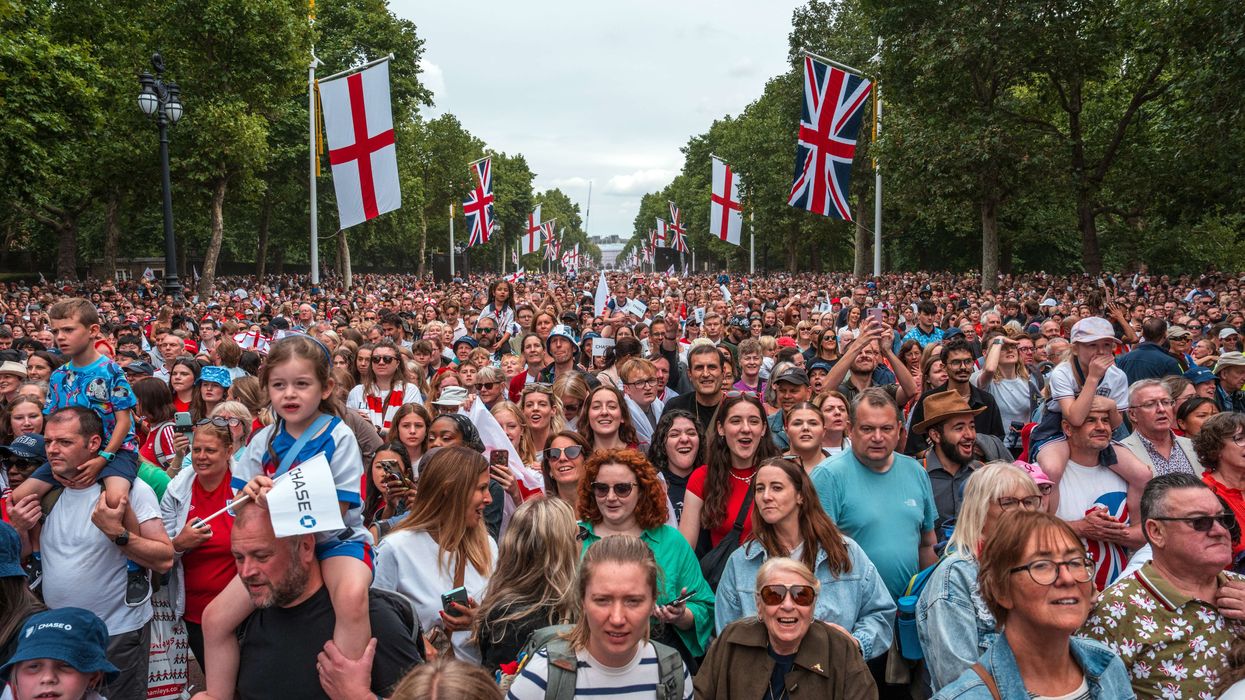
Celebratory banners on Wembley Way lauded – with slogans including “Proper England” over a picture of the massive crowds who had thronged the Mall to see the Lionesses bring the trophy home. The men’s World Cup draw this weekend will make it possible to start to visualise what England’s men would need to do to emulate the women. This could be a strange World Cup – co-hosted by the US, Mexico and Canada. US president Donald Trump believes he deserves the Nobel Peace Prize, so FIFA have invented a FIFA Peace Prize to flatter his ego. Perhaps it is intended to persuade him not to invade his co-hosts, nor to deport visiting players and supporters while the tournament is on. An expanded tournament of 48 teams offers some fairytale moments – as tiny Curacao go to the tournament, alongside Haiti and Jordan. But it also creates the longest ever tournament, taking a month to send 12 teams home before, so it may take some time for the anticipation of next summer’s tournament to build.
Our England flag had come out of the wardrobe for the match for the trip to Wembley, too. My daughter’s English class had been writing about flags, looking at John Agard’s poem which opens “what’s that fluttering in a breeze. It’s just a piece of cloth”. Flags matter: we can all recognise how intent and context matter to how they are received. It would be hard to find a more inclusive pride and patriotism than the way in which the Wembley crowd were cheering on the Lionesses.
Where I live in Dartford, St George’s flag bunting reflects the inclusive spirit of the local St George’s Day parade, which is as diverse as the nearby schools. But when lamp-posts are drafted to carry flags – inadvertently at half-mast – it sends a more territorial signal, closer to Belfast than Birmingham. That feels very different from flags on people’s homes or in car windows during major tournaments.
The same red cross daubed on our street sign or as graffiti has a more menacing intent and reception.
The lesson from the Lionesses is not to retreat or reject flags, but to show how they can bring people together. A shared pride can unite England – in a way that prejudice never could. We should show how to use the moments of next year – not just the World Cup, but also on St George’s Day to show how it is possible beyond sport to show how an inclusive pride can defeat prejudice and help to bring our diverse country together.

Anurag Bajpayee's Gradiant: The water company tackling a global crisis