
THE US strikes against Iran could severely disrupt the global supply of crude oil and send prices soaring to levels not seen in years. Iran remains just inside the world's top 10 oil producers even though its output has fallen sharply since the 1970s, hit in particular by rounds of US sanctions.
"In 1974, Iran was the third-biggest producer in the world after the US and Saudi Arabia, and ahead of Russia, producing some six million barrels per day," said Arne Lohmann Rasmussen, chief analyst at Global Risk Management.
Today, Iran produces about 3.1 million barrels per day, according to the oil-producing cartel OPEC, of which Iran is a member. This remains a significant amount, and the Islamic republic is believed to hold the world's third-largest crude reserves, cementing its strategic importance.
Additionally, Iran's oil industry is in far better shape than that of Venezuela, another country hit by years of US sanctions.
Strait of Hormuz
The main risk to the oil market remains a blockade of the Strait of Hormuz, which connects the Gulf to the Gulf of Oman and which Iran has frequently threatened to paralyse.
This waterway is by far the main shipping route connecting the wealthy oil-producing countries of the Middle East to the rest of the world.
Approximately 20 million barrels of crude oil passed through it daily in 2024, equivalent to nearly 20 percent of global liquid oil consumption, according to the US Energy Information Administration (EIA).
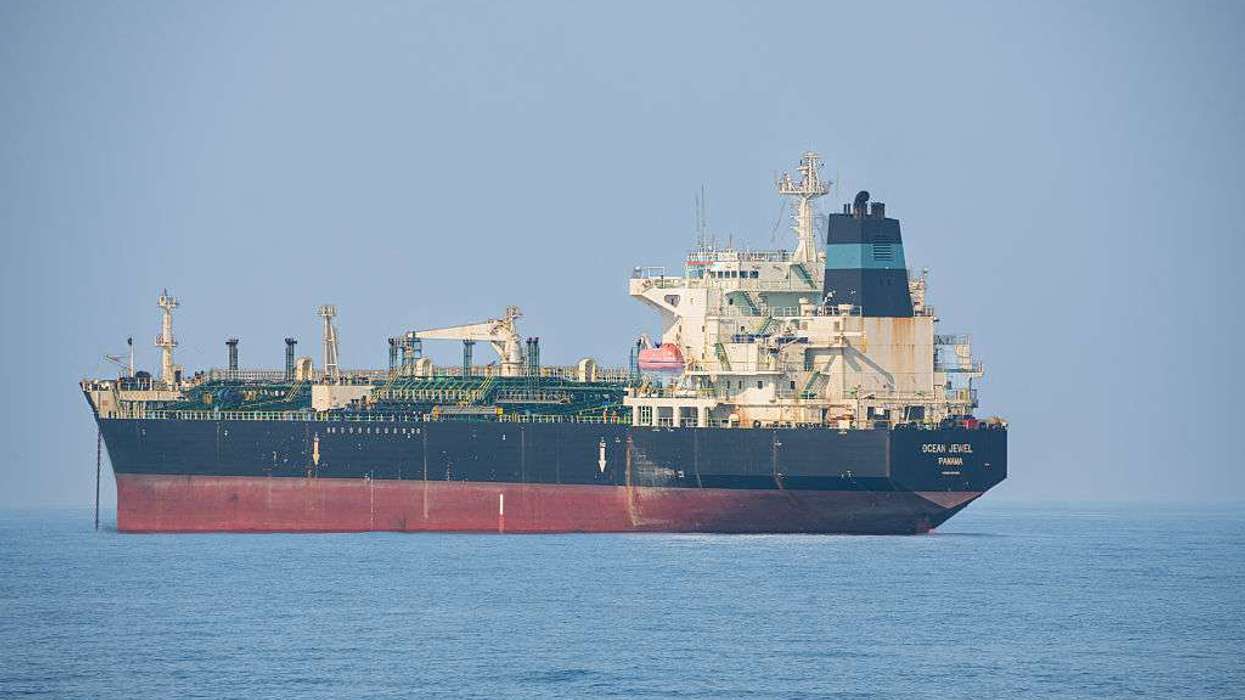 The oil/chemical tanker, OCEAN JEWEL, sails near Bandare Asaluyah, Iran, on January 27, 2026. (Photo by Sam / Middle East Images / AFP via Getty Images)
The strait is particularly vulnerable owing to its narrow width, around 50 kilometres (30 miles), and its shallow depth, which does not exceed 60 metres (200 feet).
"Even a doubt about security in the Strait would prompt many vessels, for insurance reasons, to face difficulties transiting, as premiums would rise sharply," said Rasmussen.
According to Saxo Bank analyst Ole Hansen, "only Saudi Arabia and the United Arab Emirates possess meaningful bypass infrastructure". The route could transport a maximum of 2.6 million barrels daily, noted the EIA.
Highly profitable oil
Iranian crude is relatively easy and cheap to extract, with production costs as little as $10 per barrel, making it particularly profitable, Rasmussen said. Only Saudi Arabia, Iraq, Kuwait and the United Arab Emirates enjoy similarly low production costs.
By comparison, major western producers like Canada and the US typically face costs of $40 to $60 per barrel. With such low costs, Iran gains disproportionately from high global prices, a crucial factor for an economy heavily reliant on oil revenues.
US sanctions imposed since the 1979 Islamic Revolution have left Iran with few export options -- especially after Trump revived a "maximum pressure" policy on Tehran upon his return to the White House.
Last year, Washington targeted Chinese "teapot" refineries, which operate independently of state-owned oil companies, accusing them of buying Iranian crude.
China, however, continues to buy Iranian oil at below-market prices. Iran exports between 1.3 and 1.5 million barrels daily, with more than 80 per cent of the total bound for Chinese refineries owing to US sanctions, according to Hansen.
Impact on Iran neighbours
Iran's neighbours, from Gulf states to Turkey and Pakistan, fear an Iranian response since their hosting of US military sites places them in the firing line. They "know they are vulnerable because the Iranians have enough basic intermediate-range missiles that allow them to strike vital points" in the worst-case scenario, noted Pierre Razoux, director of studies at the Mediterranean Foundation for Strategic Studies.
At-risk infrastructure includes hydrocarbon hubs as well as electrical power and seawater desalination plants, he added.
Soaring oil prices meanwhile risk a return to soaring inflation, hurting the global economy.
Crude reaching $100 per barrel for the first time since the start of Russia's invasion of Ukraine in February 2022 could also hurt Trump in the midterm elections at the end of the year, especially as he has promised American voters cheap energy.
(AFP)