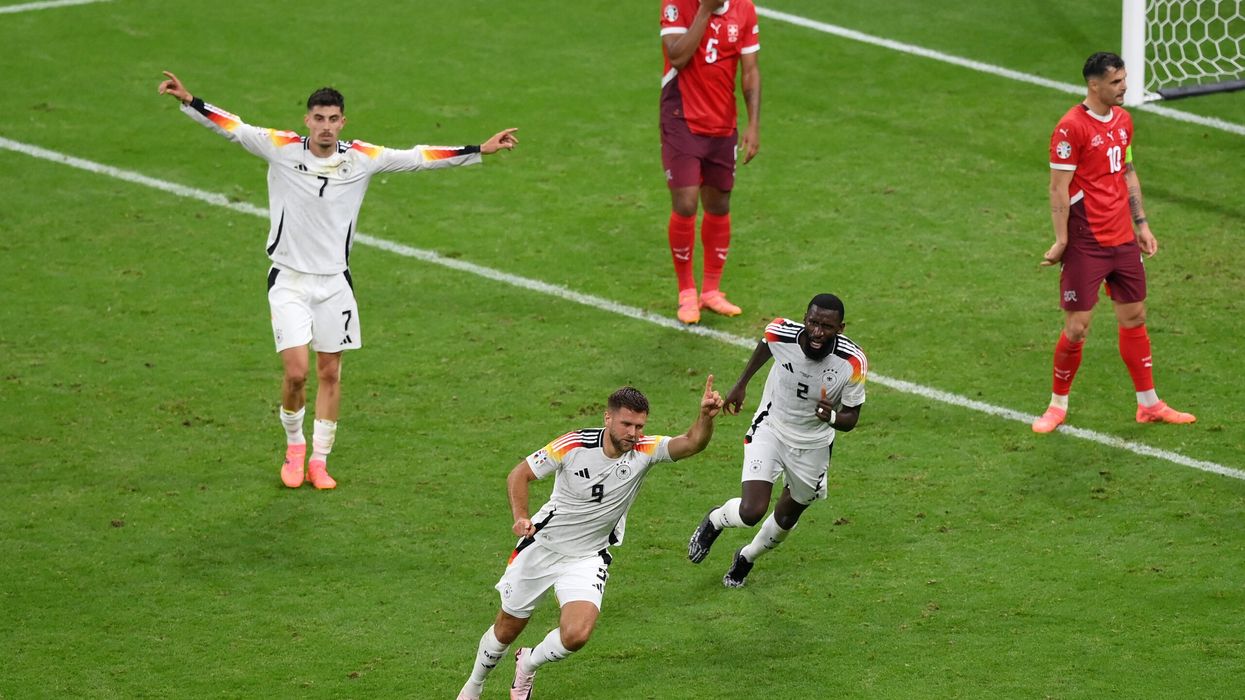

Germany finished top of Group A at Euro 2024 after Niclas Fuellkrug's stoppage-time goal secured a 1-1 draw against Switzerland on Sunday. Hungary's Barnabas Varga suffered an injury during a 1-0 win that eliminated Scotland.
Dan Ndoye's first-half goal in Frankfurt had put Switzerland on course to overtake Germany for the top spot. However, Fuellkrug's late header ensured Julian Nagelsmann's side advanced to the last 16 in first place with seven points.
"In the end it's a well-deserved point. We did well to come back. We deserved it," Nagelsmann said. "Niclas is important for us. It's important to have players who can score decisive goals coming on as substitutes."
In Stuttgart, Varga was described as being in a "stable" condition after a second-half collision halted play for eight minutes while medics treated him. The 29-year-old was surrounded by worried teammates as red sheets were used to shield him on the pitch. He was stretchered off and taken to the hospital where he was conscious but diagnosed with a fractured cheekbone. Hungary winger Roland Sallai described the incident as a "terrible moment."
Germany, who last won the Euros in 1996, will face the Group C runners-up in the last 16, currently slated to be Denmark. Denmark play Serbia in their last group game on Tuesday.
Germany could also face Spain in a potential quarter-final clash. Switzerland, as Group A runners-up with five points, will face the second-placed team in Group B in the last 16.
"We fought, but against such an opponent it's difficult. We did a great job. It was a huge challenge," said Switzerland coach Murat Yakin.
Already through to the last 16, Germany fell behind in the 28th minute when Ndoye met Remo Freuler's cross with a close-range volley. Ndoye's first international goal was notable as both he and Freuler played for Bologna last season.
Germany's Jonathan Tah was booked, earning a ban for the first knockout game. Germany dominated possession but Ilkay Gundogan missed a close chance after Yann Sommer parried Jamal Musiala's strike. Fuellkrug's header in stoppage time secured the draw.
In Stuttgart, Scotland failed to secure the win needed to advance to the knockout stage of a major tournament for the first time. Scotland, who lost to Germany and drew with Switzerland in their first two games, were eliminated after a stoppage-time goal from Kevin Csoboth.
Steve Clarke's team took only one point from three matches. Clarke said, "I don't understand how VAR can look at that and say it's not a penalty. The over-riding feeling is to be sad for everybody that we are out."
Hungary may not advance to the last 16 despite their victory as they have only three points. The four third-placed teams with the best records from the six groups will move into the last 16.
The Varga incident overshadowed the result. Hungary coach Marco Rossi said, "The condition of Barnabas Varga is stable. Probably he will be operated on in the coming hours because he suffered a fracture. If we go through the competition, he will not be part of the team any more."
In Group B on Monday, Italy will take on Croatia, while Spain, already qualified in first place, face Albania. Italy are second in the group with three points, while Croatia and Albania both have one point.
(With inputs from AFP)