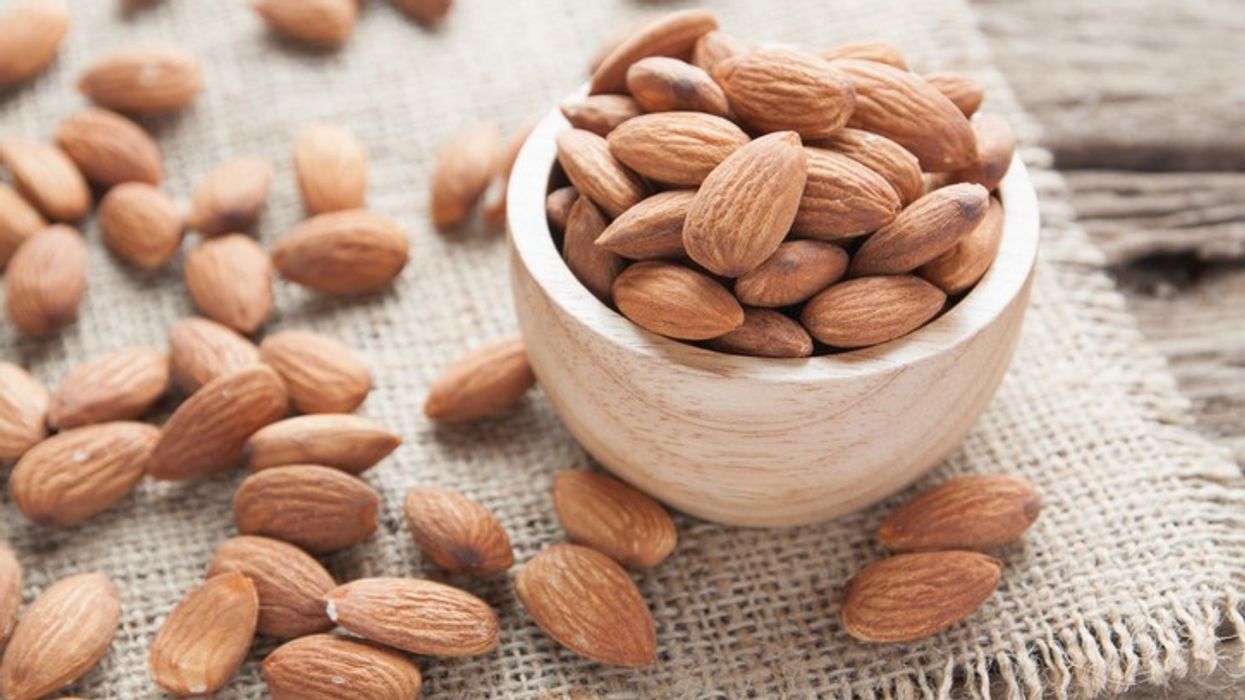

Eating almonds every day may be the ideal new year's resolution for individuals who regularly work out. Female and male participants who ate 57g almonds daily for one month had more of the beneficial fat 12,13-dihydroxy-9Z-octadecenoic acid (12,13-DiHOME) in their blood immediately after a session of intense exercise than control participants, according to a randomised controlled trial published in Frontiers in Nutrition.
This chemical, known as oxylipin (oxidised fat), is produced by brown fat tissue from linoleic acid and has a positive impact on metabolic health and energy balance.
Corresponding author Dr David C Nieman, a professor and director of the Appalachian State University Human Performance Laboratory at the North Carolina Research Campus, said: "Here we show that volunteers who consumed 57g of almonds daily for one month before a single 'weekend warrior' exercise bout had more beneficial 12,13-DiHOME in their blood immediately after exercising than control volunteers. They also reported feeling less fatigue and tension, better leg-back strength, and decreased muscle damage after exercise than control volunteers."
Four-week dietary supplementation with almonds
The clinical trial involved 38 men and 26 women between the ages of 30 and 65, who didn't engage in regular weight training. Approximately half were randomized to the almond diet group, and the other half to the control group, who daily ate a calorie-matched cereal bar. The researchers took blood and urine samples before and after the four-week period of dietary supplementation.
Performance measures included a 30 second Wingate anaerobic test, a 50 meter shuttle run test, and vertical jump, bench press, and leg-back strength exercises. Additional blood and urine samples were taken immediately after this 90 minute session of 'eccentric exercise' and daily for four days afterwards.
After each blood draw, the participants filled out the 'Profile of Mood States' (POMS) questionnaire to quantify their mental state, and rated their delayed onset muscle soreness - that is, pain and stiffness felt after unaccustomed or strenuous exercise - on a 10-interval scale.
As expected, the 90 minute exercise led to an increase in the volunteers' self-reported feeling of muscle damage and muscle soreness, as well as an increased POMS score, indicating self-reported decreased vigor and increased fatigue, anxiety, and depression.
The exercise also resulted in transient elevated levels of pro-inflammatory cytokines such as IL-6, IL-8, IL-10, and MCP-1 in the blood, consistent with minor muscle damage.
However, these changes in cytokines were equal in the almond and cereal bar groups.
Differences in two DiHOME concentrations
Importantly, immediately after exercise, the concentration of the beneficial 12,13-DiHOME was 69% higher in blood plasma of participants in the almond group than in participants in the control group. 12,13-DiHOME is known to increase the transport of fatty acid and its uptake by skeletal muscle, with the overall effect of stimulating metabolic recovery after exercise.
The reverse pattern was found for another oxylipin, the mildly toxic 9,10-Dihydroxy-12-octadecenoic acid (9,10-diHOME), which was 40% higher immediately after exercise in the blood of the control group than in the almond group. Unlike 12,13-DiHOME, 9,10-diHOME has been shown have negative effects on overall health and the body's recovery to exercise.
Polyphenols in almond skin may be key
Nieman and colleagues concluded that daily consumption of almonds leads to a change in metabolism, downregulating inflammation and oxidative stress from exercise and enabling the body to recover faster.
"We conclude that almonds provide a unique and complex nutrient and polyphenol mixture that may support metabolic recovery from stressful levels of exercise. Almonds have high amounts of protein, healthy types of fats, vitamin E, minerals, and fiber. And the brown skin of almonds contains polyphenols that end up in the large intestine and help control inflammation and oxidative stress," said Nieman.
- ANI






 Sunder Katwala
 Reform UK spokesperson for home affairs, Zia Yusuf, attends a press conference with Leader of Reform UK Nigel Farage at The Clermont London Hotel on November 2, 2026 in London, United Kingdom. (Photo by Ben Montgomery/Getty Images)
 The decline has renewed calls for tighter immigration controls from the Conservatives.


