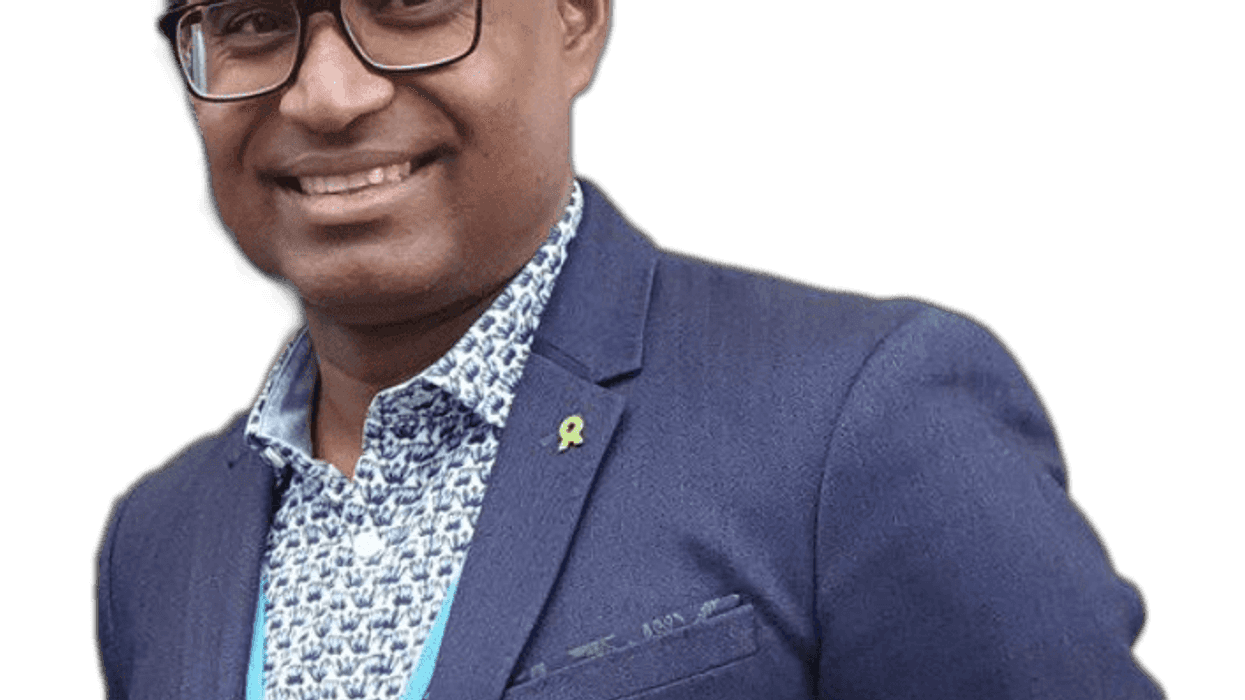

AID group Oxfam is known for its hard hitting reports that document the growing economic inequality around the world, and for Dhananjayan (Danny) Sriskandarajah, the chief executive of Oxfam Great Britain, this issue has been his lived experience.
Sriskandarajah was born in Sri Lanka, to Sri Lankan Tamil parents, in 1975, and initially raised in a rural community without electricity or running water. As ethnic tensions escalated to a brutal civil war in 1983, his family had moved to Papua New Guinea and then to Australia, where he went to school and university.
He arrived in the UK in 1998 as a Rhodes Scholar and completed his Masters and Doctorate in international development at University of Oxford.
“The contrast between the wealth and opportunity of life in the Global North with my early years in rural Sri Lanka has given me a passion to take on the root causes of poverty, and I am committed to Oxfam’s long-standing approach to speaking out and taking action against injustice,” he wrote in an Oxfam blog.
The charity’s report this year, titled Survival of the Richest, has revealed that billionaires had doubled their wealth over the last 10 years, with the wealthiest one per cent gaining 74 times more than the bottom 50 per cent. The report called for a permanent tax increase on the richest one per cent, with a minimum 60 per cent tax on their income from labour and capital, offering stark comparisons that hit the bull’s eye to drive the point.
Citing a report by the US investigative news group ProPublica, Oxfam said many of the world's richest people paid hardly any taxes, with Tesla boss Elon Musk facing a ‘true tax rate’ of just 3.2 per cent between 2014-2018 and Amazon founder Jeff Bezos paying less than one per cent. In contrast, Aber Christine, a market trader in Northern Uganda who sells rice, flour and soya, who makes $80 (£60) a month in profit, pays a tax rate of 40 per cent!
“Just last year, rich countries agreed a global minimum effective corporate tax rate of 15 per cent for large multi-national enterprises. They should extend this to cover high-net worth individuals, ban anonymous shell companies used by the rich to hide their wealth and invest in better global tracking of who actually owns assets,” Sriskandarajah wrote in an article for the Daily Express, coinciding with the launch of the Oxfam report.
“And the time is now, not only because of the scale of need – the parlous state of public finances and the devastating hardship caused by rapidly rising poverty levels – but because the public demand it.”
Before joining Oxfam GB in January 2019, Sriskandarajah was the secretary general of CIVICUS, the Johannesburg, South Africa-based alliance of civil society organisations with members in more than 180 countries, serving from January 2013. In this role he regularly represented civil society at international fora including the UN General Assembly and the World Economic Forum.
He first made his mark in supporting citizen action globally at the Royal Commonwealth Society (RCS), a UK-based international civil society network with members and branches in more than 40 countries, where he has been director general since January 2009. He was the first non-British and youngest ever head of the RCS, which is founded in 1868, and he led a complete overhaul of the organisation and its profile. During this time, he was seconded to serve as interim director of the Commonwealth Foundation, the only intergovernmental development agency with a sole remit to support civil society, where he steered the organisation through a restructure.
Previously, he was deputy director of influential think tank the Institute for Public Policy Research. Long recognised as an influential researcher and thinker, particularly on migration issues, he has authored several books and articles on international migration and economic development, and his works include The Returns of Peace in Sri Lanka: The development cart before the conflict resolution horse? (2003), Brits Abroad: Mapping the scale and nature of British emigration (2006), Britain's Immigrants: An economic profile (2007) and Global Challenges, Local Responses (2019).
He was the first Asian Australian to win a Rhodes scholarship, and he studied at Magdalen College, a constituent college of the University of Oxford. In 2012, he was named a Young Global Leader by the World Economic Forum.
He was appointed by the UN Secretary General in May 2015 to a nine-person group of experts, the High-Level Panel on Humanitarian Financing, to examine humanitarian financing challenges and identify ways in which the gap between rising needs and the resources available to meet them can be closed.
Later in July 2018, he was nominated to the UN Secretary General's High Level Panel on Digital Cooperation, which was convened to provide recommendations on how the international community could work together to optimise the use of digital technologies and mitigate the risks. In 2019, he was announced as a member of the World Economic Forum’s Global Future Council on Global Public Goods in the Fourth Industrial Revolution.
He serves as a trustee at Guy's & St Thomas' Foundation, the key charity partner of Guy's and St Thomas' NHS Foundation Trust, and the Disasters Emergency Committee, which brings together 15 leading UK aid charities to raise funds quickly and efficiently at times of crisis overseas. He has previously been a trustee of The Baring Foundation, Comic Relief, and Praxis Community Projects.
A longtime resident of the UK, and married to a Trinidadian, Sriskandarajah is a true global citizen, actively playing his part in trying to forge a radically better world.