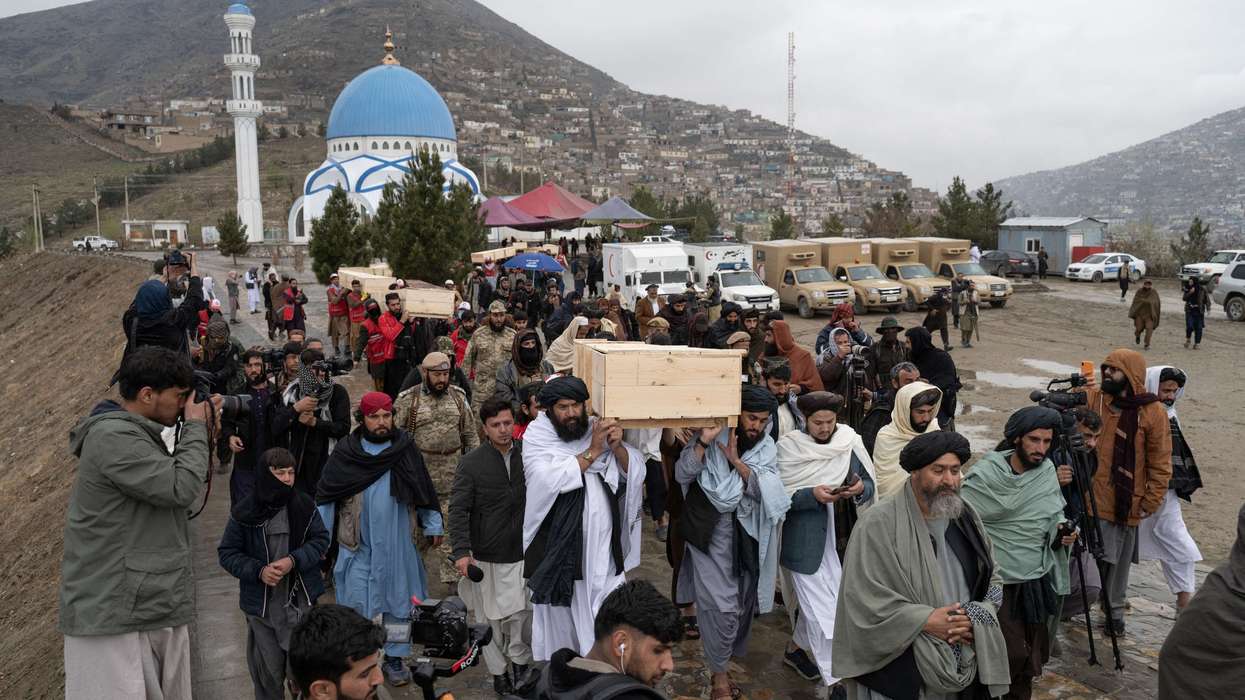

THE AFGHAN government said on Tuesday that around 400 people were killed in a Pakistani air strike on a drug rehabilitation centre in Kabul, calling it the deadliest attack in the recent violence between the two countries.
Hundreds more were reported wounded after the facility was hit on Monday night. Buildings used to treat people for addictions to marijuana, amphetamines and other narcotics were flattened.
There was no immediate independent verification of the toll, but AFP reporters saw at least 30 bodies taken from the site on Monday night. More than 65 bodies were seen being removed on Tuesday as rescuers searched through the rubble.
"The toll is not final as the rescue operation is still going on, but we have around 400 martyrs and more than 200 wounded," said health ministry spokesman Sharafat Zaman.
Interior ministry spokesman Abdul Mateen Qani gave a toll of "408 killed and 265 wounded" at the same briefing.
Afghan authorities have asked families of those killed to accept their relatives being buried in a mass grave.
In Geneva, UN rights office spokesman Thameen Al-Kheetan called for a swift, independent investigation into the strike, with those responsible "held to account in line with international standards".
Pakistan's Information Minister Attaullah Tarar said Taliban government claims that Pakistan deliberately targeted the clinic were "entirely baseless".
"No hospital, no drug rehabilitation centre, and no civilian facility was targeted," he wrote on X.
"The targets were military and terrorist infrastructure, including ammunition and technical equipment storage sites and other installations linked to hostile activity against Pakistan."
Late on Tuesday, Afghan Foreign Minister Amir Khan Muttaqi said Afghanistan does not want war but would continue "proportionate and legitimate defensive measures until the other side ceases its violations".
The two sides have been in conflict for months, with Islamabad accusing Afghanistan of harbouring Islamist extremists responsible for cross-border attacks.
Search for survivors
Chairs, blankets, pieces of hospital beds and human remains were seen in the remains of the rehabilitation centre on Tuesday.
Crowds gathered outside as families searched for relatives while rescuers continued operations.
Habibullah Kabulbai, 55, arrived at the centre on Monday night looking for his brother Nawroz, who had been admitted five days earlier.
"I can't find him," he said, weeping. "What should we do? I have no words... We are helpless. This has not only happened to me but to the whole of Afghanistan."
Monday evening's attack caused panic in Kabul, with people running for cover as anti-aircraft guns fired after they broke their Ramadan fast.
"I heard the sound of the jet patrolling," Omid Stanikzai, 31, a security guard at the centre, told AFP.
"There were military units all around us. When these military units fired on the jet, the jet dropped bombs and a fire broke out."
All of the dead and wounded were civilians, he added.
Pakistan's Tarar said the six strikes conducted on Monday also hit the eastern province of Nangarhar, calling them "precise, deliberate, and professional".
'Devastating impact' -
The head of the Norwegian Refugee Council, Jan Egeland, said his organisation "saw firsthand the devastating impact on civilians and the hospital".
"Civilians and civilian infrastructure must never be targeted," he wrote on X.
The International Committee of the Red Cross (ICRC) said it had delivered emergency medical supplies after "hundreds were left wounded" in the attack.
At least 76 civilians had been killed in Afghanistan between February 26 and Monday due to the hostilities, according to the United Nations mission in the country (UNAMA).
The UN mission called for "an immediate ceasefire". Beijing, which had sent a special envoy to mediate before the strikes, said it would "play a constructive role in de-escalating tensions".
India called Monday's attack "a cowardly and unconscionable act of violence" that threatened regional peace and stability.
The EU called for "maximum restraint" from both sides, describing the strike on the Kabul medical facility as "a new and deadly escalation" of the conflict.
(With inputs from agencies)