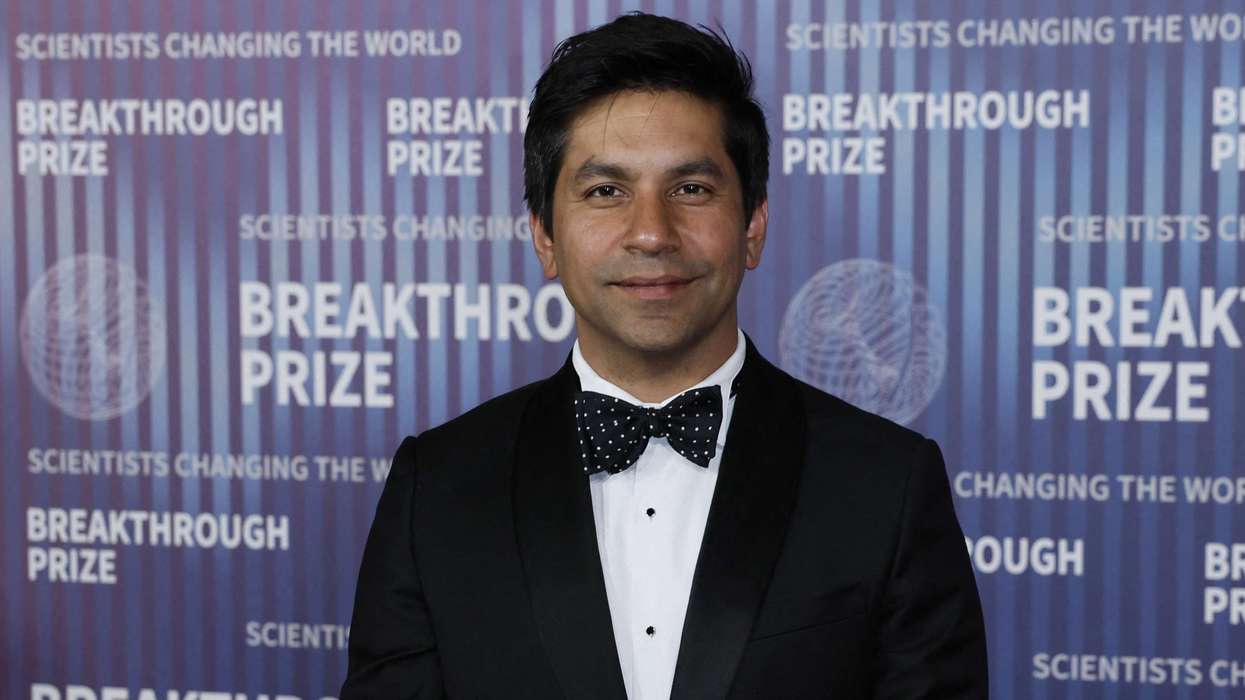

He is the man The Spectator has described as “the most important adviser you’ve never heard of”.
Varun Chandra, who has just been appointed Sir Keir Starmer’s special envoy to the US, has said he is “very proud” of his Indian heritage.
Not much is known about Chandra who appears to have tried hard to stay under the radar.
He disclosed his parents came to Britain from Bihar, one of the poorest states in India.
He was born in Britain in November 1984 and grew up in South Shields, “a lovely little seaside town in the northeast of England”.
Chandra, who joined Starmer as a special adviser on business and investment after Labour won the general election in July 2024, said: “My parents ended up moving there before I was born.”
Chandra’s new job is a key one because US is the UK’s largest single-country trading partner and bilateral UK–US trade was worth over £330 billion in the year up to summer 2025. He will be given a remarkable degree of freedom. He will be based in London, work across government and travel regularly to the US.
He has already received praise from the US commerce secretary Howard Lutnick, whom he met last month: “Always great to be with Varun Chandra. He is an excellent representative of Great Britain and a trusted friend. Our partnership is deep and the future looks bright.”
Chandra spoke about his background in a conversation, called “Principal Navigations”, with two colleagues, Simon King and Tom Bristowe, when he was managing partner from 2019 to 2024 at a firm called Hakluyt & Company.
It is described as “a London-based, high-end strategic advisory and corporate intelligence firm founded in 1995 by former MI6 officials. It advises multinational corporations and investors on risk, market entry, and political issues, often utilising a network of well-connected individuals to provide information not found through conventional research.”
Chandra sketched in his parents’ background in Bihar, which is a rich agricultural state but with historically a high level of rural poor.
“Basically, my father came from a very subsistence peasant existence in a little village, no running water, no electricity. He walked to school, and worked his way up, qualified as a doctor in Patna, which is the capital city of Bihar. Then came over to the UK when the NHS was looking for doctors.”
His parents found life in Britain to be very unsettling. “I remember the first day at school. My mother got a leaflet inviting her to a wine and cheese evening for parents. And she didn’t know what wine was. ‘Cheese? I’m supposed to turn up and eat cheese?’ Just all so alien to them. They came to this country to give my sister a better life.”
He hadn’t lost touch with his Indian side, said Chandra. “I speak fluent Hindi. I learned how to play the tabla, the Indian drums. We watched Bollywood films growing up.”
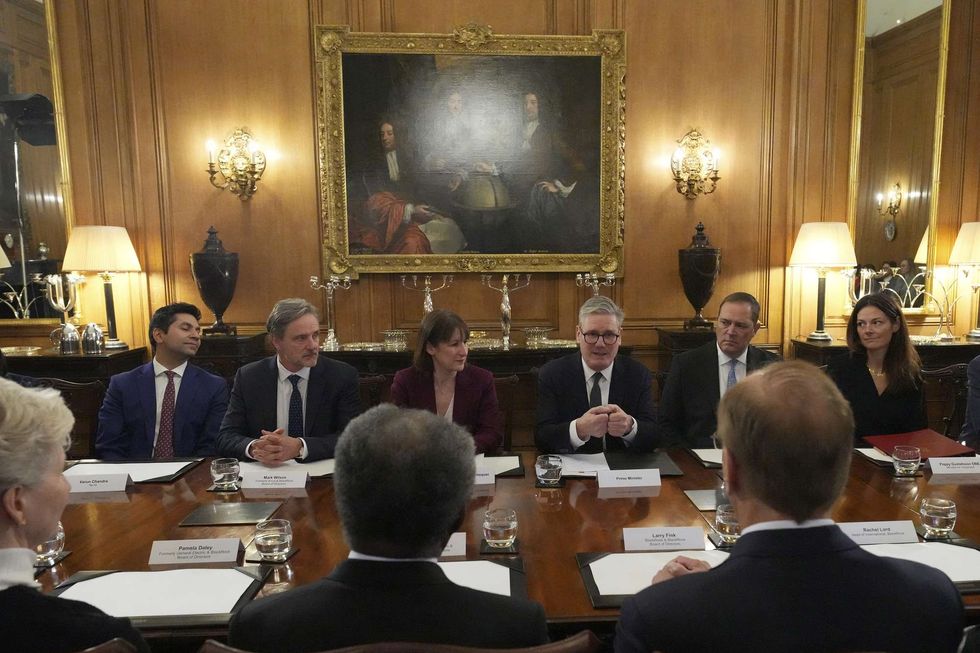 Keir Starmer sits with Varun Chandra (left), Mark Wilson (second from left), Rachel Reeves (third from left), and Poppy Gustafsson (right) as he hosts an investment roundtable discussion with BlackRock CEO Larry Fink (bottom row R) and members of the BlackRock executive board, inside 10 Downing Street in London, on November 21, 2024.Getty Images
He emphasised he was “very proud” of his Indian heritage and of India. “That’s where my parents are from. That’s my heritage, and it’s a wonderful country with a tremendous history. Of course, I love Britain. It’s given me everything I have.”
As for his work ethic, “my mum and dad have not once asked me to do anything. Never put any expectation on me, any pressure on me. What I’ve always known from a very young age is because my parents told me their story, the amount of hardship and sacrifice and struggle that they had to go through.”
He explained: “South Shields was not the most diverse place in Britain in the early 80s. My mother was going cafe to cafe. She tried to figure out how to contribute and have a job. She’s trying to sell samosas and being rebuffed. My dad suffered a lot of racism and didn’t know how to socialise, didn’t know how to go for a drink, talk about football and that sort of stuff. So he’s passed over.”
His father worked as a locum, which meant he was “away from us as a family for three weeks, trying to earn some money. I always felt obligated to make the most of every opportunity that I’ve been presented because of the sacrifices that they made for my success.”
There were no secondary schools in South Shields where anyone had “got over a (grade) C. Anyway, I got into the Royal Grammar School in Newcastle. I vividly remember the first lesson I had on my first day at school was with Mr Dickinson – it was an English lesson.
“I remember turning up with an incredibly thick Geordie accent. Young people nowadays like to say ‘like’ a lot. In the northeast, a version of that is ‘geet’. At this school, a lot of the kids had come from the local prep school. I was geeting away as I was asked a question by Mr Dickinson. All the other children started laughing at this boy who can’t speak properly, in a much thicker Geordie accent than most. And Mr Dickinson saved me. He said, ‘Let him say what he’s got to say.’ I can’t remember exactly the topic, but I got it out, and he made what I had said sound clever and thoughtful. He then replicated that through the course of the year. And I went from being quite uncomfortable in that environment to just rising and rising and rising, just in that single year. It was very easy for him to have just moved on, and that would have crushed me. It is so vividly in my mind that he did the opposite.”
When he worked in the US, he made it a point of working with a children’s charity called Sesame Workshop, “the largest philanthropic investment in childhood education in the world”. It “focuses on kids from zero to five, and gives them stuff that they would otherwise never get”.
He also talked of his strong bonds with a girl called Fiona Kelly.
“My mum encouraged me to do lots of things,” said Chandra. “She was an actress when she was in India, and wanted to encourage that in me. So from quite a young age, I ended up going to the English Shakespeare Company. It used to do touring youth theatres. I went to this about 11-12 years old, and it’s out of school. It’s just kids from all across Newcastle. And I met this girl, Fiona Kelly, who was a year older than me, and we hit it off. She was pretty and sporty and fun and vibrant. And from the age of 12 to about 18, she was like the other half of my soul. It sounds ridiculous, but that’s almost how we would talk about it. We were such close friends. At that age, it’s wonderful to have a friend like that.”
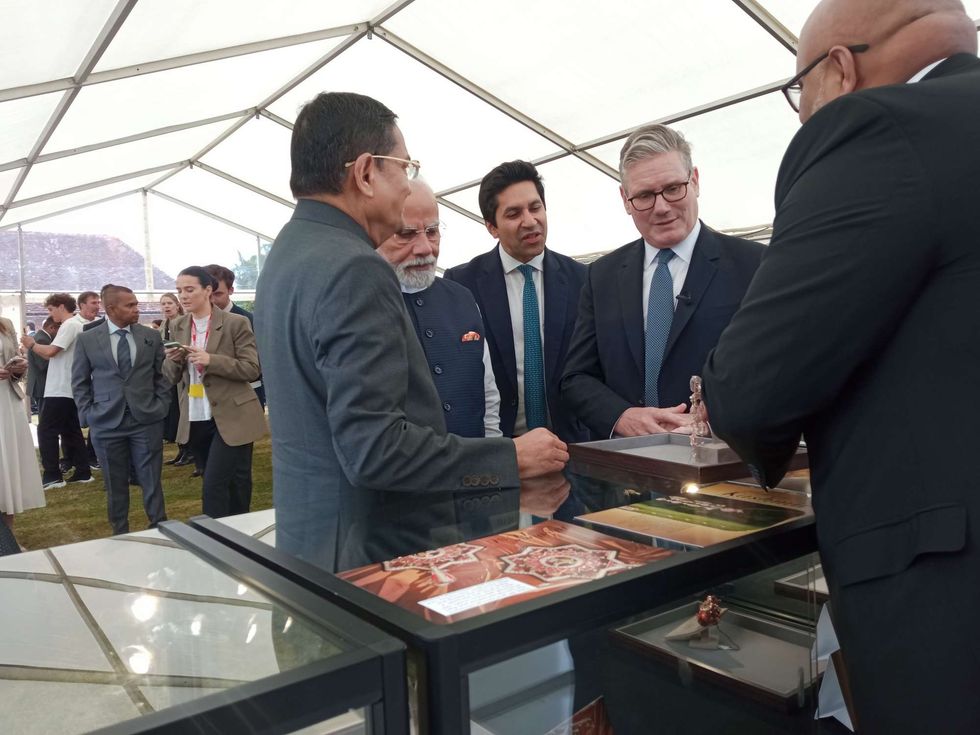 Varun Chandra with Keir Starmer and Narendra Modi during the latter's visit to the UK in July, 2025. Amit Roy
It was a period when his all boys’ school was starting to become co-educational. His friendship with Fiona gave him street cred.
“In an all boys’ school, I do think there is a problem about the way in which you interact with girls. And here I had the person I shared everything with, and she shared everything with me. The other thing is women are generally regarded as having more emotional intelligence than men. Certainly, when you’re a teenage boy, being so close to Fiona, I probably developed a bit of a skill around people and human beings I perhaps wouldn’t have had otherwise.
“When you are a 13-14-15-year-old boy, being clever or musical doesn’t get you very far with your peers. And what Fiona gave me, she was my pal, and she just protected me from the not being cool thing. And the lads in the year above me were like, ‘What the hell are you doing with her?’ And it was just hugely helpful. She’s also white, and I wasn’t. And in the northeast at that time, brown people hung out with brown people. It was very helpful in preventing me from being pigeonholed. Again, I am very proud of my heritage, but I’m British, and I’m not going to be put into a bucket.”
The Spectator has provided a bit of personal detail: “Varun won a place at Magdalen College, Oxford, where he read philosophy, politics and economics, was elected president of the Junior Common Room, played cricket, rugby, hockey and football for the college, and met Emma Jenkinson, from Swansea. She was reading history and politics, and on New Year’s Day 2013 they were married.”
Chandra stressed: “I’ve got to be clear. RGS, Newcastle, that I went to, is a great school. I also had quite a lot of confidence by this point. What Oxford gave me – my college in particular was really important – was this view on what the world was like. Some things I’ve never heard of. What is the foreign office, a bank, concepts like Westminster, Winchester, Eton? What are all these things where everyone knows each other, and these networks? But it wasn’t intimidating. It was fascinating. Learning how Britain and the British establishment work began a little bit at university.”
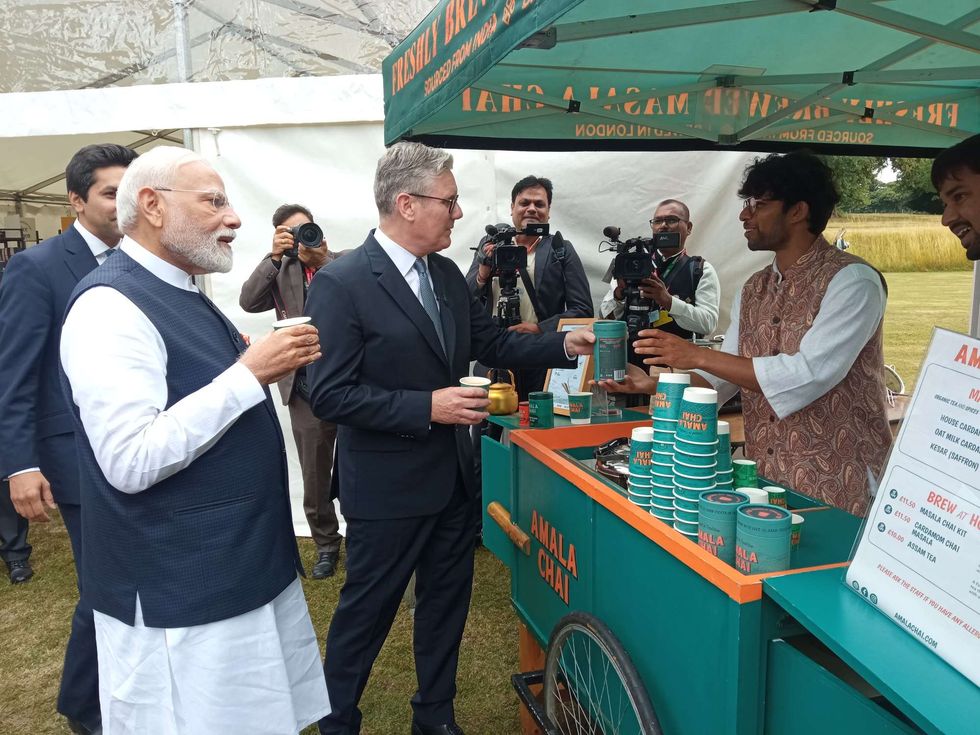 Varun Chandra with Keir Starmer and Narendra Modi during the latter's visit to the UK in July, 2025. Amit Roy
Working for Lehman Brothers after university “gave me enough money as a starting salary to put a deposit down, get a mortgage”.
After a year and a half at the bank, he heard through a friend of a friend that the former prime minister, Tony Blair, was looking for a young banker to help build a business.”
At the age of 22, “I applied for the job, was interviewed and got the job. The day I started (in my new job) Lehman got bankrupt. I was extraordinarily lucky.”
At the interview, Blair asked Chandra to “walk me through leverage”. Chandra calmly did just that by drawing diagrams on sheets of paper.
“And that sets the tone of how he (Blair) chose to treat people, where he focused on competence and capability. He was incredibly decent. For someone at my age and stage what an opportunity to work with someone like that. That’s the first thing. The second thing is the exposure. I spent five and a half years flying around the world, meeting presidents and prime ministers and billionaires and people running businesses. Understand the decision making process. What an education to have in your 20s, but also to realise that they’re just human beings. Just something quite levelling about seeing these people in their own home. Actually, they were impressed by Tony.
“The final thing, though, is the other way around, which is people don’t know this man (Blair) particularly well. He treats everyone with absolute respect. Again, at a young age, to see someone of that position talk to the assistant of the billionaire in the same way that he talked to the billionaire was another real education. The opportunity he gave me, the way he treated me, the exposure, it’s extraordinary.”
At 28, he was recruited by Hakluyt. “And I saw quite early on, this is such a wonderful place. There is so much potential. We have a really remarkable opportunity, to cut through the noise and be unbiased, independent, help people take better decisions. Having that influence and impact is incredibly exciting.”
He spoke of his gratitude at all the good things that had happened in his life. “I remind myself every day, that my parents were my parents, that they love me like they love me, that I went to the school that I went to. All of these things are luck, are fortune. And if you remind yourself of that luck every day, it gives you tremendous perspective. With perspective comes humility, and I think humility gives you freedom. All those little things that are irritating are put it into context and sort of disappear. You realise just how fortunate you are.”