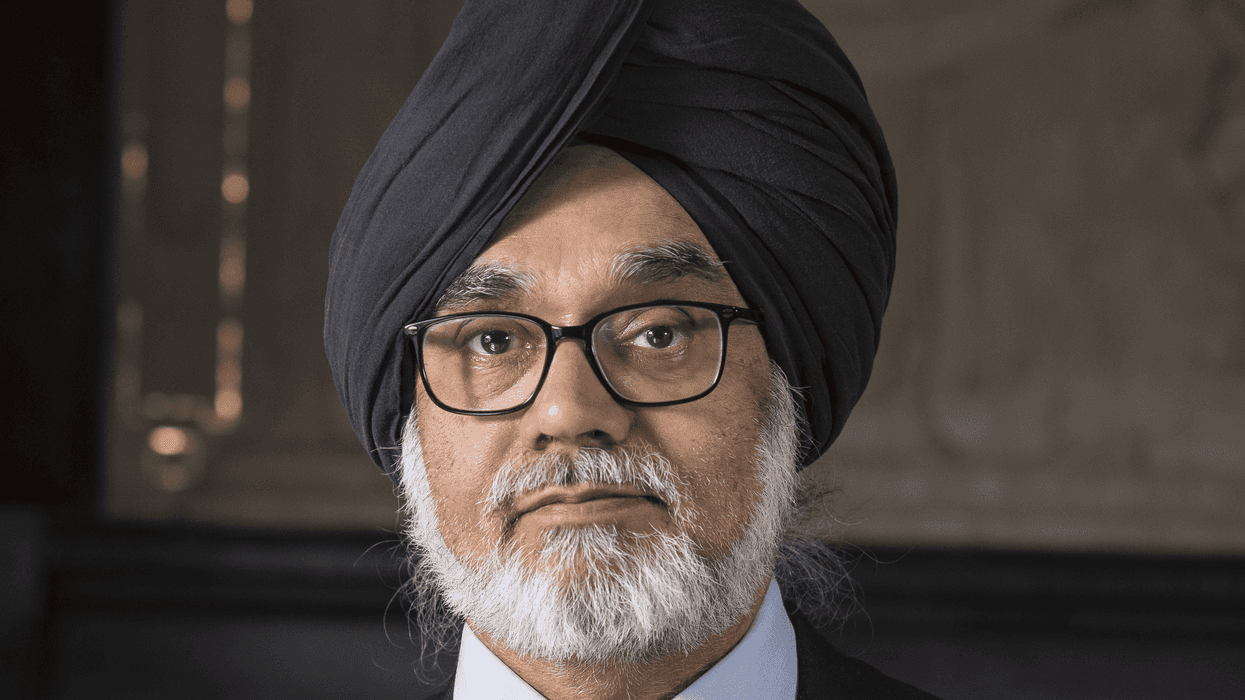

IN THE Royal Courts of Justice on London’s Strand, where the Court of Appeal sits beneath the building’s high Gothic arches, Sir Rabinder Singh has built a reputation for clarity in the most contested corners of British law. His judgments rarely seek the spotlight, yet they often end up there – precisely because they address the tension at the heart of modern governance: how to reconcile state power with individual liberty.
It is a balance Lord Justice Singh has spent much of his professional life interrogating. As a judge of the Court of Appeal and, until late 2025, president of the Investigatory Powers Tribunal (IPT), he has stood at the intersection of national security, technology, constitutional principle and human rights.
That role has been particularly visible in the past year. In early 2026, Singh joined the Court of Appeal bench that dismissed a legal challenge to the government’s decision to apply VAT to private school fees. Parents and faith school leaders argued that the policy would make religious education unaffordable and undermine their rights. The court disagreed.
In the judgment, Singh and his colleagues emphasised that the state had no obligation to guarantee education of a particular type beyond what the public system provides. “We acknowledge that the measure may have a serious impact [on parents] … but it is important to bear in mind that they have the option of home schooling if free education in the state sector is not acceptable to them,” the court noted.
The ruling was characteristic of Singh’s judicial style: measured, pragmatic and attentive to constitutional boundaries. It neither dismissed the social consequences of policy nor allowed them to override Parliament’s authority to legislate.
The same instinct shaped another high-profile case the previous year, when the IPT, under Singh’s presidency, rejected a bid by the Home Office to conceal the existence of a legal dispute with Apple over surveillance powers.
The government had argued that even revealing the case’s basic details could endanger national security. Singh and Mr Justice Johnson disagreed. “We do not accept that the revelation of the bare details of the case would be damaging to the public interest or prejudicial to national security,” the tribunal concluded.
Born in Delhi in 1964 and raised in Bristol, he grew up in a Britain still grappling with questions of immigration and identity. His parents, Sikh immigrants, faced discrimination but placed unwavering faith in education as the route to opportunity. Singh attended Bristol Grammar School before going on to Trinity College, Cambridge, where he achieved a double first in law.
A Harkness Fellowship took him to the University of California, Berkeley, for an LL.M. – an experience that broadened his intellectual horizons and exposed him to American constitutional debates. Yet his first professional step was not at the Bar but in academia. From 1986 to 1988 he lectured in law at the University of Nottingham before deciding to practise.
Called to the Bar at Lincoln’s Inn in 1989, Singh quickly established himself as a formidable advocate in public and human rights law. His practice ranged across constitutional challenges, employment disputes and cases testing the limits of executive authority. In 2000 he was among the founding members of Matrix Chambers, a set that would become synonymous with cutting-edge public law litigation.
The Belmarsh litigation of 2004 marked a turning point. Representing human rights organisation Liberty in the House of Lords, Singh helped challenge the indefinite detention without trial of foreign nationals suspected of terrorism. The landmark ruling against the government cemented his reputation as one of Britain’s leading human rights barristers.
In 2011, at the age of 39, Singh was appointed to the High Court – becoming both one of its youngest judges and the first Sikh to serve there. When he sits in court he wears a turban rather than the traditional judicial wig, a quiet visual marker of the diversity he has helped bring to Britain’s legal institutions.
His ascent continued with his appointment to the Court of Appeal in 2017, making him the first person of colour to serve in the Senior Courts' highest tier.
He counts Sir Mota Singh QC, Britain's first ethnic minority judge, as an inspiration.
“It is no exaggeration I think to say that Sir Mota Singh opened doors which enabled others like me to come through in a way which would have been very difficult if not impossible to imagine previously,” he said in a memorial lecture.
Along the way he also developed an influential academic voice, publishing widely on constitutional and human rights law. His books include The Future of Human Rights in the UK (1997) and, with Sir Jack Beatson and others, Human Rights: Judicial Protection in the UK (2008). His most recent book, The Unity of Law (2022), brings together a curated selection of his previously published and unpublished writings, tracing the evolution of his thinking on the common law across his career as both an advocate and a judge.
Yet it is perhaps in the quieter, more technical corners of the law that Singh’s influence is most evident. As president of the IPT from 2018 until October 2025, he presided over cases that scrutinised the activities of Britain’s intelligence services – often in proceedings partly conducted behind closed doors because of their sensitivity.
In one notable ruling, the tribunal dismissed a legal challenge brought by lawyer Christine Lee after MI5 issued an “interference alert” alleging she had attempted to influence British politicians on behalf of Beijing. The tribunal concluded that the security service’s concerns had “a rational basis”, while acknowledging that aspects of the reasoning had to remain secret for national security reasons.
Such cases illustrate the peculiar constitutional territory Singh has occupied. Intelligence oversight is rarely visible to the public, yet it carries immense consequences for civil liberties and democratic accountability. Navigating that terrain requires both technical legal expertise and an instinct for constitutional balance.
In an era defined by geopolitical uncertainty, rapid technological change and renewed debates about state power, the courts have become a crucial arena for resolving fundamental questions about the limits of government.
Few judges have played a more consistent role in answering those questions than Lord Justice Singh. His judgments rarely claim the final word – but they often set the terms of the argument for years to come.
ENDS