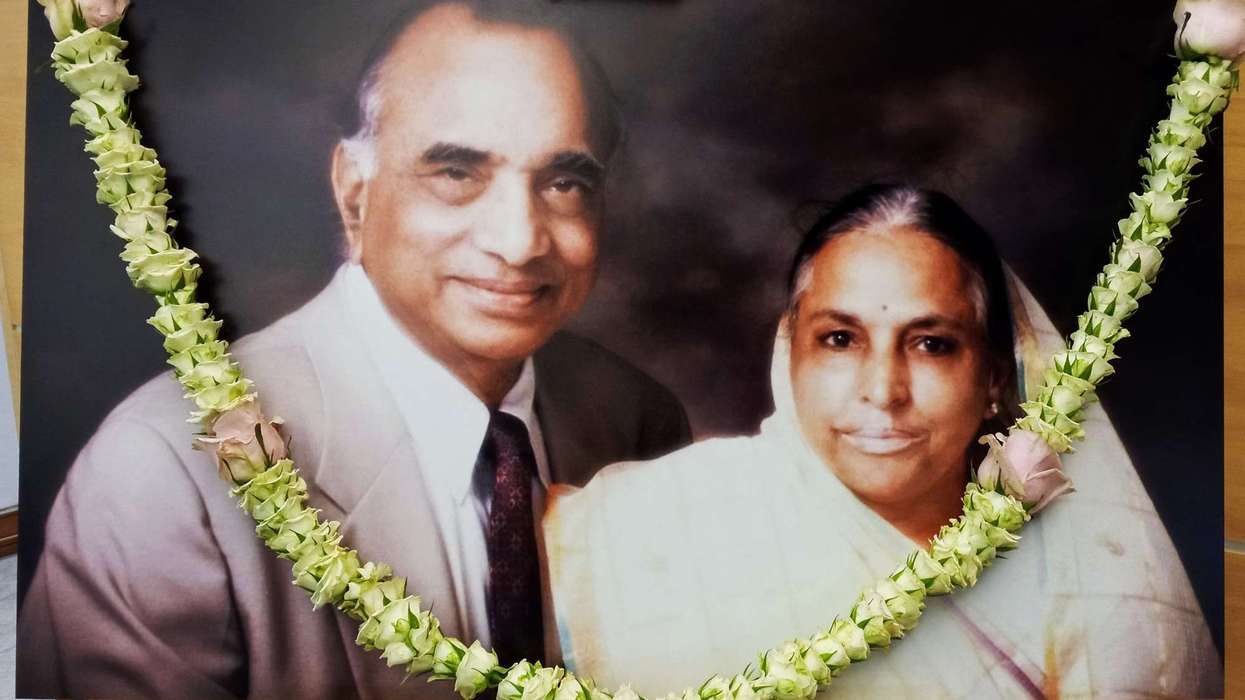

Mohanlal Mittal, father of the steel tycoon Lakshmi Mittal, was hailed as “India’s first global entrepreneur”.
He was also “a strict father, but his strictness came from love” and in many ways, remarkably liberal and progressive.
Mohanlal, who was born in the Rajasthan village of Rajgarh on 24 October 1926, died in London, aged 99, on 15 January 2026.
His funeral was held on Sunday (18) at Chilterns Crematorium in Buckinghamshire, followed by a memorial service the following day at the Chancery Rosewood hotel in Grosvenor Square, London. The latter previously housed the US embassy before it moved to Battersea.
Speaking at the memorial service, his eldest grandson, Amit Lohia – his mother, Seema, is Mohanlal’s daughter – said: “Nanaji was a man of immense vision, determination and courage. I will always regard him as India’s first global entrepreneur, a man whose example showed that it was possible to build a truly Indian global business.”
In the US, where Amit was once a student, he noticed a trait in his grandfather during his visits: “I once asked him in the US why did you tip so generously in restaurants and in hotels. And believe me, it was excessive by any standard. And he smiled and said, ‘So that we improve their impression of Indians.’ ”
Amit is vice chairman of the Indorama Corporation, which was founded by his father, Sri Prakash Lohia, who remains the chairman.
The farewell to Mohanlal by 54 members of his inner core family, including his five children and their spouses, 11 grandchildren and their partners, and no fewer than 22 great grandchildren – he apparently never forgot a birthday, anniversary or special occasion – reflected old school Indian family life.
Firstly, the Mittal family came across as singularly united. It is useless to pretend that differences do not emerge in prominent Indian dynasties as well but the Mittals’ show of unity comes at a time when the news in Britain is dominated by the splits between Prince Harry, Duke of Sussex, and his father and brother, King Charles and the Prince of Wales respectively, and the manner in which Brooklyn Beckham has rubbished his parents, David and Victoria Beckham.
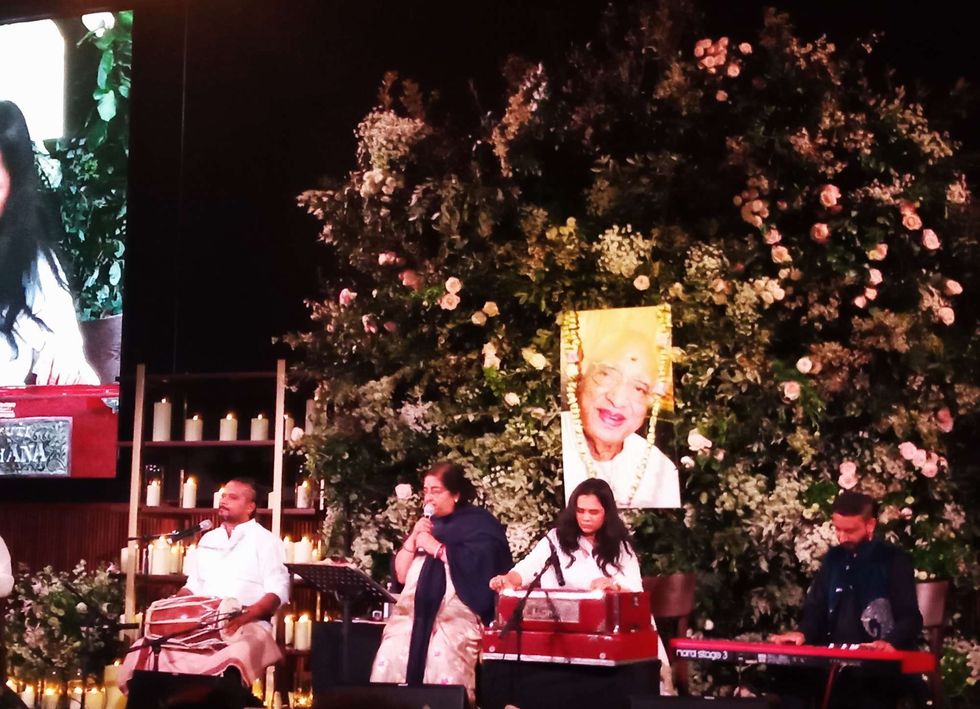 Mohanlal Mittal memorial with musician Anuradha Paudwal Amit Roy
Mohanlal told his family there was no substitute for hard work, instilled confidence in them and urged them to stand on their own two feet. This, too, has to be set into some kind of social context at a time when around 11 million people in Britain are not working, comprising about 1.8 million unemployed (actively seeking jobs) and over 9 million economically inactive (not seeking work due to reasons like study, retirement, or long-term sickness). As of late 2025, approximately 735,000 young people (aged 16-24) were unemployed in the UK, with the youth unemployment rate at around 16.0 per cent. The expression “welfare benefit” did not figure in Mohanlal’s vocabulary.
Masters of ceremony at the memorial service were two of his great granddaughters. As they presented a family video. one quipped: “He was so progressive, we are going to play a video that utilises some AI.”
At one point, Mohanlal says: “I am the luckiest person in the world. I am getting so much happiness from my family.”
He was modest about his achievements: “Whatever I am today, it is not my doing. I may be head of the family. I get this credit, but it is done by all of you.”
First up on stage was Lakshmi Mittal, executive chairman of ArcelorMittal, with his wife Usha.
Providing a snapshot of his father’s life, Lakshmi said: “I had the rare privilege of spending 75 years with my father. Very few people are blessed with so much time with their father. While we feel deep sadness today, we also feel great gratitude for the life we shared.
“My father lived a long and meaningful life of almost 100 years. He saw great changes in the world, in society, technology and nations. Yet his values never changed. He believed in discipline, hard work, honesty, curiosity, and above all, family. These values stood him in good stead.
“He was born in Rajgarh, a small village in Rajasthan. Many born in such circumstances may have limits to what they dream of, but not my father. He wanted to learn. He wanted to grow. He wanted to explore. He wanted to travel.
“This curiosity and thirst to experience everything in life would lead to him starting his first business of trading in Karachi, which was then part of India. After partition, he moved to India, and his first port of call was Hardoi, a small place in Uttar Pradesh. From there, he moved to Calcutta (now Kolkata) and started his steel business. I moved to Calcutta in 1954. From there, he grew the business and laid the foundation for global business.
“He taught me how to walk, how to run, how to learn and how to think. He was a strict father, but his strictness came from love. He always pushed me to work hard and do my best. Our happiest moments were simple ones spent with my family. My mother was also a remarkable person with few words. She did not have the opportunity to study in schools, but she certainly pushed me hard in my life.
“At every stage of my life, my father held my hand. He was my mentor and my guide. When I hesitated, he encouraged me to be bold when opportunities came. He pushed me to move forward.
“He supported my decision to leave India (for Indonesia) and face the world. Over the years, our relationship grew beyond father and son. We became close friends. We spoke often about family, business, politics and world affairs. We shared many laughs. I have so many stories about my father, which I will treasure always, but I will share one now, which shows who my father was.
“On the day my son, Aditya, was born in Calcutta, my father called me from Singapore. We spoke for a long time about business. Only at the end did I tell him that his grandson had been born. He was angry, not because of the news, but because I should have shared his grandson’s birth first.
“Even in his later years, his mind remained sharp. Just days before he passed, he asked me about the events in Venezuela. A few weeks earlier, we discussed Russia-Ukraine. He stayed interested in the world and learning about the new ideas. He always wanted to understand the views of world leaders. He was curious about technology, and even asked how steel could be made without coal.
“He was very proud of family. He always called everyone on birthdays, anniversaries and special occasions. Our Sunday lunches were special. If I was in town, he never missed them.
“He worried more about our health than his own. He was also respected beyond our family. One unforgettable moment was when we went to Indian prime minister (Narendra) Modi together. They spoke warmly like old friends. It showed my father’s ability to connect with people through sincerity, warmth and respect.
“On his final day, he held my hand, gave me his blessings. That quiet moment will stay with me forever.”
Lakshmi concluded: “My father showed us how to live not just a long life, but a good life, a life of values, courage, curiosity and love for family. His passing has left a deep void in our lives, but his presence remains within us and the values he passed to us. We pray that his soul rests in peace, that he continues to guide and watch over us as he always did.”
Usha Mittal spoke about how her son, Aditya, and daughter, Vanisha, were encouraged by her father-in-law.
She said: “I remember when Aditya was about three years old and was learning swimming. He said, ‘Really, can you swim across the pool?’ And to make him happy, he accomplished the big task of crossing the pool all on his own for the first time. Same was true with Vanisha. It was his 60th birthday, and I asked Vanisha to dance for him. And Vanisha, who was six years old, within 14 days, learned and perfected the art of dancing to the song Radha Na Bole. He always inspired not only Aditya and Vanisha to do their best, but all of us in the family. He was like a beacon of life in our lives.”
Next to speak was Sir Prakash Lohia who said: “When I married Seema, I stepped into a new family with open eyes but an uncertain heart, not knowing what awaited me. What I found was Babuji from that day onward was not just my wife’s father. He became my own guiding star. Through every dream I chased, every challenge I faced, he stood beside me with quiet strength and unfailing faith. Never once did he draw lines between those born in the family and those who came into it. To him, love was not divided. It was multiplied.”
He went on: “The light that guided us so much of our lives now shines from somewhere unseen. Babuji was not just remarkable. He was rare. His greatness was never loud or showy. He lived quietly in the things he did every day. He greeted everyone with genuine warmth. He had a way of making you feel that in that exact moment you were the most important person in the world. That was his gift to make everyone feel seen, valued and loved.”
Sangeeta Mittal, wife of Mohanlal’s second son, Pramod, revealed her father-in-law “really enjoyed James Bond movies because they had new technologies” and also Bollywood films starring Amitabh Bachchan.
Sangeeta, who had the grace to thank the medical team that had looked after her father-in-law in his final years, remembered an important date.
“Pramod, Babuji and I were sitting together in the countryside, on the morning of 1st January, 2026,” said Sangeeta. “We were having breakfast in the glasshouse That’s when Babuji said, ‘I was born in 1926 and today is the morning of 1 January 2026 and it is so amazing that I am sitting here enjoying breakfast.’ And he sat there for a very long time. He paused, reflected on how extraordinary it felt to have lived for an entire century and witnessed how completely life had changed. Sitting across from him, I was struck by the wondering humility in his voice. That moment captured his deep awareness of time and of the incredible journey he had lived.”
The same point was touched on by Mohanlal’s youngest son, Vinod, who commented: “He lived almost a full century, from 1926 to 2026, long enough to witness 100 years of change. We all know where Babuji came from – a simple family in Rajasthan with almost no money. But with vision and courage and belief, Babuji did not build only the wealth. He created value in people, value in discipline, value in standing on one’s own feet. He constantly guided and taught us, sharing life’s lesson through his own understanding of the Bhagavad Gita.”
There were humorous insights into how Mohanlal was in some ways closer to his great grandchildren than even their parents.
For example, when visiting the US, Vinod found a room “filled with glasses of champagne” to celebrate the 21st birthday of his daughter Natasha.
When Vinod told his father, “Natasha doesn’t drink,” he remarked dryly, “You don’t know about her.”
Also Mohanlal knew that his great grandson, Atulya, had a girlfriend, Isheti, when his parents were in the dark.
Vinod’s wife, Archana, said her father-in-law sent her on a reconnaissance trip to his birthplace, Rajgarh, before starting a project in what was once a very rural part of Rajasthan.
Archana admitted: “I was shocked when I saw the room he was born in. He told me, ‘Don’t drink anything there, don’t eat anything there. Just tell everyone you’re on a fast. Just go and see the room and leave immediately.” Seeing that room and to where he had reached is something absolutely unbelievable.”
Aditya Mital, who is CEO of ArcelorMittal where his father, Lakshmi is the executive chairman, said his grandfather would pay frequent visits when his parents were living in Indonesia.
Mohanlal would tell Aditya of his early days in Rajasthan: “He would always remind me that he used to get up at 5am get onto a camel and go to school.”
Later, when Aditya was a student in Philadelphia in the US – his cousin, Amit Lohia, was also studying at the Wharton School in the University of Pennsylvania – his grandfather would visit frequently and share a room with him rather than stay at a comfortable hotel. “He would visit us more often than parents would visit their kids.”
Aditya offered a humorous anecdote: “Megha and me got married, and we were on our honeymoon in St Moritz. And one fine morning, we heard a knock on our door. Thought it was room service. We opened the door. It was the hotel manager, and he proudly announced that my Dadaji had checked in last night and is waiting downstairs for breakfast with us. So we ended up sharing our honeymoon with my dear Dadaji. I think all the kids here are so happy that that has not become a family tradition.”
Aditya, who pushed for many of the acquisitions that his father made when Mittal Steel was growing, said his grandfather “had more confidence in me than I had in myself. He always pushed me and he always told me to dream the impossible.”
His wife, Megha, said: “Our bond was permanently sealed at that famous breakfast on my honeymoon. Coincidentally, he moved to London at the same time as me, and thus he has been a constant presence in my life for the last 27 years.”
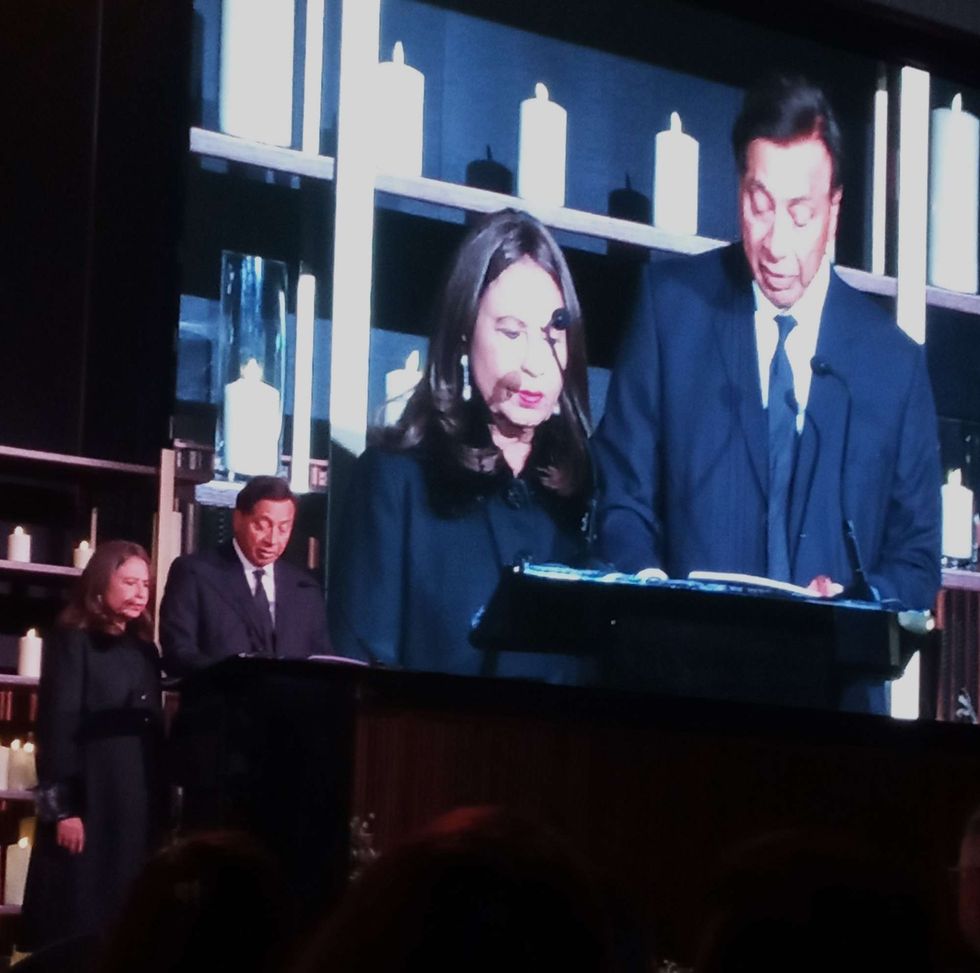 Lakshmi and Usha Mittal at the memorial Amit Roy
Aditya’s brother-in-law, Amit Bhatia, who is married to his sister, Vanisha, said: “I first met Dadaji on Saturday, October 25, 2003. I know the date because it happened to be Diwali. Vanisha and I had only a couple of days before decided that we wanted to get married. Her parents, somewhat miraculously, had quietly given me their blessings. I walked into that annual Diwali party at Summer Palace (then the Mittal home in north London) dressed in the best clothes that I had, but without any idea what lay ahead. My father-in-law – most wonderful man, but as many of you know, has a slightly mischievous side – pulled me aside and whispered the four most terrifying words in the English language. He said, ‘Don't mess it up.’ ”
Amit was marched up to Mohanlal. “And with that my father-in-law walked away. As I stood there, filled with enormous anxiety, I could feel my own heartbeat. I tried quickly to think of something intelligent to say, but no words were forthcoming.”
Amit was put at ease by Mohanlal. “As I answered his soft and his polite questions, my anxiety melted away. I felt calm. I felt more confident. I felt his warmth, and I felt his friendship, and every interaction that I’ve had with him in the subsequent 22 years that followed that first meeting on Diwali 2003 made me feel the same way. Perhaps I didn’t mess it up, because he gave me his blessings, and soon our wedding followed, and with that, he gave me one of the greatest gifts in my life, the right to call him Dadaji.”
Amit said: “Whilst he didn’t accompany us on our honeymoon, he did call Vanisha every single day of our honeymoon. I think he was just trying to make sure about that strange looking Punjabi guy that his granddaughter had married.”
Vanisha read from a four-page letter she had preserved as a treasure, written on 2 April 1991 when she was 10 and her grandfather was 65 and had just returned to Calcutta after paying a visit to Lakshmi’s home in Indonesia.
Mohanlal wrote about his childhood when he had been brought up not by his parents but by a maternal uncle: “I was very fond of reading books and studying mathematics. I could not afford to buy books, hence used to spend a lot of time in the school library and attend special classes on mathematics with higher students. I used to see film slide in school related to Birla factory, which I liked very much, and was determined to set up factories when I started my life.”
“My dear little girl,” he wrote to Vanisha, “I shall advise you to follow the advice of elders. Have a disciplined life. Today, the world is completely changed. You children are fully exposed to the world like adults and can take better decisions than we could do at your age.”
Pramod’s daughter, Vartika, confirmed: “He had a gift. In a family of 54 people, he made each of us feel like we mattered. He remembered our birthdays, our routines, our lives. Even at the age of 99 he never forgot a single one of us.”
Vartika’s husband, Utsav, spoke of Mohanlal: “From the very beginning, you welcomed me, not as someone married to your granddaughter, but as one of your own grandchildren. For that, I will always be grateful. You often spoke of your humble beginnings and of the adversity and resistance you faced along the way. Through perseverance, discipline, determination and hard work, you overcame every obstacle, yet success never changed you. You carried it lightly with humility, humanity and gentleness.”
Mohanlal’s youngest grandson, Divyesh Mittal, and his husband, Jake Prior, also spoke with great affection about the family patriarch.
“He loved the small things in his life, his routine, his yoga, his newspaper and his favourite food, which was simple, home cooked Indian food,” said Divyesh. “He was very progressive. He carried no prejudices. He judged people by who they were, not where they came from, who they loved and how they lived. He believed in support, in kindness and allowing others to build lives that were authentically their own.”
To this, Jake added: “I never had a grandfather of my own, so I didn’t know how powerful that love could be. When I joined this family, Dadaji gave me that love, freely becoming my adopted grandfather from the very first, without prejudice, without condition. He was very happy to hear that I was vegetarian.”
Five of his grandchildren rounded off the memorial service. One said: “When I was 10 years old, I once sat with him for three hours and he told me his life story, and I never wanted it to end. He talked about Calcutta, about living through World War Two, and about India before and after independence.”
The great grandchildren – the girls had accents from PG Wodehouse’s aristocratic England – read speeches from their mobile phone, while the older ones rustled bits of paper.