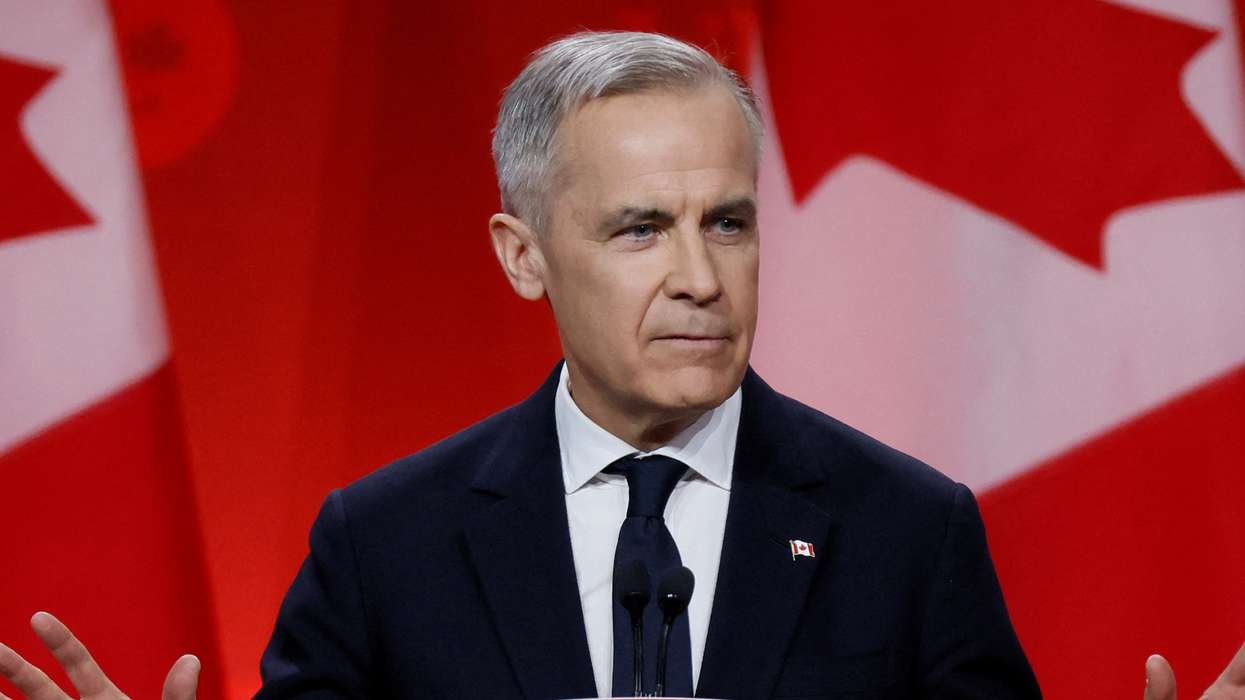

CANADIAN prime minister Mark Carney arrived in India on Friday for a visit aimed at resetting relations and increasing trade, as Canada looks to reduce the impact of strained ties with the United States.
The visit follows a breakdown in relations in 2023 after Ottawa accused New Delhi of being involved in a deadly campaign against Sikh activists in Canada.
Carney landed in Mumbai and is expected to address business leaders before travelling to New Delhi. He is scheduled to meet Prime Minister Narendra Modi on Monday, the last day of his visit.
Indian broadcasters showed a police convoy escorting Carney through Mumbai.
India's foreign ministry described the visit as a "significant step in further strengthening India–Canada ties".
"The India–Canada partnership is anchored in shared democratic values, strong people-to-people ties, and expanding cooperation across diverse sectors," ministry spokesman Randhir Jaiswal said in a post on X.
Carney's office said talks would focus on "ambitious new partnerships in trade, energy, technology and artificial intelligence (AI), talent and culture, and defence".
Last year, both countries agreed to resume negotiations on a proposed free trade agreement.
Carney has said he wants to more than double two-way trade with India by 2030, targeting $51 billion annually.
Before Carney took office last year, Ottawa accused Modi's government of direct involvement in the 2023 killing of Hardeep Singh Nijjar, a naturalised Canadian citizen linked to a fringe group advocating for an independent Sikh state called Khalistan.
Khalistan militants have been blamed for the assassination of an Indian prime minister and the bombing of a passenger jet.
Former prime minister Justin Trudeau's government also alleged that India directed a campaign of intimidation against Sikh activists in Canada.
India has denied the allegations. The dispute led to both countries expelling several senior diplomats in 2024.
Relations improved after Carney took office in March 2025, and envoys have since been reinstated.
Asked if concerns about transnational repression would be raised during talks in New Delhi, Foreign Minister Anita Anand said: "That is always at the forefront of our minds."
Pivot away from US reliance
India, described as the world's fastest-growing major economy, is seeking more foreign investment. It says Canadian pension and wealth funds have already invested $73 billion.
India, the world's most populous country with 1.4 billion people, is looking for support from Canada to expand its nuclear power capacity.
After his India visit, Carney will travel to Australia and Japan as part of efforts to reduce Canada's reliance on the United States.
In 2024, before US President Donald Trump returned to office and introduced new tariffs, more than 75 per cent of Canadian exports went to the United States. Two-way trade exceeded $900 billion that year.
Trump has largely followed the North American free trade agreement signed during his first term, and about 85 per cent of US-Canada trade remains tariff-free.
However, he has imposed industry-specific tariffs. There are concerns that if the broader trade agreement is scrapped, Canada’s economy could face a serious impact.
Carney has said increasing trade with Europe and Asia is central to protecting Canada's economy if free trade with the United States collapses.
Trade growth expectations with Australia and Japan are lower, but Carney's office said cooperation on critical mineral supply chains would be a priority.
Developed countries are working to increase cooperation on critical minerals, particularly rare earth elements used in high-tech products.
China currently dominates rare earth supply chains, an issue Canada highlighted during its recent G7 presidency.
(With inputs from agencies)