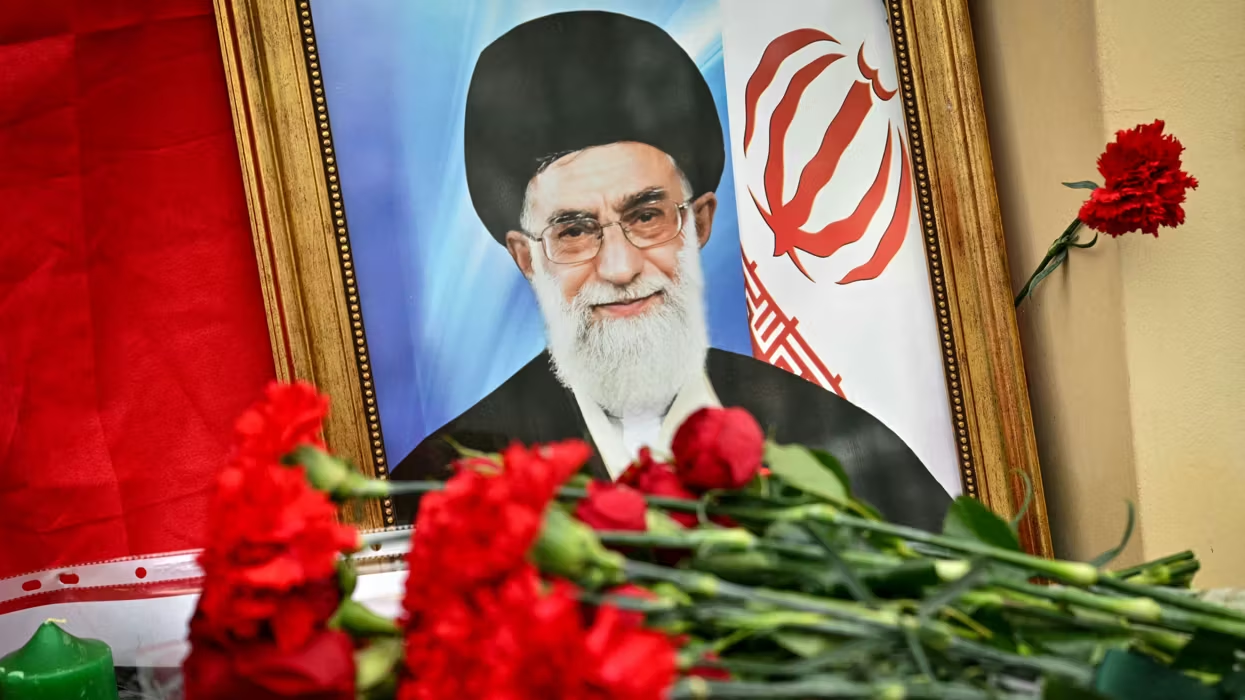

Trump, has certainly diverted attention away from the increasingly awkward questions that were being asked about the US president’s long-standing relationship with the sex offender Jeffrey Epstein by launching an attack on Iran – and assassinating Ayatollah Ali Khamenei on day one.
It would be foolish to suggest that this was Trump’s sole reason for targeting “the head of the snake” in Iran but the Epstein saga has been pushed out of the papers for the time being. Some emails alleging Trump had abused women have been suppressed, according to the New York Times and other American newspapers.
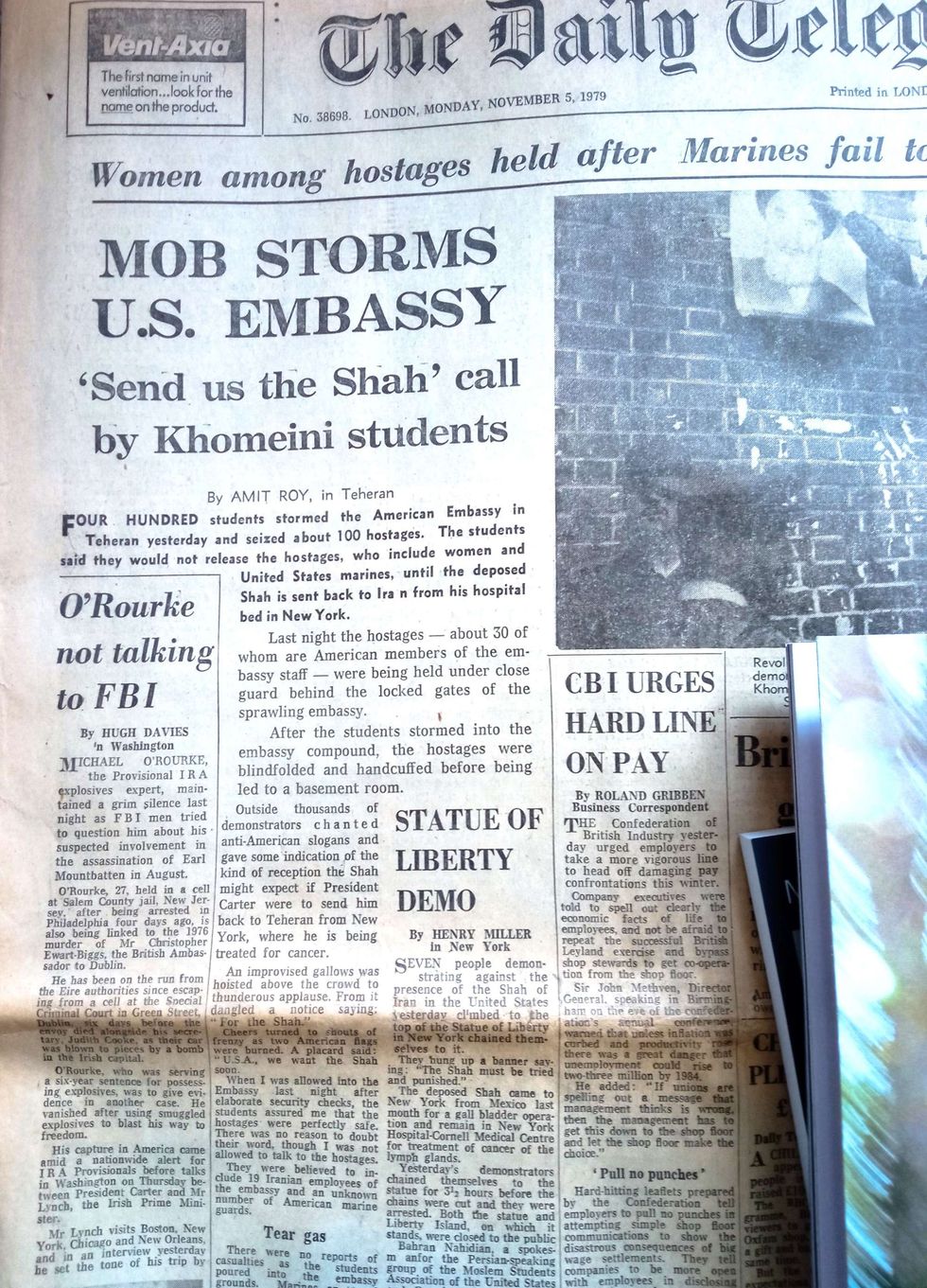 Amit Roy’s page-one report in the Daily Telegraph on November 5,1979.
Iranian exiles, especially in cities like Los Angeles – nicknamed “Tehrangeles” because so many had fled the country after the Islamic revolution in 1979 – might be dancing in the street and treating Trump as a “hero” but will the killing of Khamenei and his inner circle bring about regime change in Iran?
No one can be sure about the kind of Iran that will emerge in the aftermath of this latest US and Israeli attack on the country but regime change for a variety of reasons will be harder to achieve. There will be no American boots on the ground.
Launching “Operation Fury”, Trump urged Iranians to bring about regime change: “Finally, to the great, proud people of Iran, I say tonight that the hour of your freedom is at hand…when we are finished, take over your government. It will be yours to take. This will be probably your only chance for generations.”
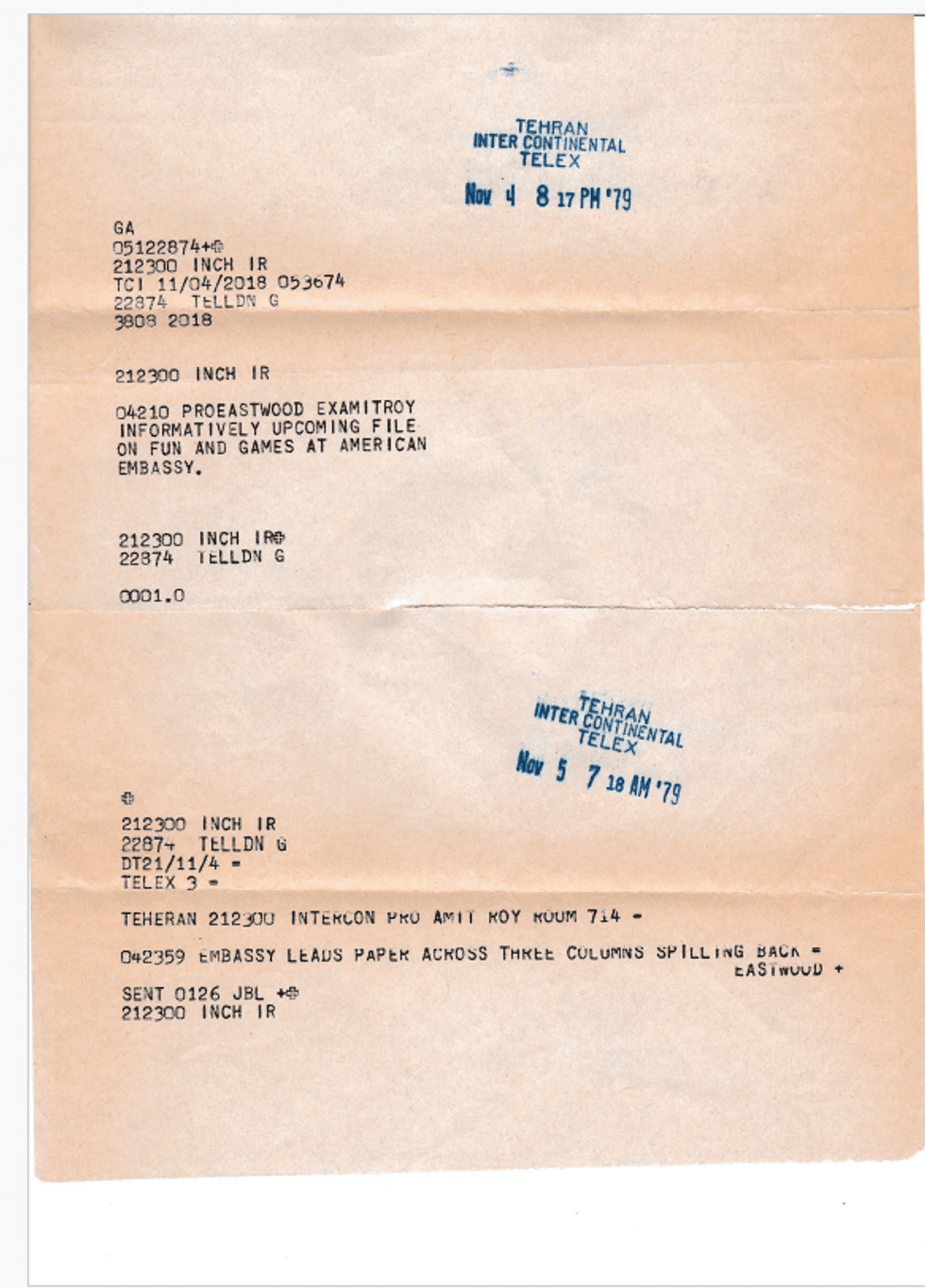 His message to the paper at the start of the 444-day hostage crisis.
The title of “Supreme leader” was given to Ayatollah Ruhollah Khomeini after he led the Islamic revolution of 1979 after returning from exile in Paris. He was the one who sentenced Salaman Rushdie to death for apostasy in 1989 after the publication of The Satanic Verses which was deemed blasphemous (even by those who hadn’t read the book). Khomeini died (of natural causes) on 3 June 1989, aged 89, but after a decade in power, he put together the structure of an Islamic republic which has taken such deep roots that regime change will be difficult. Iran’s population, which was 38m in 1979, is now headed towards 100m. Most people in Iran, especially the young, have experience of no other political system other than rule by the ayatollahs. The notion that Khamenei’s death will usher in a more progressive, liberal regime is not a realistic one.
Khamenei was 86 so he would have been gone in a few years. The violent manner of his death fits in perfectly with the philosophy of martyrdom that is at the core of Shia Islam.
His death was confirmed on Iranian television by a weeping announcer who said: “After a lifetime of Hosseini struggle, unceasing and untiring, with a lofty and celestial spirit like steadfast mountain of (Islamic) guardianship, the compassionate father of kindness and resolve, the Leader and Imam of the Muslims, His Eminence Ayatollah Seyyed Ali Hosseini Khamenei, on the path of upholding the exaltation of the sacred sanctuary of the Islamic Republic of Iran, drank the sweet, pure draught of martyrdom and joined the Supreme Heavenly Kingdom.”
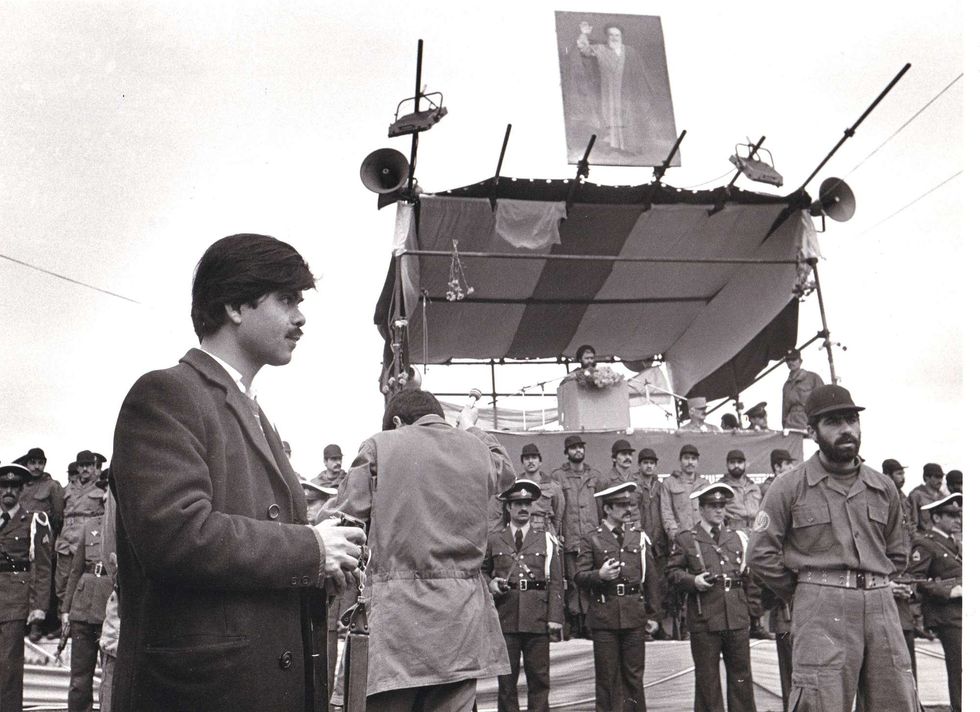 Roy at a Tehran rally during the 1979 revolution featuring Ayatollah Ruhollah Khomeini’s portrait..
This sounds much better in Farsi, which is a beautiful language as I discovered during my Tehran days. I witnessed the birth of the Islamic Republic and its evolution which is why I think regime change will not be easy. Khomeini ensured his way of thinking was built into the DNA of the people of Iran. He was ruthless in eliminating potential sources of dissent and created the Islamic Revolutionary Guard Corp to crush any challenge to his view of how Iran should be run. In the aftermath of Khamenei’s death, it is the IRGC which will stand in the way of regime change. Khomeini succeeded in 1979 because the Air Force came over to his side. I cannot see the IRGC defecting and supporting a new order backed by the Americans and the Israelis.
Trump said: “To the members of the Islamic Revolutionary Guard, the armed forces and all of the police, I say tonight that you must lay down your weapons and have complete immunity, or, in the alternative, face certain death.”
My guess is the IRGC are indoctrinated to prefer “the sweet, pure draught of martyrdom”. I would be very surprised if they simply surrendered.
I have seen the evolution of the Islamic Republic because I happened to be in Tehran on November 4, 1979 when the US embassy was overrun by militant students who took the Americans diplomats hostage.
I have just come across the telex message to the foreign desk of the Daily Telegraph, addressed in cablese to Peter Eastwood, the managing editor of the paper and our supreme leader: “Informatively upcoming file on fun and games at American embassy.”
Clearly, as a callow youth, I had underestimated the gravity of the crisis. The next morning, a little slip of paper was pushed under my hotel door (Room 714), signifying how my story had been used: “Embassy leads paper across three columns spilling back.”
I found a copy of the paper which was kept at home for me. I covered the story day in, day out for 444 days while the hostage crisis lasted. Possibly because I was Indian and considered harmless by the regime, I was allowed to meet its leaders and wander around at rallies and religious gatherings. Khomeini – I was ushered into his presence on a few occasions (though I never interviewed him one to one) had a status much higher than that of Khamenei, who was picked to succeed the founder of the revolution. I kept returning to Iran over the years. It has an ancient culture similar to that of India. Lord Karan Bilimoria will confirm that historically, the Zoroastrians fled Persia after the arrival of Islam and set up the Parsi community in Bombay (its most illustrious son being the late Ratan Tata). Karan is the Parsi leader in the UK and often talks of Dadabhai Naoroji, the first Asian MP in the UK (elected for the Liberal Party in Finsbury Central in 1892).
The regime has lost its legitimacy because of the brutality with which it has put down any kind of dissent. No one knows how many people have been executed. Western sanctions have also ruined the economy. During the recent demonstrations, thousands were killed. Many of those detained were due to be executed. The protestors, who were demonstrating in cities across Iran, will want the current Islamic government to be gone. But what should take its place is a trickier question to answer. In theory, Iran should have a flourishing economy with an open society. Not much to ask for. But it has been brutalised beyond belief by its own rulers and now by war. Regime change, if it happens, might bring more of the same.
The history of American interventions in Vietnam, Afghanistan, Iraq and Libya is not encouraging. That said, without US intervention, there is no hope of change. Heads you lose, tails you lose as well.
It’s useful to have a sense of perspective about Iran. Many years ago, the US encouraged Iraq to attack Iran. Khomeini would be toppled very quickly, the Iraqis were told. The war lasted eight years and cost a million lives on both sides.
At Behest-e-Zahra cemetery just outside Tehran, I chanced upon the first burials from that war. A cold wind was blowing down from the Alborz mountains. I was encouraged to congratulate a family on the martyrdom of their son. They gave me a biscuit by way of thanks. Had I been in Iran today, it would have been prudent when dealing with regime officials, to offer them my congratulations on Khamenei’s martyrdom.
(Views in this column do not necessarily reflect those of the newspaper)