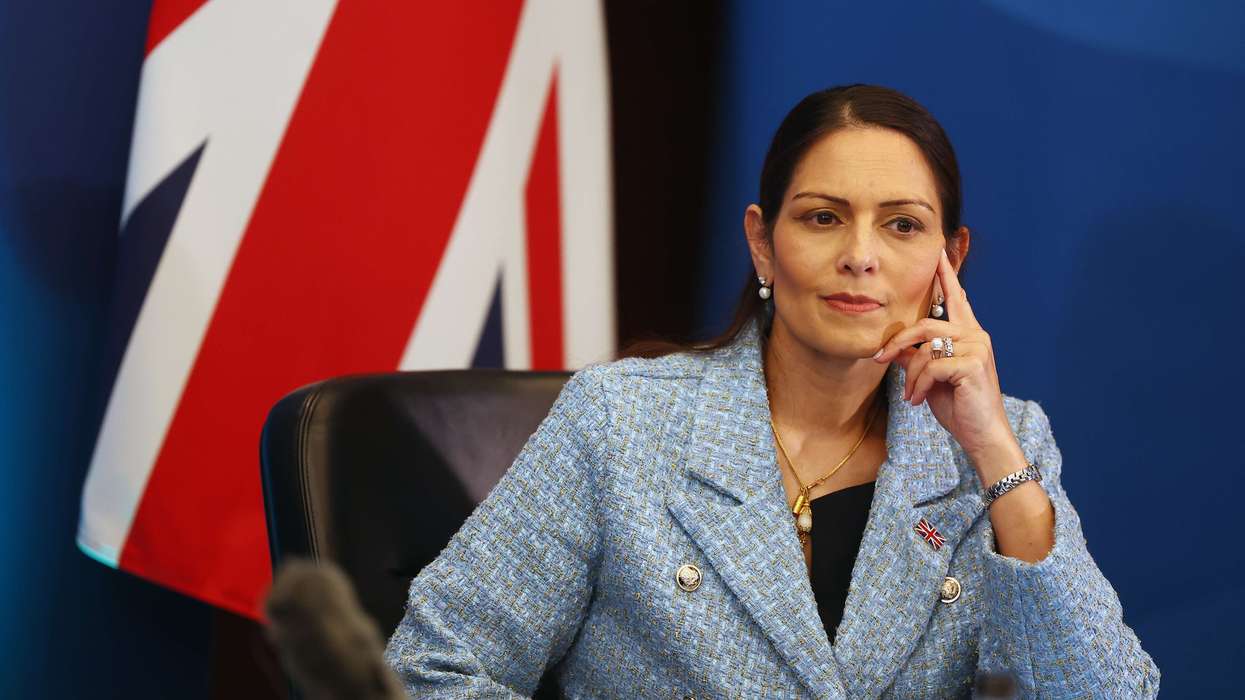

WHEN the US and Israel launched coordinated strikes against Iranian targets on 28 February, tensions rippled across global diplomacy within hours. For Dame Priti Patel, the moment was a test not only of Britain’s foreign policy posture but also of her own authority as shadow foreign secretary.
Her response was immediate and characteristically uncompromising. “Iran is a regime that has sponsored terror around the world,” she wrote on social media as the crisis escalated. “It has murdered thousands of its own citizens and supports Iranian proxies operating here in the UK. I welcome the US and Israeli attacks against this regime. Keir Starmer should do more to proactively support our allies against this evil regime.”
For Patel, foreign policy has increasingly become the arena in which she seeks to define her influence in the post-election Conservative landscape. Appointed shadow foreign secretary by Conservative leader Kemi Badenoch following the party’s defeat in the 2024 general election, she has used the role to project a hawkish and unapologetically Atlanticist vision of Britain’s place in the world.
The Iran crisis offered an opportunity to press that case forcefully. Patel warned that Tehran’s actions demanded stronger responses from the UK government, arguing that “the government’s indecision on Iran has left the United Kingdom weaker,” as she called for emergency legislation to ban the Islamic Revolutionary Guard Corps.
Her criticism extended beyond Tehran to the broader direction of Labour’s foreign policy.
Patel argued that the government’s handling of global alliances risked weakening Britain’s strategic relationships. She warned that the proposed Chagos agreement with Mauritius could undermine national security and relations with Washington. “Mauritius is a friend of China and if Labour’s Chagos Surrender goes ahead, their actions could undermine our security, defence and national interest,” she said. “This is also damaging the UK-US Special Relationship. Starmer’s Surrender Treaty must be scrapped.”
China policy has been another recurring theme. After the prime minister’s diplomatic visit to Beijing, Patel dismissed official claims of success. “According to the Foreign Secretary, Keir Starmer’s visit to China was a ‘complete success’. And yet Britain got very little out of it, Hong Kongers living in the UK still have bounties on their heads, and Jimmy Lai is still in prison. It was a complete failure.”
While foreign affairs increasingly dominate her Westminster profile, Patel has continued to cultivate her political base at home. As MP for Witham in Essex, she remains an active presence in local community life. In January she visited the White Hart pub in the town to discuss pressures on the hospitality sector, including rising energy costs and higher business rates.
“The Great British pub is part of the fabric of our nation,” she said during the visit. “It is an integral part of the community and provides a place of comfort and connection for people across the country.”
Yet Patel’s political year has not been free of turbulence. A combative interview with Sun political editor Harry Cole reignited debate within Conservative ranks about her record as home secretary. Confronted with migration figures that had reached 1.2 million during the latter years of Conservative government, she defended the policies implemented under her leadership.
“Brightest and the best coming to our country, people on skilled work visas. It’s legal migration. (Those) who come and work and contribute to our economy,” she said, emphasising the points-based immigration system introduced while she was in office.
When challenged over claims that foreign workers had displaced domestic labour, she pushed back firmly. “That is totally distortionary and that’s not true,” she said, pointing to the influx of health and social care workers during the pandemic. “What would have happened to our NHS (if they hadn’t come)? Are you now saying we don’t need those people in our NHS?”
Badenoch’s office later distanced the party leadership from parts of her defence of the policy, emphasising that the Conservatives would “tell the truth about the mistakes we made”.
Despite the internal friction, Patel’s political durability remains evident. The 2024 general election wiped out more than 250 Conservative MPs, yet she retained her seat in Witham, albeit with a sharply reduced majority. The result left the Conservatives with just 121 MPs and thrust surviving senior figures into the task of rebuilding the party.
Born in London on in March 1972 to Sushil and Anjana Patel, parents of Gujarati origin who arrived in Britain during the 1960s and ran a chain of newsagents in Hertfordshire, she attended a comprehensive school in Watford before studying economics, sociology and social anthropology at Keele University. She later completed a postgraduate diploma in government and politics at Essex.
A Conservative activist from her teenage years, she worked in the press office of former party leader William Hague before moving into public relations. David Cameron later placed her on the party’s A-list of priority candidates, paving the way for her election as MP for Witham in 2010.
Her ministerial career spanned several roles: exchequer secretary to the Treasury from July 2014 to May 2015, minister of state for employment from May 2015 to July 2016, and secretary of state for international development from July 2016 until November 2017.
Patel returned to the cabinet when Boris Johnson appointed her home secretary in July 2019, a role she held until September 2022. She was given damehood by Johnson in his resignation honours.
Her appointment as shadow foreign secretary has returned her to the political frontline. For supporters, her assertive stance on global security issues demonstrates clarity at a time of geopolitical uncertainty. For critics within her party, it raises questions about the direction of a Conservative movement still reckoning with the legacy of its years in government.
Either way, Patel continues to operate with the instincts of a political survivor: quick to seize moments of international tension, ready to provoke debate, and determined to remain a prominent voice in Britain’s evolving political landscape.