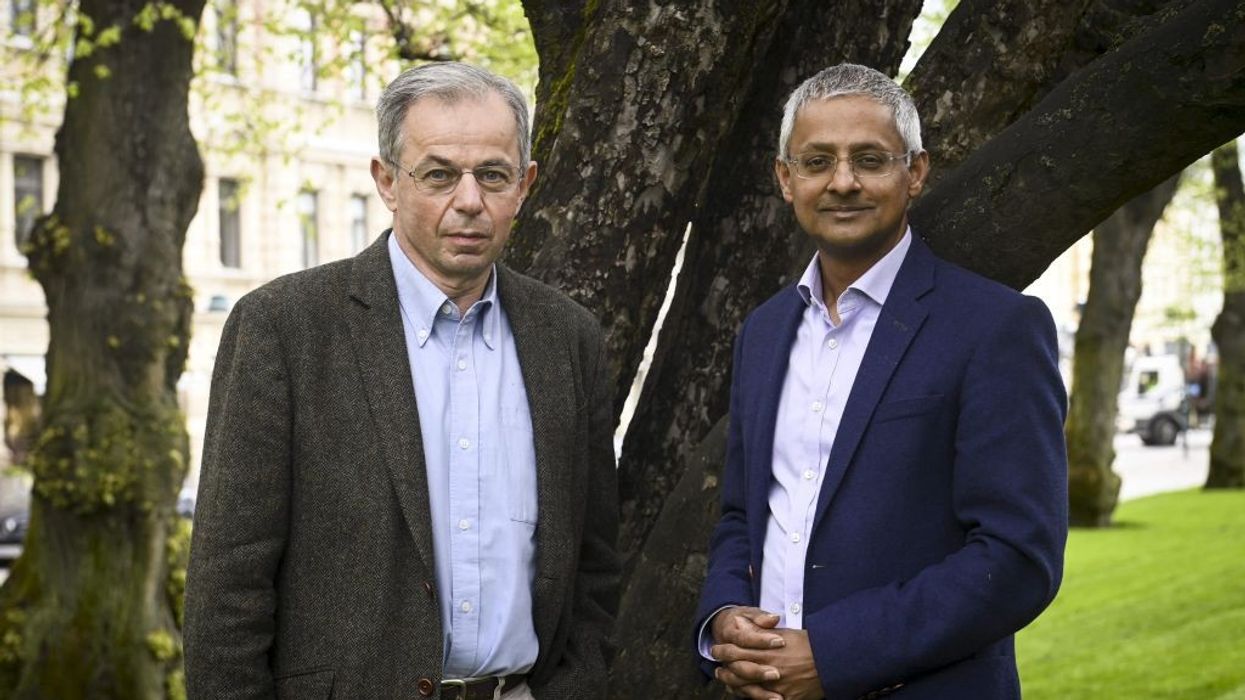

TWO British chemists who developed a super-fast DNA sequencing technique that paved the way for revolutionary healthcare advances were on Tuesday (18) awarded Finland's version of the Nobel science prizes.
Cambridge University professors Shankar Balasubramanian and David Klenerman took home the $1.22 million Millennium Technology Prize for their work over 27 years creating ever faster and cheaper ways to sequence the human genome.
The pair's Next-Generation DNA Sequencing technology (NGS) "means huge benefits to society, from helping the fight against killer diseases such as Covid-19 or cancer, to better understanding crop diseases and enhancing food production," the Technology Academy Finland, which awards the biennial prize, said in a statement.
Born in Chennai, India in 1966, Balasubramanian moved to the UK with his parents in 1967. He grew up in a rural area just outside Runcorn in Cheshire and attended Daresbury Primary School, then Appleton Hall High School. He then went on to study the Natural Sciences Tripos at Fitzwilliam College, Cambridge, where he did his undergraduate degree from 1985–88 and continued with a PhD for research on the reaction mechanism of the enzyme chorismate synthase supervised by Chris Abell.
Following his PhD, Balasubramanian travelled to the US as a SERC/NATO Research Fellow and worked in the group of Stephen J Benkovic at Pennsylvania State University. He started his independent academic career in 1994 in the University of Cambridge and has remained there ever since.
He was most recently appointed Herchel Smith Professor of Medicinal Chemistry in 2008. He directs research laboratories in the Department of Chemistry and also the Cancer Research UK (CRUK) Cambridge Institute at the Cambridge Biomedical Campus.
Twenty years ago, the first attempt to "read" the sequence of 3.2 billion letters that makes up the human genome took a decade and cost over a billion dollars.
Thanks to Next Generation Sequencing the process can now be performed in one day for just $1,000 dollars, and the technology is used over a million times a year, most recently to track coronavirus mutations during the pandemic.
NGS is now widely used in the diagnosis and treatment of some cancers and rare diseases.
"It is the first time we've got an international prize that recognises our contribution to developing the technology," Klenerman said in a statement, dedicating the prize to the team behind the invention "and also for the university in Cambridge and for the UK".
The Finnish Millennium Technology Prize, founded in 2004, singles out innovations that have practical applications and which "enhance the quality of people's lives."
It aims to be a technology equivalent of the Nobel science prizes, which have been criticised by some for focusing too much on traditional, decades-old scientific research.
Previous tech laureates include the creator of the World Wide Web, Tim Berners-Lee, Linux open source operating system creator Linus Torvalds and ethical stem cell pioneer Shinya Yamanaka.
In 2018, Finnish physicist Tuomo Suntola won the award for groundbreaking technology allowing the creation of ultra-thin layers of materials now ubiquitous in smartphones and microprocessors.
This year's Millennium Technology Prize was postponed from 2020 due to the pandemic.